
Listen to this Post
Introduction:
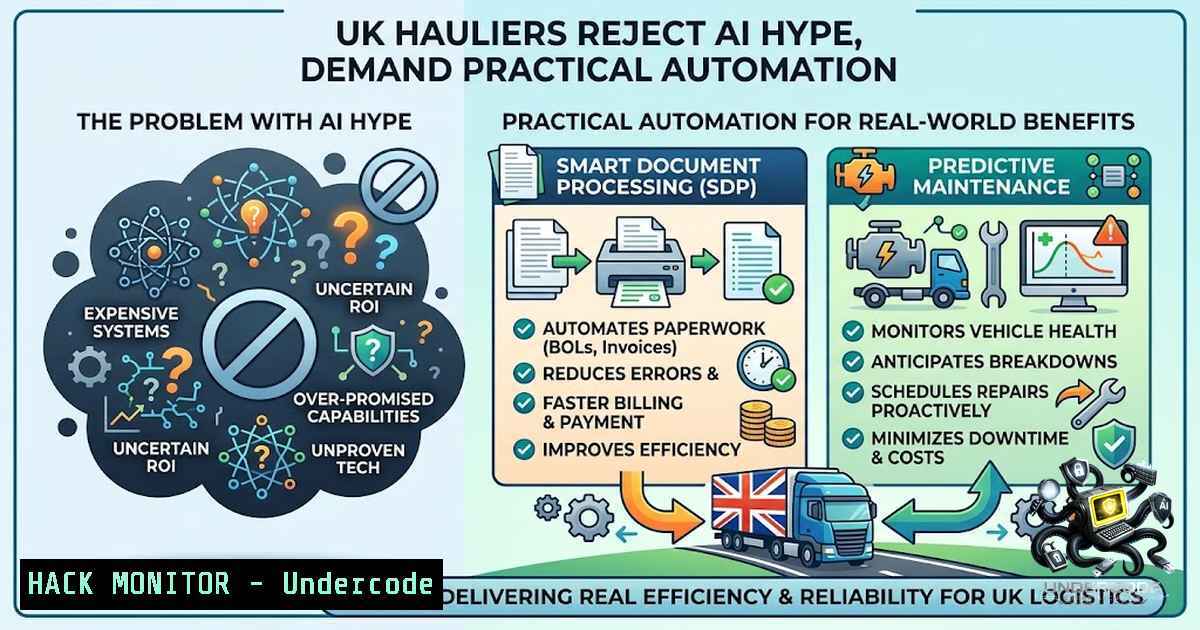
The logistics sector, often perceived as a laggard in digital adoption, is quietly undergoing a pragmatic revolution. While the broader tech world chases generative AI’s dazzling potential, the UK’s haulage industry is demanding a grounded, utility-focused application of technology. According to the 2026 Technology & Resilience Benchmark Report, the real priorities are not sci-fi fantasies but the automation of mundane, paper-heavy tasks and the prediction of mechanical failures before they occur. This shift represents a critical cybersecurity and IT resilience inflection point: as operational technology (OT) and information technology (IT) converge to enable these capabilities, the attack surface expands, demanding robust security frameworks to protect both digital documents and connected fleet assets.
Learning Objectives & Secrets:
- Objective 1: Master Secure Document Automation Pipelines. Learn how to implement intelligent document processing (IDP) that extracts data from physical paperwork (e.g., delivery notes, customs forms) and integrates it securely into backend systems without creating data leakage vectors.
-
Objective 2 Secret Tips: Proactive Fleet Health Monitoring. Discover how to leverage telematics and sensor data for predictive maintenance, moving from reactive repairs to scheduled interventions that minimize downtime—and how to secure the IoT devices feeding this data.
-
Objective 3 Secret Tips: Application Rationalization & API Security. Understand the hidden risk of “application sprawl” (hauliers switching between 20-50 apps) and learn how to consolidate tools and harden APIs to prevent unauthorized access and data exfiltration.
You Should Know:
- Automating the Paper Trail: Intelligent Document Processing (IDP)
The heart of the matter is the persistent dominance of paper in back-office processes. IDP systems use a combination of Optical Character Recognition (OCR), Natural Language Processing (NLP), and machine learning to classify, extract, and validate data from unstructured documents. This transforms a manual, error-prone task into a streamlined digital workflow.
- Step‑by‑Step Guide:
- Ingestion: Set up a secure scan-to-email or API endpoint for receiving documents. Use tools like `scanimage` (Linux) for network scanner integration.
- Pre-processing: Enhance image quality using tools like ImageMagick:
convert input.pdf -deskew 40% -sharpen 0x1.0 output.pdf. - OCR & Extraction: Deploy Tesseract OCR for text extraction:
tesseract input.png stdout --oem 3 --psm 6. For structured data, use Python with libraries like `pytesseract` and `spaCy` for NLP. - Validation & Integration: Validate extracted data against business rules (e.g., checking a delivery postcode against a database). Integrate with ERP systems via secure REST APIs.
- Security: Encrypt documents at rest (using LUKS on Linux or BitLocker on Windows) and in transit (TLS 1.3). Implement strict IAM policies to control who can access processed data.
2. Predictive Maintenance: Securing the OT-IT Bridge
Predictive maintenance uses IoT sensors on vehicles (engines, brakes, tyres) to stream telemetry data to a central analytics platform. Machine learning models then detect anomalies and predict failures, enabling proactive repairs.
- Step‑by‑Step Guide:
- Data Acquisition: Deploy edge devices (e.g., Raspberry Pi with CAN bus interface) to collect data from vehicle ECUs. Use `cansend` (Linux) to simulate and test data streams.
- Data Transmission: Securely transmit data to the cloud using MQTT over TLS. Configure a broker like Mosquitto with certificate-based authentication.
- Data Storage & Analysis: Ingest data into a time-series database (e.g., InfluxDB). Use Python with `scikit-learn` to build anomaly detection models (e.g., Isolation Forest).
- Alerting: Set up automated alerts using tools like Prometheus and Alertmanager.
- Hardening: Segment the OT network from the corporate IT network using VLANs and firewalls. Disable unnecessary services on edge devices. Regularly patch firmware to mitigate known vulnerabilities (e.g., CVE-2023-XXXX).
3. Application Rationalization & API Security
Hauliers often use between 20 and 50 different applications for operations. This “application sprawl” creates a massive attack surface, with redundant and often unpatched systems.
- Step‑by‑Step Guide:
- Discovery: Use network scanning tools like `nmap` to discover all active services and applications:
nmap -sV -p- 192.168.1.0/24. - Rationalization: Map application capabilities to business functions. Identify overlapping tools and consolidate.
- API Hardening: For remaining APIs, enforce strong authentication (OAuth 2.0 with JWT). Validate all inputs to prevent injection attacks.
– Example (Linux): Test API endpoints with `curl` for vulnerabilities: curl -X GET "https://api.example.com/orders?id=1' OR '1'='1".
4. Access Control: Implement the principle of least privilege. Use Azure AD or AWS IAM to manage identities and access.
5. Continuous Monitoring: Deploy a SIEM (e.g., Wazuh) to monitor logs for suspicious API activity. Set up alerts for failed authentication attempts or unusual data access patterns.
4. Cloud Hardening for Logistics Platforms
The shift to cloud-based IDP and predictive maintenance platforms necessitates robust cloud security configurations. Misconfigured cloud storage (e.g., AWS S3 buckets) is a leading cause of data breaches.
- Step‑by‑Step Guide:
- Infrastructure as Code (IaC): Define cloud resources using Terraform or AWS CloudFormation to ensure consistent, auditable deployments.
- Storage Security: Enforce bucket policies that block public access. Enable default encryption (SSE-S3 or KMS).
- Network Security: Use VPCs with private subnets for database and analytics instances. Restrict inbound traffic using security groups and NACLs.
- Identity & Access: Use IAM roles for EC2 instances instead of hard-coded credentials. Enable MFA for all root and privileged user accounts.
- Compliance: Enable AWS Config or Azure Policy to continuously audit and remediate non-compliant configurations (e.g., publicly accessible S3 buckets).
5. Windows & Linux Commands for Security Auditing
Regular auditing of systems is critical to maintaining resilience.
- Linux:
– `auditd` to track file access:auditctl -w /etc/passwd -p wa -k passwd_changes.
– `chkrootkit` to scan for rootkits.
– `fail2ban` to block brute-force SSH attempts. - Windows (PowerShell):
– `Get-EventLog -LogName Security -InstanceId 4625` to list failed logon attempts.
– `Test-1etConnection -Port 443 -ComputerName api.example.com` to test secure connectivity.
What Undercode Say:
- Key Takeaway 1: The logistics industry is prioritizing practical, problem-solving AI over flashy, unproven innovation. This is a “pragmatic automation” approach, not a “revolution.”
-
Key Takeaway 2: The convergence of IT and OT for predictive maintenance introduces new cybersecurity risks. Securing the bridge between these domains is as critical as the technology itself.
-
Key Takeaway 3: Application sprawl is a major, often overlooked, security and efficiency liability. Consolidation and API hardening are essential first steps.
-
Analysis: The industry’s focus on mundane tasks like document processing is a double-edged sword. While it offers immediate ROI, it also means that sensitive commercial data (rates, customer info, routes) is being digitized and moved to the cloud, making it a prime target for ransomware and espionage. The 2026 Technology & Resilience Benchmark Report highlights a sector waking up to these realities, not with fear, but with a clear-eyed assessment of what technology can and cannot deliver. The real “secret” is not a single tool but a holistic strategy that marries automation with a hardened security posture, ensuring that the cure is not worse than the disease.
Prediction:
-
+1 By 2028, we will see a proliferation of specialized, industry-specific “micro-AI” models for logistics, trained on proprietary datasets, making generic AI solutions obsolete for this vertical.
-
-1 The rapid adoption of IoT in fleets will lead to a significant increase in OT-targeted ransomware attacks, forcing the industry to invest heavily in network segmentation and zero-trust architectures.
-
+1 Application rationalization will become a multi-million-pound service opportunity for IT consultancies, as hauliers seek to consolidate their toolchains and secure their APIs.
-
-1 Without a commensurate investment in cybersecurity training, the “human factor” (e.g., phishing attacks targeting document processing staff) will remain the weakest link, potentially undoing the benefits of automation.
-
+1 The focus on predictive maintenance will not only reduce downtime but also generate vast datasets that can be used to optimize supply chain logistics, creating a new competitive advantage for early adopters.
▶️ Related Video (74% Match):
https://www.youtube.com/watch?v=4sePFn_dEhE
🎯Let’s Practice For Free:
🎓 Live Courses & Certifications:
Join Undercode Academy for Verified Certifications
🚀 Request a Custom Project:
Secure, high-velocity infrastructure and disruptive technological engineering. Contact our engineering team for high-tier development and proprietary systems:
[email protected]
💎 Smart Architecture | 🛡️ Secure by Design | ⭐ Trusted by Thousands
IT/Security Reporter URL:
Reported By: https://lnkd.in/p/eCJ9nqwh – Hackers Feeds
Extra Hub: Undercode MoN
Basic Verification: Pass ✅


