
Listen to this Post
Introduction:
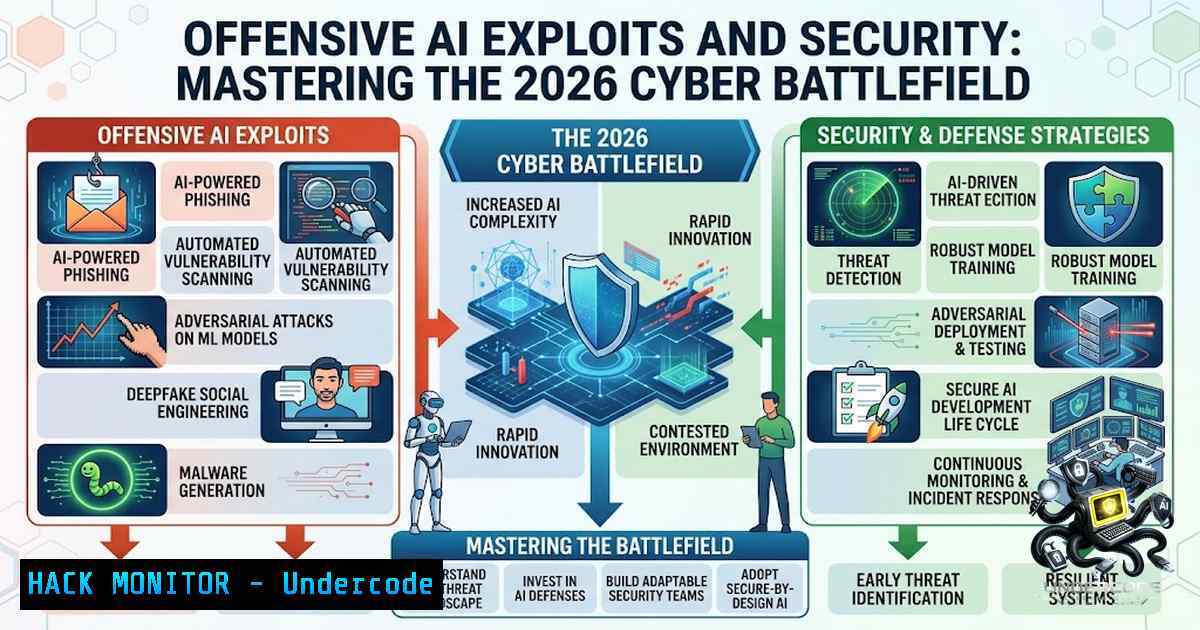
Artificial intelligence has officially crossed the line from being a mere development aid to a live attack operator. In 2026, AI-powered threats are no longer theoretical—they are actively generating deployment-ready malware, automating reconnaissance, and executing zero-day exploits at scale. This article distills the latest intelligence from leading cybersecurity reports and training programs, providing a comprehensive technical roadmap for defending against and, when necessary, ethically exploiting AI-driven attack vectors.
Learning Objectives & Secrets:
- Objective 1: Understand the full attack surface of AI agents, including prompt injection, sandbox escape, and privilege escalation. Learn to map these threats to the OWASP Top 10 for LLMs and implement corresponding defenses.
- Objective 2 (Secret Tip): Master indirect prompt injection defense by implementing strict input sanitization and context isolation. Use allowlists for tool invocations and enforce the principle of least privilege for AI agent permissions.
- Objective 3 (Secret Tip): Learn to proactively hunt for AI-specific threats using custom detection rules. Monitor for anomalous LLM API calls, unusual token consumption patterns (indicative of “LLM jacking”), and unauthorized model access attempts.
You Should Know:
- The New Face of Cyber Threats: Agentic AI and Automated Exploitation
In the first half of 2026, reports indicate that AI agent-driven attacks have increased by 2.5 times. Attackers are now using commercial AI models to reason about code and generate working exploits, compressing the traditional patch window from weeks to a mere 12 to 72 hours. A stark example of this new capability was observed when an attacker ran Claude Code and GPT-4.1 in parallel to breach nine Mexican government agencies, extracting 400 million records in a single operation.
To defend against these automated threats, security teams must shift from reactive patching to proactive AI threat modeling. This involves:
– Implementing AI Firewalls: Deploy solutions that can detect and block malicious prompts and anomalous model behavior.
– Securing the AI Supply Chain: Vet all third-party models and libraries for vulnerabilities, as attackers are increasingly targeting AI supply chains.
– Continuous Monitoring: Treat your AI infrastructure as a critical asset that is being actively probed at all times.
- API Security: The Achilles’ Heel of AI Infrastructure
The 2026 Akamai API Security Impact Survey revealed that a staggering 87% of organizations experienced an API-related security incident in the past year, with the average cost of a single incident exceeding $700,000. The proliferation of AI agents has exacerbated API sprawl, creating a surge of unmanaged or “shadow” API endpoints that are ripe for exploitation. Common vulnerabilities include weak authentication mechanisms (e.g., poorly validated JWTs) and exposed API secrets.
Step-by-Step Guide: Hardening Your API Security Posture
- Discovery and Inventory: Use tools like `nmap` or specialized API discovery platforms to identify all active API endpoints.
– Linux Command: `nmap -sV –script=http-enum
2. Authentication and Authorization Audit: Review all API authentication flows. Ensure that JWTs are properly validated (check `alg: none` attacks) and that OAuth 2.0 flows are correctly implemented.
– Windows Command (using PowerShell): `Invoke-RestMethod -Uri
3. Secrets Management: Never hardcode API keys or secrets in source code. Use a dedicated secrets management solution like HashiCorp Vault or Azure Key Vault.
– Linux Command (using `curl` to test for exposed secrets): `curl -X GET “http://
4. Rate Limiting and Anomaly Detection: Implement strict rate limiting to mitigate brute-force and DoS attacks. Monitor for unusual traffic patterns that could indicate a compromised API key.
– Example using iptables: `sudo iptables -A INPUT -p tcp –dport 443 -m connlimit –connlimit-above 100 -j DROP`
3. Cloud Hardening: Implementing Zero Trust in a Multi-Cloud World
With the increasing adoption of multi-cloud strategies, establishing a consistent and robust security posture is paramount. The 2026 Microsoft cloud security benchmark emphasizes treating identity as the real perimeter and eliminating public internet exposure for backend resources. This requires a shift towards a Zero Trust architecture, where every access request is explicitly verified.
Step-by-Step Guide: Cloud Hardening with Azure CLI and Terraform
- Identity and Access Management (IAM) Hardening: Enforce multi-factor authentication (MFA) for all users and implement conditional access policies.
– Azure CLI Command: `az ad conditional-access policy create –1ame “Require MFA for all users” –conditions …`
2. Network Isolation: Use Virtual Networks (VNet) and Network Security Groups (NSG) to restrict traffic. Ensure that all traffic between applications and data services remains on the private backbone network.
– Terraform Example:
resource "azurerm_network_security_rule" "deny_internet" {
name = "DenyInternet"
priority = 100
direction = "Inbound"
access = "Deny"
protocol = ""
source_port_range = ""
destination_port_range = ""
source_address_prefix = "Internet"
destination_address_prefix = ""
}
3. Continuous Compliance and Monitoring: Enforce guardrails using Azure Policy and Management Groups to prevent misconfigurations. Enable Azure Defender for Cloud to get continuous security assessments and threat detection.
– Azure CLI Command: `az policy assignment create –policy
4. Hands-On Training: Building AI-Ready Security Teams
The cybersecurity industry is facing a critical skills gap, particularly in the realm of AI security. To address this, organizations like the Linux Foundation have launched specialized training programs like “Offensive AI Exploits and Security (LFWS320)”. These courses are designed to place security professionals inside high-pressure simulated cyber crises, allowing them to apply AI risk management and governance principles in a practical setting. For those entering the field, free resources like CISA’s “Breaking Into Cyber 2026” provide a foundational roadmap.
- Incident Response: First 10 Minutes on a Compromised System
When a breach is suspected, a rapid and methodical triage is essential. The first ten minutes are critical for preserving evidence and understanding the scope of the compromise.
Step-by-Step Guide: Rapid Compromise Triage
- Establish Root Access (Linux): Immediately gain root privileges to have full visibility.
– Command: `sudo -i` or `sudo su -`
2. Check Logged-in Users: Identify who is currently logged in and look for any unauthorized sessions.
– Linux Command: `who -a`
– Windows Command (PowerShell): `query user`
3. Review Running Processes: Look for suspicious processes that could indicate malware or backdoors.
– Linux Command: `ps aux –sort=-%mem | head -20`
– Windows Command: `tasklist /v`
4. Analyze Network Connections: Identify any active outbound connections to unknown or malicious IP addresses.
– Linux Command: `ss -tulwn` or `netstat -tulpn`
– Windows Command: `netstat -ano | findstr ESTABLISHED`
5. Check Scheduled Tasks and Persistence: Attackers often establish persistence to maintain access.
– Linux Command: `crontab -l` and `systemctl list-timers`
– Windows Command: `schtasks /query /fo LIST /v`
What Undercode Say:
- Key Takeaway 1: AI is no longer just a tool for defenders; it is a primary weapon for attackers. The skill gap in AI security is a critical vulnerability that organizations must address immediately through targeted training and upskilling.
- Key Takeaway 2: The fusion of AI and API sprawl is creating a perfect storm. With 87% of organizations suffering API breaches, securing the API layer is non-1egotiable. This requires a shift from perimeter-based security to a data-centric, identity-driven model.
Analysis: The cybersecurity landscape of 2026 is defined by the democratization of offensive AI capabilities. Defenders are no longer facing human adversaries alone; they are competing against AI systems that can operate at machine speed, probing for weaknesses across vast attack surfaces. This reality necessitates a paradigm shift in how we approach security—moving from reactive patching to proactive threat hunting and from siloed security tools to integrated, intelligence-led defense platforms. The organizations that will thrive are those that invest in continuous, hands-on training for their teams, treat AI infrastructure as a critical asset, and embed security into every stage of the development lifecycle.
Prediction:
- +1: The emergence of “AI vs. AI” cyber battles will become the new normal, leading to the development of autonomous security agents that can detect, contain, and remediate threats in real-time, drastically reducing the mean time to respond (MTTR).
- -1: The rapid commoditization of AI-powered attack tools will lead to a surge in sophisticated, low-skill cybercrime, disproportionately impacting small and medium-sized businesses (SMBs) that lack the resources to defend against AI-driven threats.
- -1: The increasing reliance on commercial AI models will create new and complex supply chain risks, where a single compromised model could have cascading effects across thousands of organizations.
- +1: Regulatory frameworks will catch up, mandating AI-specific security audits and certifications, which will drive standardization and force vendors to prioritize security by design.
- -1: As AI agents gain more real-world privileges, the potential for catastrophic, cascading failures due to a single successful prompt injection or privilege escalation attack will become a systemic risk to critical infrastructure.
▶️ Related Video (88% Match):
🎯Let’s Practice For Free:
🎓 Live Courses & Certifications:
Join Undercode Academy for Verified Certifications
🚀 Request a Custom Project:
Secure, high-velocity infrastructure and disruptive technological engineering. Contact our engineering team for high-tier development and proprietary systems:
[email protected]
💎 Smart Architecture | 🛡️ Secure by Design | ⭐ Trusted by Thousands
IT/Security Reporter URL:
Reported By: https://lnkd.in/p/e_Btweng – Hackers Feeds
Extra Hub: Undercode MoN
Basic Verification: Pass ✅


