
Listen to this Post
Introduction:
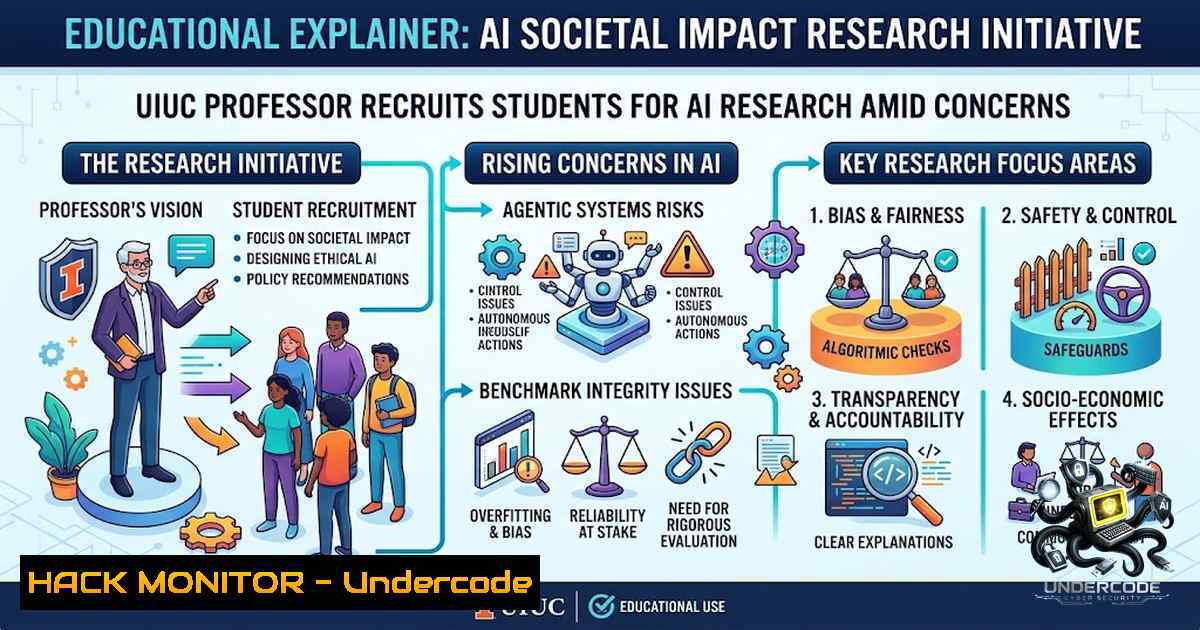
The intersection of artificial intelligence and societal systems is rapidly becoming a critical frontier in computer science, with researchers increasingly focusing on how AI collaborates with humans in high-stakes environments. As agentic AI teams become more prevalent in sectors ranging from healthcare to finance, the need for robust benchmark design and ethical collaboration frameworks has never been more urgent. This emerging field, as highlighted by recent academic recruitment at the University of Illinois Urbana-Champaign (UIUC), demands a multidisciplinary approach that combines technical rigor with deep understanding of human behavior and social impact.
Learning Objectives & Secrets:
- Objective 1: Master Human-AI Collaboration Frameworks – Understand the fundamental dynamics of how humans and AI systems interact in decision-making processes, including trust calibration, communication protocols, and error recovery mechanisms.
- Objective 2: Secret Tip – Benchmark Design for Agentic Systems – Learn to design benchmarks that not only measure raw AI performance but also evaluate the quality of human-AI teaming, including metrics for mutual understanding, task allocation efficiency, and adaptive learning.
- Objective 3: Secret Tip – Socio-Technical System Analysis – Develop the ability to analyze AI systems as socio-technical constructs, considering not just algorithmic outputs but the broader ecosystem of stakeholders, regulatory frameworks, and unintended consequences.
You Should Know:
1. Designing Robust Benchmarks for Human-AI Collaboration
Effective benchmark design goes beyond traditional accuracy metrics and must account for the dynamic nature of human-AI interactions. This involves creating evaluation frameworks that assess both the AI’s technical performance and its ability to support human decision-makers in real-world scenarios. For example, when testing medical diagnosis AI, benchmarks should include measures of how well the system communicates uncertainty to doctors and how this affects diagnostic outcomes.
Step-by-Step Guide:
- Step 1: Define the collaborative task and identify key decision points where human-AI interaction occurs.
- Step 2: Design a baseline AI model (e.g., using Python with scikit-learn) and a simulation environment for human interaction.
- Step 3: Implement logging mechanisms to capture interaction data, including decision times, confidence scores, and final outcomes.
- Step 4: Develop metrics that evaluate both task performance (e.g., accuracy, speed) and collaboration quality (e.g., user satisfaction, trust scores).
- Step 5: Conduct pilot studies with human participants and refine benchmark parameters based on feedback.
 Example: Simple logging system for human-AI interaction benchmark
import logging
import datetime

class InteractionLogger:
def <strong>init</strong>(self, log_file="interaction_log.txt"):
logging.basicConfig(filename=log_file, level=logging.INFO)

def log_interaction(self, user_input, ai_response, confidence, decision_time):
timestamp = datetime.datetime.now().isoformat()
logging.info(f"{timestamp} | User: {user_input} | AI: {ai_response} | Confidence: {confidence} | Time: {decision_time}s")
2. Building Secure Agentic Teams in Production Environments
As AI agents increasingly operate autonomously within organizational infrastructures, securing these systems against adversarial attacks and ensuring robust communication protocols becomes paramount. This involves implementing identity management, secure API gateways, and monitoring systems that can detect anomalous agent behavior indicative of compromise or malfunction.
Step-by-Step Guide:
- Step 1: Implement mutual TLS (mTLS) for agent-to-agent communication to ensure identity verification and encrypted data exchange.
- Step 2: Deploy a service mesh (e.g., Istio) to manage traffic policies and implement zero-trust network segmentation.
- Step 3: Integrate a centralized logging and monitoring solution (e.g., ELK Stack) to track all agent actions and system states.
- Step 4: Implement rate limiting and circuit breakers to prevent cascade failures in agentic teams.
- Step 5: Conduct regular penetration testing specifically targeting the agent communication pathways and orchestration layers.
 Linux: Set up iptables to restrict agent communication ports
sudo iptables -A INPUT -p tcp --dport 8443 -m state --state NEW -j ACCEPT  Allow mTLS traffic
sudo iptables -A INPUT -j DROP  Drop all other traffic

Windows: Use New-1etFirewallRule to restrict access
New-1etFirewallRule -DisplayName "Allow Agent mTLS" -Direction Inbound -LocalPort 8443 -Protocol TCP -Action Allow
New-1etFirewallRule -DisplayName "Block All Other" -Direction Inbound -Action Block
3. Ethical Considerations in AI Benchmark Design
The design of AI benchmarks carries significant ethical weight, as they shape the development priorities of the entire AI ecosystem. Researchers must consider how benchmark selection influences which capabilities are developed and how these benchmarks may encode biases or reinforce existing societal inequalities.
Step-by-Step Guide:
- Step 1: Conduct a stakeholder analysis to identify all groups that might be affected by the AI system.
- Step 2: Audit existing benchmarks for potential biases using tools like IBM’s AI Fairness 360.
- Step 3: Develop diverse evaluation datasets that represent the full spectrum of use cases and user demographics.
- Step 4: Implement regular fairness audits and create mechanisms for community feedback.
- Step 5: Publish benchmark design decisions and limitations transparently to inform broader research community practices.
 Using AI Fairness 360 to audit a dataset for bias
from aif360.datasets import StandardDataset
from aif360.metrics import BinaryLabelDatasetMetric
import pandas as pd

Load your dataset
df = pd.read_csv('your_dataset.csv')
dataset = StandardDataset(df, label_name='outcome',
favorable_classes=[bash],
protected_attribute_names=['race'])

Compute fairness metrics
metric = BinaryLabelDatasetMetric(dataset,
unprivileged_groups=[{'race': 0}],
privileged_groups=[{'race': 1}])
print(f"Disparate Impact: {metric.disparate_impact()}")
4. Cloud Hardening for AI Workloads
AI workloads in cloud environments present unique security challenges, including data poisoning attacks, model theft, and inference attacks. Hardening these environments requires a combination of access controls, encryption, and continuous monitoring.
Step-by-Step Guide:
- Step 1: Implement AWS IAM or Azure RBAC with least-privilege principles for all AI service accounts.
- Step 2: Enable encryption at rest and in transit using AWS KMS or Azure Key Vault.
- Step 3: Deploy AWS GuardDuty or Azure Defender to detect anomalous API calls and potential data exfiltration.
- Step 4: Implement input validation and sanitization for all training data pipelines.
- Step 5: Use AWS Nitro Enclaves or Azure Confidential Computing for sensitive training processes.
 AWS CLI: Create an S3 bucket policy for secure AI model storage
aws s3api create-bucket --bucket secure-ai-models --region us-east-1
aws s3api put-bucket-encryption --bucket secure-ai-models --server-side-encryption-configuration '{
"Rules": [
{
"ApplyServerSideEncryptionByDefault": {
"SSEAlgorithm": "AES256"
}
}
]
}'
5. Vulnerability Exploitation and Mitigation in AI Systems
Understanding the attack surface of AI systems is crucial for developing effective defenses. Common attack vectors include adversarial input perturbations, model extraction, and training data poisoning.
Step-by-Step Guide:
- Step 1: Implement adversarial training using TensorFlow’s adversarial examples library to improve model robustness.
- Step 2: Deploy input validation using libraries like Adversarial Robustness Toolbox (ART) to detect and reject adversarial samples.
- Step 3: Implement differential privacy in training pipelines to prevent model inversion attacks.
- Step 4: Use model watermarking techniques to detect unauthorized replication or theft.
- Step 5: Establish incident response protocols specific to AI security incidents.
 Example: Implementing adversarial detection using ART
from art.estimators.classification import TensorFlowV2Classifier
from art.defences.detector.evasion import BinaryInputDetector
import tensorflow as tf

Load your trained model
model = tf.keras.models.load_model('your_model.h5')
classifier = TensorFlowV2Classifier(model=model,
nb_classes=10,
input_shape=(28, 28, 1))

Train a detector
detector = BinaryInputDetector(classifier,
detector=True,
fit_kwargs={'epochs': 10})
What Undercode Say:
- Key Takeaway 1: The integration of human and AI systems requires a paradigm shift from viewing AI as a replacement tool to seeing it as a collaborative partner, emphasizing the need for benchmarks that measure these complex interactions.
- Key Takeaway 2: Security in AI systems extends beyond traditional cyber threats to include socio-technical vulnerabilities, necessitating a holistic approach that considers both technical defenses and human factors.
- Key Takeaway 3: The coming wave of AI agents in enterprise and public services will require new governance frameworks that balance innovation with accountability, particularly in high-stakes decision-making domains.
Prediction:
- +1 Over the next 3-5 years, human-AI collaboration benchmarks will become standardized across industries, driving the development of more intuitive and trustworthy AI systems.
- -1 However, the rapid deployment of agentic teams without adequate security hardening and ethical oversight may lead to significant failures, eroding public trust in AI technologies.
- +1 Academic programs focused on the societal impact of AI will proliferate, producing a new generation of researchers who can bridge the gap between technical and social sciences.
- -1 The increasing complexity of AI systems will create new attack surfaces that attackers will exploit, leading to high-profile incidents that underscore the urgent need for improved AI security practices.
- +1 The integration of ethical considerations into benchmark design will catalyze the development of more inclusive and equitable AI applications across diverse global communities.
▶️ Related Video (72% Match):
🎯Let’s Practice For Free:
🎓 Live Courses & Certifications:
Join Undercode Academy for Verified Certifications
🚀 Request a Custom Project:
Secure, high-velocity infrastructure and disruptive technological engineering. Contact our engineering team for high-tier development and proprietary systems:
[email protected]
💎 Smart Architecture | 🛡️ Secure by Design | ⭐ Trusted by Thousands
IT/Security Reporter URL:
Reported By: https://lnkd.in/p/eeBGkRNv – Hackers Feeds
Extra Hub: Undercode MoN
Basic Verification: Pass ✅


