
Listen to this Post
Introduction:
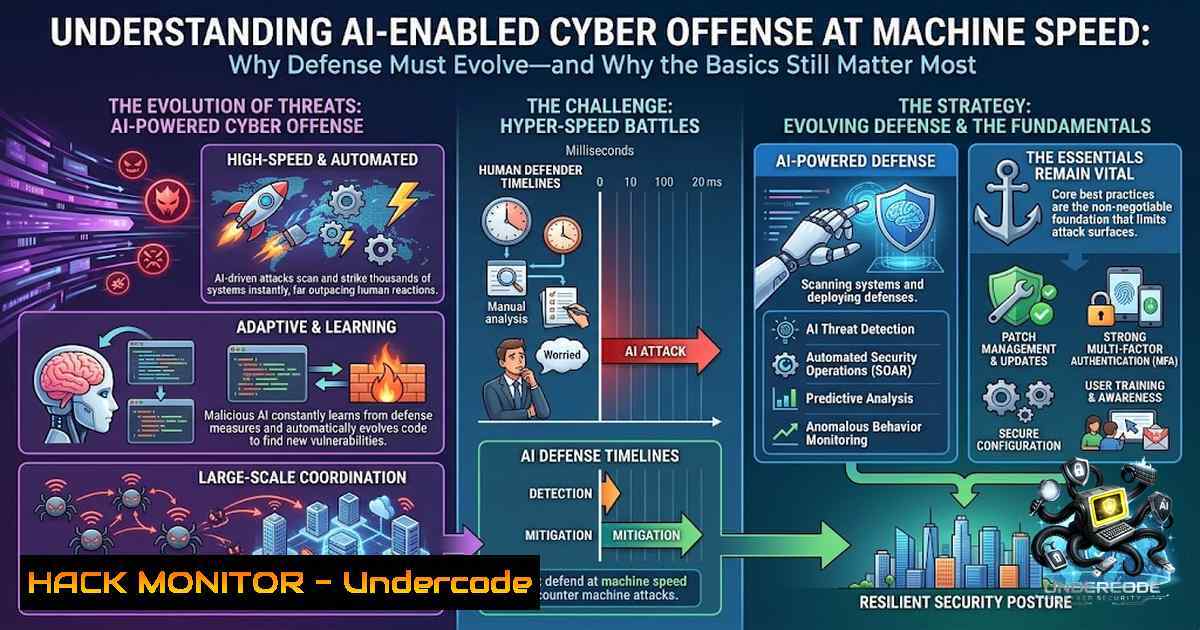
Artificial intelligence is fundamentally reshaping the cyber threat landscape, industrializing capabilities that once demanded teams of elite specialists and placing them within reach of anyone with malicious intent. Former NSA Cybersecurity Director Rob Joyce warns that AI is accelerating offensive operations to machine speed while defense remains mired in traditional, human-paced response cycles—a dangerous asymmetry that threatens to expose years of accumulated technical debt. This article distills Joyce’s insights from his recent Cipher Brief conversation, examining how AI is transforming vulnerability discovery and exploit generation, the persistent threat posed by nation-state actors like Iran targeting critical U.S. infrastructure, and the counterintuitive truth that mastering cybersecurity fundamentals remains the most effective defense against AI-powered attacks.
Learning Objectives & Secrets:
- Objective 1: Understand the AI-Offense Asymmetry – Grasp how AI is compressing the window between vulnerability discovery and exploitation, enabling attackers to automate reconnaissance, vulnerability scanning, and payload delivery at unprecedented scale.
- Objective 2 Secret Tip: Prioritize the “Boring” Basics – While AI grabs headlines, Joyce emphasizes that strong authentication, rapid patching, and network segmentation neutralize most of the AI advantage. Attackers succeed not through sophisticated zero-days but by exploiting known, unpatched weaknesses.
- Objective 3 Secret Tip: Adopt a Resilience Mindset – Prevention is ideal, but resilience is survival. Assume breach, segment critical assets, and practice rapid incident response. As Joyce notes, “by the time you investigate, attackers have likely advanced two stages beyond you”.
You Should Know:
1. The AI Industrialization of Cyber Offense
AI is not merely an assistive tool for cyber attackers—it is becoming an autonomous operator capable of discovering vulnerabilities and generating exploits faster than humans can patch. Joyce observes that AI has already outpaced humans in finding software flaws, and it is rapidly approaching the capability of a top-tier vulnerability exploit developer. What once required a team of experts can now be packaged and handed to anyone who wants it.
This industrialization changes the economics of cyber offense. Attackers can automate reconnaissance, scan for misconfigurations, craft convincing phishing lures, and even adapt malware in real-time to evade detection. The result is a dramatic compression of the attack timeline—what used to take days or weeks can now unfold in minutes.
Step‑by‑Step Guide: Assessing Your Organization’s AI-Exposed Attack Surface
- Inventory external-facing assets – Use tools like `nmap -sV -p- -T4
` to scan for open ports and service versions. - Identify legacy protocols – Search for deprecated services (e.g., SMBv1, Telnet, FTP) using
nmap --script smb-protocols -p445 <target>. - Scan for known vulnerabilities – Leverage `nmap –script vuln
` or use vulnerability scanners like OpenVAS or Nessus to identify CVEs that AI tools are likely to exploit. - Analyze authentication mechanisms – Check for weak or default credentials using tools like
hydra -l admin -P /usr/share/wordlists/rockyou.txt <target> ssh. - Map network segmentation – Use `traceroute` and `nmap` to understand lateral movement paths: `traceroute -1
` and nmap -sn <subnet>. - Prioritize remediation – Focus on CVSS scores above 7.0 and vulnerabilities with known public exploits.
-
Nation-State Threats: Iran’s Campaign Against U.S. Water Infrastructure
Joyce’s discussion also touched on Iran’s cyber operations against U.S. critical infrastructure, particularly water and wastewater systems. In mid-2026, federal authorities warned that Iranian-linked hackers had targeted water facilities in at least seven U.S. states. The attacks appeared designed more to demonstrate reach and intimidate than to cause catastrophic failure, but the implications are sobering.
Water and wastewater systems are particularly vulnerable because they often rely on legacy operational technology (OT) with minimal security controls. Many of these systems were not designed with cybersecurity in mind, and they frequently lack basic protections like strong authentication, network segmentation, and patch management.
Step‑by‑Step Guide: Hardening Industrial Control Systems (ICS) Against Nation-State Threats
- Conduct an OT asset inventory – Document all PLCs, RTUs, HMIs, and other ICS components. Use tools like Shodan (
shodan search <query>) to identify internet-exposed OT devices. - Implement network segmentation – Isolate OT networks from IT networks using firewalls and VLANs. On Cisco devices: `vlan 10` and `interface vlan 10` with ACLs restricting traffic.
- Enforce strong authentication – Replace default credentials on all OT devices. Use Active Directory or LDAP for centralized authentication where possible. On Windows: `net user
/add` and enforce password policies via secpol.msc. - Disable unnecessary services – On Windows ICS workstations, use `services.msc` to stop and disable Telnet, FTP, and other insecure protocols.
- Implement application whitelisting – Use Windows AppLocker (
gpedit.msc→ Computer Configuration → Windows Settings → Security Settings → Application Control Policies → AppLocker) or Linux `fapolicyd` to restrict execution to approved binaries. - Deploy continuous monitoring – Use Security Information and Event Management (SIEM) solutions to aggregate logs. On Linux, configure `rsyslog` to forward logs to a central server:
. @@<SIEM_IP>:514.
3. The Resilience vs. Prevention Debate
Joyce emphasizes the distinction between resilience and prevention. Prevention aims to stop attacks entirely, but in today’s environment, that is increasingly unrealistic. Resilience, by contrast, accepts that breaches will occur and focuses on minimizing impact and enabling rapid recovery.
This shift in mindset is critical. Organizations that invest solely in perimeter defenses often find themselves paralyzed when those defenses fail. A resilient approach includes robust backup strategies, rapid incident response playbooks, and continuous monitoring to detect and contain breaches early.
Step‑by‑Step Guide: Building a Cyber Resilience Framework
- Adopt the NIST Cybersecurity Framework – Align with the Identify, Protect, Detect, Respond, Recover functions. Start with a self-assessment using the NIST CSF tool.
- Implement the 3-2-1 backup strategy – Maintain three copies of data on two different media, with one copy offsite. On Linux: use `rsync -avz /source /backup` and `borgmatic` for encrypted backups.
- Develop an incident response plan – Document roles, communication channels, and containment procedures. Test the plan quarterly with tabletop exercises.
- Deploy endpoint detection and response (EDR) – Use tools like Microsoft Defender for Endpoint or CrowdStrike. On Windows: `Set-MpPreference -DisableRealtimeMonitoring $false` to ensure protection is active.
- Conduct regular breach simulations – Use frameworks like MITRE ATT&CK to emulate adversary behavior. Tools like Caldera or Atomic Red Team can automate this: `atomic run T1003` to simulate credential dumping.
- Establish recovery time objectives (RTO) and recovery point objectives (RPO) – Define acceptable downtime and data loss thresholds, and test restore procedures regularly.
4. The Hack Back Debate
Joyce also addressed the contentious issue of “hack back”—the practice of private entities launching counterattacks against their cyber adversaries. While the idea is appealing, it raises significant legal, ethical, and operational concerns. Attribution is rarely certain, and counterattacks can easily misfire, harming innocent third parties or escalating conflicts.
Instead of hack back, Joyce advocates for improved information sharing and collaboration between the private sector and government agencies. The Cybersecurity and Infrastructure Security Agency (CISA) provides numerous resources for threat intelligence sharing, including the Automated Indicator Sharing (AIS) program.
Step‑by‑Step Guide: Legal and Safe Threat Intelligence Sharing
- Join an Information Sharing and Analysis Center (ISAC) – Sector-specific ISACs (e.g., FS-ISAC for financial services, WaterISAC for water utilities) provide vetted threat intelligence.
- Implement STIX/TAXII – Use Structured Threat Information Expression (STIX) and Trusted Automated eXchange of Indicator Information (TAXII) to automate intelligence sharing. On Linux: install `stix2` Python library:
pip install stix2. - Configure a TAXII client – Use `taxii2-client` Python library to pull indicators:
from taxii2client import Collection; collection = Collection('https://taxii.example.com/collection/'). - Integrate with SIEM – Feed indicators into your SIEM for automated alerting. On Splunk: use the Threat Intelligence add-on to ingest STIX feeds.
- Participate in CISA’s AIS program – Register at cisa.gov/ais and configure your systems to share and receive indicators.
5. The Fundamentals That Neutralize AI Advantage
Despite the AI hype, Joyce returns to a consistent theme: most successful attacks exploit vulnerabilities that defenders already knew about. Strong authentication, rapid patching, and network segmentation remain the most effective defenses. AI may make attacks faster, but it does not change the fundamental weaknesses that attackers exploit.
Organizations that master these basics can neutralize most of the AI advantage. Attackers will always pursue the path of least resistance, and if that path is blocked by robust fundamentals, they will move on to softer targets.
Step‑by‑Step Guide: Implementing Foundational Security Controls
- Enforce multi-factor authentication (MFA) – On Microsoft 365: `Enable-MFAPolicy` via PowerShell. On Google Workspace: enforce MFA through admin console.
- Automate patch management – Use Windows Server Update Services (WSUS) or Azure Update Management. On Linux: configure `unattended-upgrades` for Debian/Ubuntu or `dnf-automatic` for RHEL.
- Segment networks with VLANs and ACLs – On Cisco: `vlan 20` and
access-list 100 permit ip 10.0.10.0 0.0.0.255 10.0.20.0 0.0.0.255. - Implement principle of least privilege – Use Group Policy on Windows: `gpedit.msc` → User Rights Assignment. On Linux: use `sudoers` file to restrict commands.
- Remove legacy protocols – Disable SMBv1 on Windows:
Set-SmbServerConfiguration -EnableSMB1Protocol $false. On Linux: comment out `protocol = SMB1` in/etc/samba/smb.conf. - Conduct regular vulnerability scans – Use `nmap` and OpenVAS weekly. Automate with cron jobs:
0 2 /usr/bin/nmap -sV -oA scan_$(date +\%Y\%m\%d) <subnet>.
What Undercode Say:
- Key Takeaway 1: AI is not a magic wand for attackers—it automates and accelerates existing techniques, but it does not create new attack vectors out of thin air. The fundamentals of defense—authentication, patching, segmentation—remain the bedrock of cybersecurity.
- Key Takeaway 2: The most dangerous threat is not AI itself but the complacency it breeds. Organizations that neglect basics while chasing AI-driven solutions are exposing themselves to the very attacks AI enables. Resilience, not just prevention, must be the guiding philosophy.
Analysis: Rob Joyce’s perspective is a sobering counterbalance to the AI hype cycle. While AI undoubtedly lowers the barrier to entry for cyber offense, it does not change the underlying physics of defense. Attackers still need to find a way in, and that way is almost always through a known vulnerability, a weak password, or a misconfigured firewall. The real danger is that organizations will be distracted by the shiny new AI problem and forget to fix the old, boring problems that have always been the real threat. Joyce’s call to focus on “being exceptional at the basics” is not a dismissal of AI—it is a recognition that the fundamentals are the foundation upon which any AI defense must be built.
Prediction:
- +1 Organizations that double down on fundamentals—MFA, automated patching, and network segmentation—will weather the AI storm far better than those chasing silver-bullet AI defenses.
- -1 The “dark period” Joyce describes will see a surge in breaches driven by AI-enabled exploitation of known vulnerabilities, particularly in critical infrastructure sectors like water and energy.
- +1 The hack back debate will intensify, but legal and diplomatic constraints will limit its adoption, driving more investment in resilience and information sharing instead.
- -1 Nation-state actors like Iran will continue to use cyber operations as a tool of intimidation, targeting critical infrastructure to demonstrate capability without triggering full-scale conflict.
- +1 AI will eventually be harnessed for defense at scale, but the transition will be slow, and the gap between AI-enabled offense and defense will widen before it narrows.
▶️ Related Video (76% Match):
🎯Let’s Practice For Free:
🎓 Live Courses & Certifications:
Join Undercode Academy for Verified Certifications
🚀 Request a Custom Project:
Secure, high-velocity infrastructure and disruptive technological engineering. Contact our engineering team for high-tier development and proprietary systems:
[email protected]
💎 Smart Architecture | 🛡️ Secure by Design | ⭐ Trusted by Thousands
IT/Security Reporter URL:
Reported By: https://lnkd.in/p/esiDNZy2 – Hackers Feeds
Extra Hub: Undercode MoN
Basic Verification: Pass ✅


