Listen to this Post
Introduction
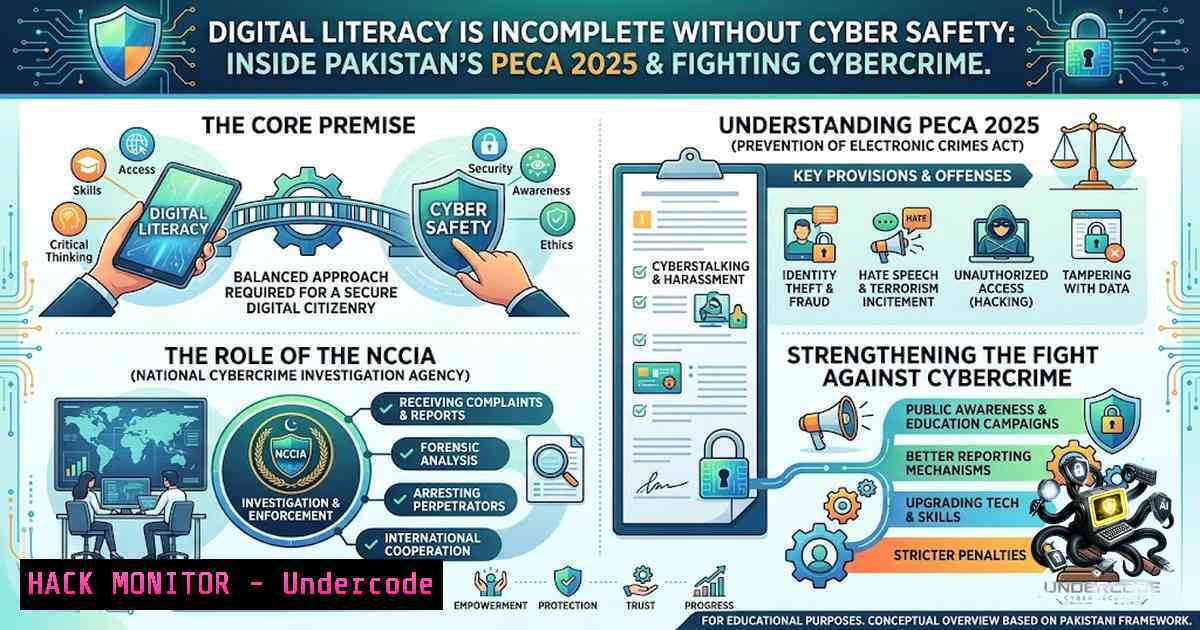
As Pakistan’s digital economy expands and the country surpasses 120 million social media users, cybercrime has escalated into a national crisis. In 2025 alone, the National Cyber Crime Investigation Agency (NCCIA) received over 150,000 cybercrime complaints, with financial fraud alone accounting for 81,996 cases—a 35% year-over-year increase. Understanding the legal frameworks, investigation mechanisms, and practical defense strategies against online threats is no longer optional; it is a fundamental requirement for every digital citizen.
Learning Objectives
- Understand the legal framework of Pakistan’s Prevention of Electronic Crimes Act (PECA) 2016 and its 2025 amendments
- Identify the structure and function of the newly established National Cyber Crime Investigation Agency (NCCIA)
- Recognize and mitigate common cyber threats including phishing, online shopping scams, and financial fraud
- Master practical command-line and technical skills for email analysis, threat detection, and secure online behavior
- Navigate the official complaint reporting process through NCCIA portals and helplines
You Should Know
- The PECA Legal Framework: Understanding Pakistan’s Cybercrime Legislation
The Prevention of Electronic Crimes Act (PECA) of 2016 serves as Pakistan’s primary legislative framework for combating cybercrime. The Act criminalizes a wide range of digital offenses and establishes mechanisms for their investigation and prosecution.
Key Provisions of PECA 2016:
| Section | Offense | Penalty |
||||
| Section 3 | Unauthorized access to information systems or data | Imprisonment and fines |
| Section 4 | Unauthorized copying or transmission of data | Criminal penalties |
| Section 9 | Data breaches and unauthorized data access | Legal prosecution |
| Section 10 | Tampering with electronic documents | Legal action |
The PECA Amendment Act 2025 introduced significant changes:
- Created a new criminal offense for intentional distribution of “false or fake information”
- Penalties include up to three years imprisonment and fines up to 2 million Pakistani Rupees
- Established the NCCIA as an independent federal body with exclusive jurisdiction over cybercrime
- Replaced the FIA Cyber Crime Wing with the autonomous NCCIA
Why This Matters: The 2025 amendments represent a significant shift in Pakistan’s approach to digital governance. While critics argue these provisions may restrict free expression, the establishment of a dedicated cybercrime investigation agency signals increased institutional capacity to combat digital threats.
2. The NCCIA: Pakistan’s New Cybercrime Investigation Authority
In April 2025, the Government of Pakistan formally established the National Cyber Crime Investigation Agency (NCCIA) as an independent institution. This marked the dissolution of the FIA’s Cyber Crime Wing and the consolidation of all cybercrime investigation authority under a single, autonomous body.
NCCIA Jurisdiction and Responsibilities:
- Investigating online fraud, harassment, digital blackmail, and identity theft
- Tackling fake websites, social media crimes, and other illicit cyber activities
- Operating with full authority to prevent, investigate, and take enforcement action
- Coordinating with international organizations including Interpol
Official Reporting Channels:
| Channel | Contact Information |
|||
| Helpline | 1799 (toll-free) |
| Phone | 051-9106691 |
| Email | [email protected] |
| Web Portal | nccia.gov.pk |
| Complaint Portal | complaint.nccia.gov.pk |
| Mobile App | NCCIA Cyber Crime Reporting (Google Play) |
2025 Enforcement Statistics:
- 150,542 complaints received
- 81,996 financial fraud cases reported
- 2,902 accused arrested
- 774 convictions obtained
- 2,196 major cybercrime cases investigated
- Rs. 461 million recovered from victims
Critical Note: Despite these enforcement actions, conviction rates remain low at approximately 3.7%, and only 9 of 372 eligible PECA cases had been transferred to NCCIA as of mid-2026. This indicates significant operational challenges that citizens should be aware of when reporting incidents.
3. Phishing Attack Analysis: Technical Defense Strategies
Phishing remains one of the most common cyber threats in Pakistan, with scammers impersonating bank officials, delivery services, and government agencies. The NCCIA issued over 30 advisories on phishing and identity theft in 2025.
Step-by-Step Email Header Analysis (Linux / Windows):
Linux – Extract and Analyze Email Headers:
 Save suspicious email as email.eml
cat email.eml | grep -E "Received:|From:|Return-Path:|SPF:|DKIM:|DMARC:"

Extract full headers
head -1 50 email.eml

Check SPF record
dig +short TXT _spf.domain.com

Verify DKIM signature
opendkim-testmsg -t email.eml
Windows – PowerShell Method:
 If using Outlook/Exchange
$mail = Get-MailboxFolderStatistics -Identity [email protected]
Get-MessageTrace -RecipientAddress [email protected] -StartDate (Get-Date).AddDays(-7)

Parse email headers
Get-Content .\email.eml | Select-String "Received|From|Authentication-Results"
Python-Based Phishing Detection (Cross-Platform):
 Clone and setup phishing detection tool
git clone https://github.com/useru1k/email-analysis.git
cd email-analysis

Create virtual environment
python3 -m venv venv
source venv/bin/activate  Linux/Mac
 .\venv\Scripts\activate  Windows

Install dependencies
pip install -r requirements.txt

Analyze email
python analyze.py --file suspicious.eml --threat-score
Red Flags to Identify Phishing Attempts:
- Urgent language demanding immediate action
- Requests for OTPs, passwords, or PINs (legitimate entities never ask for these)
- Mismatched or suspicious sender email addresses
- Links that don’t match the displayed text
- Grammar and spelling errors
- Unsolicited attachments
4. Online Shopping Scams: Recognition and Prevention
Pakistan loses approximately $9.3 billion annually to digital scams and financial fraud. Online shopping fraud (54%) ranks as the most common scam type.
How the Scam Works:
When you order from a local e-commerce store, the seller and courier collect your name, address, and phone number. Scammers then:
1. Pose as courier representatives contacting you about a “delivery issue”
2. Request verification codes or payment for customs fees
3. Use your information for unauthorized transactions
Protection Measures:
| Action | Why It Works |
|–|–|
| Prefer Cash on Delivery (COD) | Eliminates advance payment risk |
| Verify seller credentials and reviews | Identifies fraudulent stores |
| Never share SMS codes with anyone | Prevents OTP-based account takeover |
| Use official courier helplines to verify | Avoids impersonation scams |
| Enable two-factor authentication on accounts | Adds extra security layer |
| Avoid clicking links in unsolicited messages | Prevents phishing redirects |
What to Do If Scammed:
1. Immediately contact your bank to block transactions
2. Change passwords for all affected accounts
3. File a complaint through NCCIA helpline (1799)
4. Submit detailed complaint via nccia.gov.pk
- Visit the nearest NCCIA Circle Office for assistance
5. Financial Fraud and WhatsApp Hacking: Emerging Threats
In 2025, WhatsApp account hacking accounted for 2,974 reported complaints. Financial crimes involved a total amount of Rs. 2.716 billion, with Rs. 452.376 million recovered.
Common Financial Fraud Tactics:
- Fake investment schemes promising high returns
- Impersonation of bank officials via phone calls
- Fake parcel notifications
- SIM swap fraud
- Fake job offers
Technical Defense: Enable Two-Factor Authentication (2FA)
For WhatsApp:
- Open WhatsApp → Settings → Account → Two-step verification
2. Enable and set a 6-digit PIN
3. Add an email address for recovery
For Email Accounts (Gmail Example):
 Security Check - Linux command to verify account security settings
curl -X GET "https://security.google.com/settings/security/secureaccount" \
-H "Authorization: Bearer $ACCESS_TOKEN"
For Social Media Accounts:
- Enable 2FA using authenticator apps (Google Authenticator, Microsoft Authenticator)
- Use strong, unique passwords (12+ characters with special characters)
- Regularly review active sessions and logged-in devices
6. AI-Powered Cyber Threats: Deepfakes and Voice Cloning
The Pakistani government is finalizing its first-ever national Artificial Intelligence Policy, with deepfake and voice-cloning scams identified as rapidly evolving threats. The NCCIA has introduced a cyber intelligence system based on modern AI and machine learning, with over 300 officers receiving advanced cyber investigation training.
How to Detect Deepfake Content:
- Look for unnatural eye movements or blinking patterns
- Check for inconsistencies in skin texture and lighting
- Verify audio synchronization with lip movements
- Use deepfake detection tools:
- Microsoft Video Authenticator
- Deepware Scanner
- Sentinel’s deepfake detection API
Protecting Against Voice Cloning Scams:
- Establish a verification code word with family members
- Never transfer money based solely on a phone call
- Call back the person on their known number to verify
- Be suspicious of urgent requests for money or sensitive information
7. Reporting Cybercrime: The Complete NCCIA Process
Step-by-Step Complaint Filing Guide:
1. Gather Evidence:
- Screenshots of conversations, transactions, and suspicious messages
- Email headers and URLs
- Transaction IDs and bank statements
- Phone numbers and usernames of perpetrators
2. Choose Reporting Channel:
- Call NCCIA helpline: 1799 (toll-free)
- Visit website: nccia.gov.pk
- Submit online complaint: complaint.nccia.gov.pk
- Use mobile app: NCCIA Cyber Crime Reporting (Google Play)
- Email: [email protected]
- Phone: 051-9106691
3. File the Complaint:
- Provide detailed description of the incident
- Attach all collected evidence
- Include your contact information for follow-up
- Obtain complaint reference number for tracking
4. Follow Up:
- Track complaint status through the portal
- Visit nearest NCCIA Circle Office if needed
- Cooperate with investigators if contacted
What Undercode Say
- Digital literacy without cyber safety is incomplete. The AuratTech Data & AI Fellowship’s focus on cybercrime awareness, led by Ms. Javeria Durani, represents a critical intervention. Women in tech must not only build with data and AI but also understand how to protect themselves in Pakistan’s increasingly hostile digital environment.
-
The PECA 2025 amendments and NCCIA establishment are double-edged swords. While they provide a legal framework and dedicated investigative body, the low conviction rate (3.7%) and slow case transfer rates reveal systemic challenges. Citizens must be proactive about their own digital defense and aware that reporting is only the first step in a lengthy process.
-
Practical technical skills are essential. Understanding how to analyze email headers, detect phishing attempts, and secure accounts through 2FA and strong passwords is as important as knowing the legal framework. The commands and tools provided in this article should be part of every digital citizen’s toolkit.
-
The human element remains the weakest link. Scammers exploit trust, urgency, and fear. Education and awareness—like the campaigns run by NCCIA reaching 2 million citizens and the “Is This Legit?” campaign by Meta and PTA—are as critical as technical defenses.
-
Pakistan’s digital future depends on collective responsibility. With over 150,000 complaints in 2025 and annual losses exceeding $9 billion, cybercrime is an economic and social crisis. Every individual, organization, and institution must prioritize cyber safety as a fundamental component of digital literacy.
Prediction
+1 Pakistan’s establishment of the NCCIA as an independent agency and the introduction of AI-powered cyber intelligence systems will gradually improve cybercrime investigation and prosecution rates, though meaningful impact may take 2–3 years to materialize.
-1 The low conviction rate (3.7%) and the fact that only 9 of 372 eligible PECA cases have been transferred to NCCIA indicate that enforcement remains severely under-resourced. Without significant investment in training, staffing, and judicial capacity, the agency risks becoming another bureaucratic bottleneck.
+1 The growing awareness campaigns—reaching 2 million citizens, the launch of the 1799 helpline, and the nccia.gov.pk portal—will empower more citizens to report incidents, creating a deterrent effect over time.
-1 Deepfake and voice-cloning scams represent a new frontier that existing legal frameworks and investigative techniques are ill-equipped to handle. The national AI policy must prioritize defensive AI capabilities and rapid response mechanisms.
+1 The integration of NCCIA with international partners like Interpol and successful joint operations signal Pakistan’s growing technical expertise in dismantling transnational cybercrime networks, which will attract further international cooperation and capacity-building support.
▶️ Related Video (72% Match):
🎯Let’s Practice For Free:
🎓 Live Courses & Certifications:
Join Undercode Academy for Verified Certifications
🚀 Request a Custom Project:
Secure, high-velocity infrastructure and disruptive technological engineering. Contact our engineering team for high-tier development and proprietary systems:
[email protected]
💎 Smart Architecture | 🛡️ Secure by Design | ⭐ Trusted by Thousands
IT/Security Reporter URL:
Reported By: Zainab Fatimadataanalyst – Hackers Feeds
Extra Hub: Undercode MoN
Basic Verification: Pass ✅


