
Listen to this Post
Introduction:
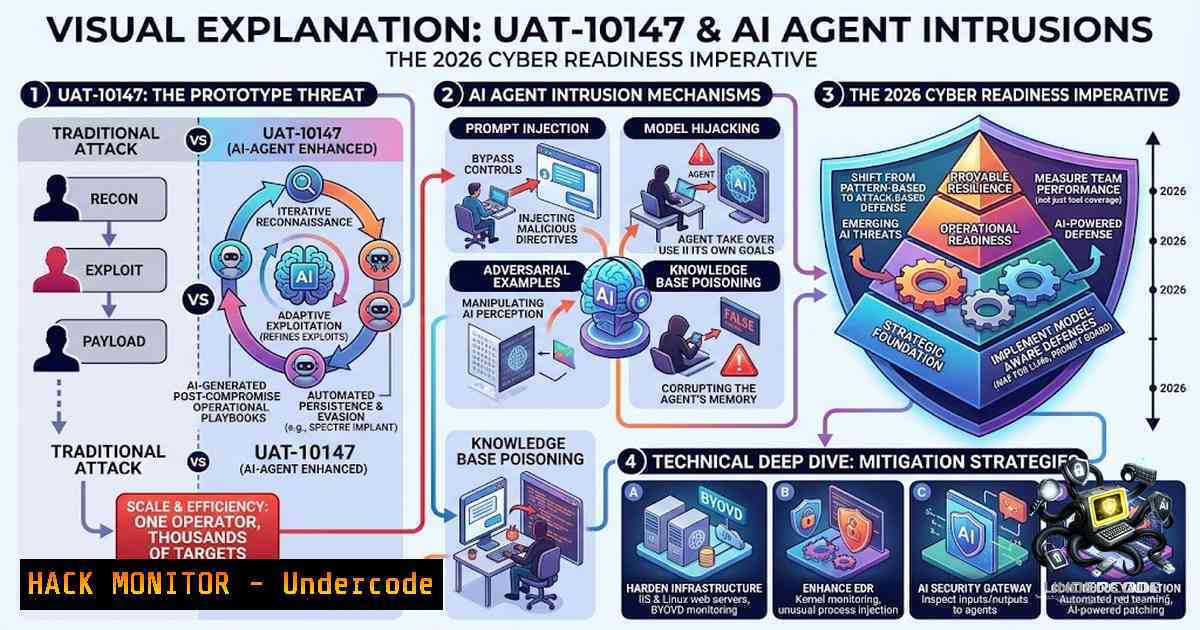
The cybersecurity landscape of 2026 is defined by the collision of two powerful forces: the weaponization of artificial intelligence by threat actors and the parallel adoption of AI as a defensive cornerstone. In August 2026, researchers disclosed details of UAT-10147, a Chinese-speaking cybercrime group leveraging AI-powered tools to conduct large-scale attacks against Windows and Linux web servers globally. Simultaneously, the July 2026 intrusion at Hugging Face demonstrated that even AI-1ative organizations are vulnerable to attack chains combining server-side request forgery, legacy token-refresh zero-days, credential reuse, Kubernetes misconfigurations, and template injection. This article provides a technical analysis of these converging threats and offers actionable guidance for building resilience.
Learning Objectives & Secrets:
- Objective 1: Master AI-Powered Attack Detection. Learn to identify and analyze attack patterns characteristic of AI-augmented adversaries, including automated vulnerability discovery, exploit code generation, and chained attacks executed without human guidance.
- Objective 2 (Secret Tip): Implement Zero-Trust for Non-Human Identities. Treat AI agents and machine identities as first-class security principals requiring continuous authorization, behavioral governance, and zero implied trust.
- Objective 3 (Secret Tip): Shrink the AI Exploit Window. Leverage AI-driven exposure management and continuous red teaming to reduce the time between vulnerability discovery and exploitation from days to hours.
You Should Know:
1. Analyzing the UAT-10147 AI-Powered Attack Chain
The UAT-10147 campaign exemplifies the new generation of AI-enabled threats. The group reportedly uses large language models to accelerate vulnerability research, write custom exploit code, and orchestrate multi-stage attacks against internet-facing web servers. While specific Indicators of Compromise (IoCs) remain limited, the operational pattern mirrors capabilities demonstrated by AI agents in controlled environments: discovering vulnerabilities, writing exploit code, and chaining attacks overnight without human guidance.
Step‑by‑step guide to investigating potential AI-powered intrusions:
- Baseline Normal Behavior: Establish behavioral baselines for web server and API traffic using tools like Zeek or Suricata. Look for anomalies in request patterns, especially those suggesting automated reconnaissance.
- Monitor for Unusual Outbound Connections: AI-powered malware often establishes command-and-control (C2) channels via encrypted or obfuscated protocols. Use `netstat` and `ss` on Linux to identify unexpected connections:
List all listening ports and established connections
sudo ss -tulpn
Monitor real-time network connections
sudo netstat -tunap | grep ESTABLISHED
- Audit Web Server Logs for Exploit Attempts: Search for patterns indicative of automated exploitation, such as rapid-fire requests to vulnerable endpoints or attempts to exploit known vulnerabilities like template injection.
Search Apache logs for common attack signatures
sudo grep -E "(eval(|base64_decode|system(|passthru(|curl)" /var/log/apache2/access.log
Check for unusual user-agent strings often used by automated tools
sudo grep -E "(python-requests|curl|wget|nikto|nmap)" /var/log/nginx/access.log
- Deploy Endpoint Detection and Response (EDR): Utilize EDR solutions to detect post-exploitation activity, such as privilege escalation attempts or the creation of persistence mechanisms. On Linux, check for unusual cron jobs or systemd services:
List all cron jobs for all users
sudo cat /etc/crontab
sudo ls -la /etc/cron.
List all systemd services
sudo systemctl list-units --type=service --all
- Correlate with Threat Intelligence: Cross-reference observed indicators with threat intelligence feeds. The Cloud Security Alliance and SANS Institute have published practitioner briefings on “AI Vulnerability Storm” tactics.
2. Hardening Cloud Infrastructure Against AI-Driven Exploits
The Hugging Face intrusion of July 2026 highlighted the danger of chaining seemingly low-severity misconfigurations. Attackers exploited a legacy token-refresh zero-day, reused credentials from a public leak, and leveraged a Kubernetes misconfiguration. This attack chain underscores the need for comprehensive cloud security hardening.
Step‑by‑step guide to cloud security hardening (Linux focus):
- Implement Principle of Least Privilege (PoLP): Regularly audit IAM roles and service accounts. Remove unnecessary permissions. Use tools like `aws-cli` or `gcloud` to review policies.
AWS: List IAM users and their attached policies
aws iam list-users --query 'Users[].UserName' --output table
aws iam list-attached-user-policies --user-1ame <USERNAME>
- Harden Kubernetes Configurations: Ensure that Kubernetes API server is not exposed to the public internet unnecessarily. Implement network policies to restrict pod-to-pod communication. Use `kubectl` to audit configurations.
List all namespaces and pods
kubectl get namespaces
kubectl get pods --all-1amespaces
Check for overly permissive RBAC configurations
kubectl get clusterrolebindings -o wide
- Secure Secrets Management: Never hardcode credentials in code or configuration files. Use a secrets management solution like HashiCorp Vault or cloud-1ative services like AWS Secrets Manager. Rotate secrets regularly.
- Reduce Internet-Exposed Attack Surface: CERT-In’s advisory CIAD-2026-0020 recommends removing unnecessary internet-facing services, disabling unnecessary ports and protocols, and hardening perimeter-facing systems.
List all open ports and the services listening on them
sudo ss -tulpn | grep LISTEN
Use iptables to block unnecessary ports
sudo iptables -A INPUT -p tcp --dport <PORT> -j DROP
Save iptables rules (Debian/Ubuntu)
sudo netfilter-persistent save
- Adopt AI-Enabled Defensive Tools: CERT-In advises adopting AI-enabled defensive security tools for automated vulnerability detection, attack surface analysis, and threat detection.
3. API Security: The Number One Attack Surface
APIs are the core building block of every enterprise’s digital strategy, yet they are also the number one attack surface for hackers. The OWASP API Security Top 10 for 2026 highlights Broken Object Level Authorization (BOLA), Broken Authentication, and Excessive Data Exposure as critical risks.
Step‑by‑step guide to API security hardening:
- Implement Robust Authentication and Authorization: Use OAuth2/OIDC for authentication. Implement ownership checks on every request in the backend to prevent BOLA attacks.
- Enforce Rate Limiting: APIs without proper rate limiting are vulnerable to credential stuffing, data scraping, and denial-of-service attacks. Test that rate limits are enforced consistently across all endpoints.
Example using NGINX rate limiting In /etc/nginx/nginx.conf http { limit_req_zone $binary_remote_addr zone=mylimit:10m rate=10r/s; server { location /api/ { limit_req zone=mylimit burst=20 nodelay; proxy_pass http://backend; } } } - Use Non-Predictable Identifiers: Replace sequential numbers with UUIDs or other non-predictable identifiers to prevent IDOR (Insecure Direct Object Reference) vulnerabilities.
- Implement API Security Posture Management (SPM): Tools like Wiz API SPM can help remove API blind spots, identify exploitable APIs, and mitigate the risk of API-related breaches.
- Treat Every Request as Potentially Hostile: Re-verify authorization on the server for every request, and do not rely on any client-side enforcement or on obscurity of URLs.
-
The AI Training and Certification Landscape in 2026
The rapid evolution of AI threats has spurred a corresponding growth in AI-specific cybersecurity training. Several major initiatives and certifications have emerged in 2026.
Key developments and recommendations:
- Hack The Box (HTB) Academy: HTB now offers more than 230 defensive security courses, a SOC Range with over 250 alerts, and HTB Coach, an AI-powered learning assistant.
- ISC2 and Coursera: Launched foundational courses in Governance, Risk and Compliance (GRC) and Software Lifecycle Development and Security.
- Cloud Security Alliance (CSA): Won a 2026 SC Award for its Trusted AI Security Expert (TAISE) credential.
- EC-Council: Unveiled an Enterprise AI Credential Suite and released Certified CISO v4.
- KnowBe4 and Secure Code Warrior: Partnered to add secure coding and AI governance training, including 31 learning activities across nine series.
5. Mitigating Prompt Injection and AI-Specific Vulnerabilities
Prompt injection is increasingly recognized as an unsolvable problem of the AI age, akin to phishing in traditional cybersecurity. Organizations must adopt defensive measures to protect their AI systems.
Step‑by‑step guide to AI system hardening:
- Treat AI Agents as First-Class Identities: Mandate a human-in-the-loop for critical AI actions.
- Split the Reasoning Layer from Execution: By day 60 of your AI security plan, harden your integrations by separating the reasoning layer (where LLMs process prompts) from the execution layer (where actions are taken).
- Conduct a Comprehensive AI Asset Audit: Spend the first 30 days identifying, mapping, and tiering every unmanaged shadow agent that bypasses your network.
- Run Continuous, AI-Driven Red Teaming: Replace point-in-time tests with continuous, AI-driven red teaming to proactively discover vulnerabilities.
- Implement Input Validation and Sanitization: Treat all user inputs to AI systems as potentially malicious. Implement strict input validation and sanitization to prevent injection attacks.
What Undercode Say:
- Key Takeaway 1: The AI threat landscape is evolving at machine speed. Organizations must move beyond traditional, periodic security assessments and adopt continuous, AI-driven monitoring and response capabilities. The Hugging Face incident demonstrated that even sophisticated AI companies are vulnerable to attack chains composed of known, textbook vulnerabilities.
- Key Takeaway 2: Security training is no longer optional; it is a critical business imperative. The proliferation of AI-specific certifications and training platforms in 2026 reflects the urgent need for skilled professionals who can defend against AI-powered attacks. Investing in training through platforms like HTB Academy, ISC2, and EC-Council is essential for building organizational resilience.
Prediction:
- -1: The weaponization of AI will continue to lower the barrier to entry for cybercrime, leading to a surge in automated, large-scale attacks. Organizations that fail to adopt AI-enabled defenses will be increasingly overwhelmed.
- -1: The “AI vulnerability storm” predicted by the Cloud Security Alliance, SANS Institute, and OWASP will materialize, with a significant increase in attacks targeting AI systems themselves, including prompt injection, model poisoning, and data extraction.
- +1: The cybersecurity industry will respond with a new generation of AI-1ative security tools that can predict, detect, and respond to threats at machine speed, potentially outpacing human analysts.
- +1: The demand for AI security skills will drive a new wave of innovation in cybersecurity training and certification, creating a more skilled and resilient workforce.
▶️ Related Video (80% Match):
https://www.youtube.com/watch?v=3X1_JnelcUc
🎯Let’s Practice For Free:
🎓 Live Courses & Certifications:
Join Undercode Academy for Verified Certifications
🚀 Request a Custom Project:
Secure, high-velocity infrastructure and disruptive technological engineering. Contact our engineering team for high-tier development and proprietary systems:
[email protected]
💎 Smart Architecture | 🛡️ Secure by Design | ⭐ Trusted by Thousands
IT/Security Reporter URL:
Reported By: https://lnkd.in/p/ejD32QnT – Hackers Feeds
Extra Hub: Undercode MoN
Basic Verification: Pass ✅


