
Listen to this Post
Introduction:
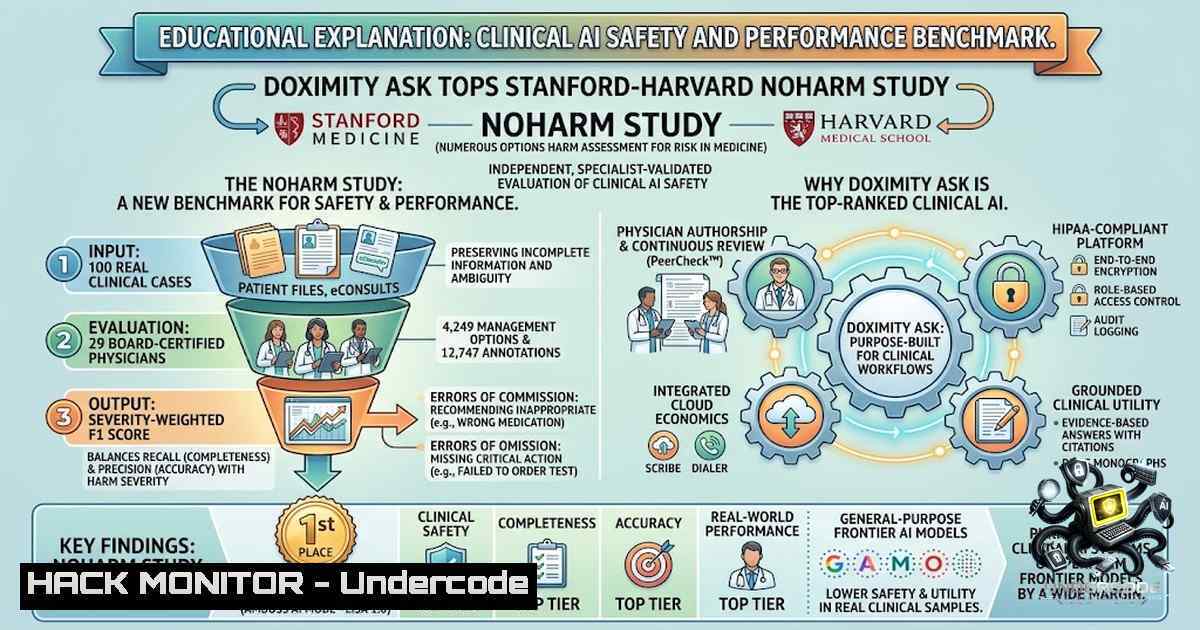
The deployment of large language models (LLMs) in high-stakes environments like healthcare demands rigorous, independent validation—not just of knowledge recall, but of safety. The NOHARM (Numerous Options Harm Assessment for Risk in Medicine) benchmark, conducted by the ARISE research network (a collaboration between Stanford and Harvard Medical Schools), represents a paradigm shift in clinical AI evaluation. Unlike traditional multiple-choice medical exams, NOHARM evaluates whether AI-generated recommendations could contribute to patient harm across 1,100 real-world clinical scenarios. The study’s findings are clear: purpose-built clinical AI systems like Doximity Ask significantly outperform general-purpose frontier models, with Doximity Ask ranking first among U.S. models on the severity-weighted F1 score (84.5%) and achieving the lowest rate of potentially severe harmful errors (4.8%).
Learning Objectives & Secrets:
- Objective 1: Understand the NOHARM Benchmark – Learn how the NOHARM study evaluates clinical AI safety through 1,100 physician-derived scenarios, scored by 29 board-certified physicians, focusing on potential patient harm rather than just accuracy.
- Objective 2 Secret Tip: Leverage Physician-in-the-Loop Systems – Doximity Ask’s success stems from its PeerCheck™ program, where over 11,000 physician experts continuously review and improve AI outputs. This creates a feedback loop that enhances clinical reasoning and completeness.
- Objective 3 Secret Tip: Prioritize Evidence-First Architectures – Doximity Ask retrieves relevant literature from a continuously updated index of millions of peer-reviewed publications at query time, rather than relying solely on static model memory. This ensures responses are grounded in current evidence.
You Should Know:
- Understanding the NOHARM Benchmark: A Safety-First Evaluation Framework
The NOHARM study represents a critical advancement in AI safety evaluation. Developed by more than 50 researchers, including 29 board-certified physicians, the benchmark tested 24 AI systems (20 generalist LLMs and 4 retrieval-augmented generation clinical tools) against 1,100 case-based tasks drawn from real physician-to-specialist consultations. The key metric was the severity-weighted F1 score, which balances precision and recall while accounting for the clinical severity of errors. The study revealed that errors of omission—where the AI recommended too little rather than something harmful—accounted for more than 80% of severe errors across all systems. This finding underscores the importance of designing AI systems that are not only accurate but also comprehensive in their recommendations. The ARISE network, established by Stanford Medicine in 2024, continues to advance this work through the Medical AI Superintelligence Test (MAST), which aims to provide a rigorous, task-based framework for evaluating medical AI across multiple clinical dimensions.
2. Doximity Ask’s Architecture: HIPAA-Compliant Clinical AI
Doximity Ask is a HIPAA-compliant clinical AI platform built specifically for clinical workflows. Its architecture includes several critical security and privacy features essential for healthcare deployments:
– End-to-End Encryption: Protects patient data throughout the entire interaction lifecycle.
– Role-Based Access Controls (RBAC): Ensures that only authorized personnel can access specific functionalities and data.
– Audit Logging: Provides a complete, immutable record of all system interactions for compliance and forensic purposes.
– Session Isolation: Prevents data leakage between different user sessions.
Step-by-Step Guide: Implementing a Secure Clinical AI Gateway
For healthcare organizations looking to deploy AI systems with similar security postures, consider this approach:
1. Assess Compliance Requirements: Identify applicable regulations (HIPAA, GDPR, etc.) and map them to technical controls.
2. Implement Identity Management: Deploy an Identity Provider (IdP) with SAML or OIDC integration for single sign-on and RBAC.
3. Encrypt Data in Transit and at Rest: Use TLS 1.3 for all API communications and AES-256 for data storage.
4. Establish Audit Trails: Integrate with a SIEM (Security Information and Event Management) system to centralize logs.
5. Conduct Regular Penetration Testing: Simulate attacks on the AI gateway to identify vulnerabilities.
6. Deploy API Rate Limiting and Anomaly Detection: Prevent abuse and detect unusual access patterns.
3. Optimizing RAG Systems for Clinical Accuracy
Doximity Ask’s performance is driven by its retrieval-augmented generation (RAG) architecture, which uses a continuously updated index of millions of peer-reviewed publications. To optimize a RAG system for clinical or technical domains:
– Indexing: Use a vector database (e.g., Pinecone, Weaviate) to store embeddings of medical literature. Ensure the index is refreshed daily to incorporate new research.
– Retrieval: Implement hybrid search combining semantic (vector) and keyword (BM25) retrieval to improve recall.
– Re-ranking: Apply a cross-encoder model to re-rank retrieved documents based on relevance to the query.
– Grounding: Feed the retrieved documents as context to the LLM, with strict instructions to only answer based on the provided sources.
Linux Command: Setting Up a Vector Database for Document Indexing
 Install Docker and run a Weaviate instance
docker run -d -p 8080:8080 \
-e AUTHENTICATION_ANONYMOUS_ACCESS_ENABLED='true' \
-e PERSISTENCE_DATA_PATH='/var/lib/weaviate' \
semitechnologies/weaviate:1.24.1

Index documents using Python (example)
python3 -c "
import weaviate
client = weaviate.Client('http://localhost:8080')
 Define schema for medical documents
schema = {
'class': 'MedicalPaper',
'properties': [
{'name': 'title', 'dataType': ['string']},
{'name': 'abstract', 'dataType': ['text']},
{'name': 'doi', 'dataType': ['string']}
]
}
client.schema.create_class(schema)
print('Schema created successfully.')
"
4. Prompt Engineering and Stability in Clinical AI
The NOHARM study revealed a critical insight: general-purpose models often improved with carefully engineered prompts, but specialized systems like Doximity Ask provided reliable guidance without requiring specialized prompting. Furthermore, the study tested model stability by making small, clinically irrelevant edits to patient scenarios (e.g., changing age from 71 to 73). General-purpose models were substantially more likely to vary their answers, while specialized systems were much less sensitive to these changes. This stability is crucial in clinical settings where consistency in recommendations is paramount. For developers, this means that domain-specific fine-tuning and architecture design are more effective than relying on prompt engineering alone to achieve reliable outputs.
Windows Command: Testing API Endpoint Stability
 Using PowerShell to send a series of requests with slight variations
$baseUrl = "https://your-clinical-ai-api.example.com/v1/query"
$headers = @{ "Authorization" = "Bearer YOUR_API_KEY"; "Content-Type" = "application/json" }

Define base patient scenario
$baseBody = @{
query = "What is the recommended treatment for a 71-year-old male with hypertension and diabetes?"
} | ConvertTo-Json

Send request for age 71
Invoke-RestMethod -Uri $baseUrl -Method Post -Headers $headers -Body $baseBody

Send request for age 73
$modifiedBody = @{
query = "What is the recommended treatment for a 73-year-old male with hypertension and diabetes?"
} | ConvertTo-Json
Invoke-RestMethod -Uri $baseUrl -Method Post -Headers $headers -Body $modifiedBody
 Compare responses for consistency
5. Securing AI APIs in Healthcare Environments
The deployment of clinical AI APIs introduces unique security challenges. The OWASP Top 10 for LLM Applications highlights risks such as prompt injection, insecure output handling, and excessive agency. For healthcare organizations, additional considerations include:
– Input Validation and Sanitization: Implement strict validation of all inputs to prevent prompt injection attacks.
– Output Filtering: Use content filters to detect and block harmful or non-compliant outputs.
– Rate Limiting: Prevent denial-of-service attacks and excessive API usage.
– Monitoring and Logging: Implement comprehensive logging of all API requests and responses for security auditing.
Linux Command: Setting Up API Gateway with Rate Limiting (NGINX)
 /etc/nginx/nginx.conf
http {
limit_req_zone $binary_remote_addr zone=api_limit:10m rate=10r/s;
server {
location /api/ {
limit_req zone=api_limit burst=20 nodelay;
proxy_pass http://ai_backend;
proxy_set_header Host $host;
proxy_set_header X-Real-IP $remote_addr;
}
}
}
6. Mitigating Errors of Omission in AI Recommendations
The NOHARM study found that errors of omission—where the AI failed to recommend a necessary action—accounted for over 80% of severe errors. This finding has significant implications for AI system design. To mitigate these errors:
– Implement Comprehensive Checklist-Based Reasoning: Train models to follow structured clinical reasoning pathways that explicitly check for common omissions.
– Use Agentic Reasoning: Break complex problems into structured steps, as Doximity Ask does for multi-step clinical decision-making.
– Incorporate Physician Feedback Loops: Continuous physician review helps identify gaps in recommendations and reinforces more complete clinical reasoning.
- The MAST Framework: The Future of Clinical AI Evaluation
ARISE has introduced the Medical AI Superintelligence Test (MAST), a comprehensive framework that combines multiple domains of clinical competence—including diagnosis, management, and safety. MAST aims to coordinate, maintain, and rapidly update high-quality AI benchmarks within a shared infrastructure. The framework addresses a critical gap: existing benchmarks are often misleading and insufficient for evaluating clinical AI, as a model can perform well on knowledge questions while failing to integrate that knowledge in complex clinical scenarios. MAST’s launch version maintains evaluations across diagnosis, management, and other domains, with future iterations enabling cross-benchmark trait analysis. This represents a significant step toward establishing standardized, rigorous evaluation protocols for clinical AI.
What Undercode Say:
- Key Takeaway 1: Specialization Matters – Purpose-built clinical AI systems consistently outperform general-purpose frontier models in safety-critical evaluations. The NOHARM study demonstrates that domain-specific architecture and continuous physician oversight are not optional differentiators but essential requirements for trustworthy healthcare AI.
- Key Takeaway 2: Safety Evaluation Must Evolve – Traditional benchmarks focused on knowledge recall are insufficient for evaluating AI in high-stakes environments. The NOHARM study’s focus on potential patient harm, combined with the MAST framework’s multi-dimensional approach, sets a new standard for AI safety evaluation that other industries should consider adopting.
Analysis:
The NOHARM study represents a watershed moment for clinical AI. By shifting the evaluation focus from accuracy to safety, it addresses the fundamental concern surrounding AI in healthcare: not whether the AI can answer correctly, but whether its recommendations could cause harm. The finding that errors of omission dominate severe errors is particularly instructive, suggesting that future AI systems must be designed with a bias toward comprehensiveness rather than conciseness. Doximity Ask’s success, driven by its physician-in-the-loop PeerCheck™ program and evidence-first architecture, validates the approach of building AI specifically for clinical workflows rather than adapting general-purpose models. As the ARISE network continues to develop the MAST framework, we can expect even more rigorous and nuanced evaluations that will drive the entire industry toward safer, more reliable AI systems.
Prediction:
- +1 The NOHARM study will accelerate the adoption of specialized clinical AI systems, as healthcare organizations prioritize safety and reliability over the allure of general-purpose models.
- +1 The MAST framework will become the de facto standard for clinical AI evaluation, driving innovation in model architecture and training methodologies.
- -1 The gap between specialized and general-purpose AI in healthcare will widen, potentially creating a two-tier system where only well-resourced organizations can afford the safest AI solutions.
- +1 The emphasis on physician-in-the-loop systems will create new opportunities for clinician-AI collaboration, improving both AI performance and physician workflows.
- -1 The high cost of maintaining continuous physician review programs may limit adoption among smaller healthcare providers, exacerbating existing disparities in care quality.
▶️ Related Video (78% Match):
🎯Let’s Practice For Free:
🎓 Live Courses & Certifications:
Join Undercode Academy for Verified Certifications
🚀 Request a Custom Project:
Secure, high-velocity infrastructure and disruptive technological engineering. Contact our engineering team for high-tier development and proprietary systems:
[email protected]
💎 Smart Architecture | 🛡️ Secure by Design | ⭐ Trusted by Thousands
IT/Security Reporter URL:
Reported By: https://lnkd.in/p/eFgfmtBf – Hackers Feeds
Extra Hub: Undercode MoN
Basic Verification: Pass ✅


