
Listen to this Post
Introduction
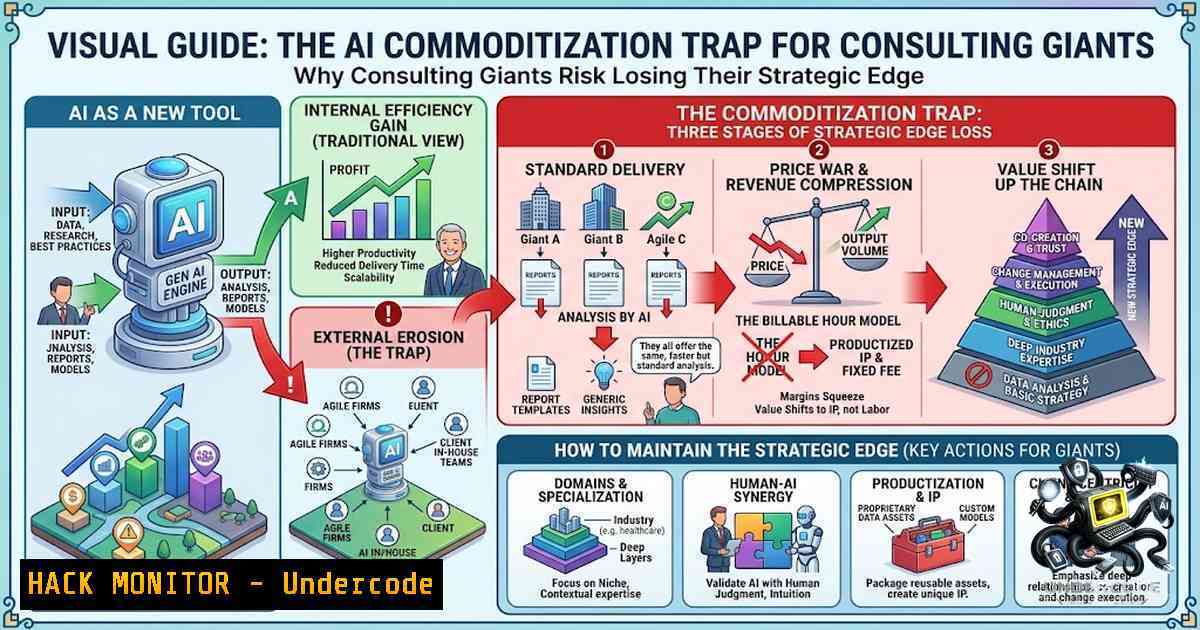
The rapid adoption of identical AI models across major consulting firms—Deloitte, Accenture, and PwC—is creating an unprecedented strategic paradox. While these firms race to deploy Claude, ChatGPT, and Gemini to hundreds of thousands of professionals, they risk transforming their core value proposition of strategic differentiation into a commoditized offering. This convergence toward shared AI frameworks, benchmarks, and methodologies threatens to homogenize market analysis, segmentation, and strategic recommendations across the consulting landscape.
Learning Objectives & Secrets
- Objective 1: Identify the AI Homogenization Risk – Recognize how shared AI models and public datasets lead to convergent outputs across competing consulting firms, undermining their unique value propositions.
-
Objective 2: Secret Tips for Proprietary AI Layer Development – Learn how to build custom AI layers using proprietary behavioral data, campaign history, and accumulated organizational knowledge that competitors cannot access.
-
Objective 3: Secret Tips for Data Moats – Discover strategies for protecting and leveraging unique data assets—customer insights, decision histories, and process intelligence—as the ultimate competitive differentiator in an AI-saturated market.
You Should Know
- The AI Standardization Phenomenon: Understanding the Convergence Risk
Major consulting firms are standardizing on the same AI models at an unprecedented scale. Deloitte has deployed Claude to 470,000 professionals, with certification programs for 15,000. Accenture has formed agreements with OpenAI and Anthropic, training tens of thousands, while Microsoft describes Accenture’s Copilot deployment to 743,000 users as the largest enterprise AI rollout. PwC has certified 30,000 professionals on Claude following a 200,000-seat ChatGPT Enterprise deployment.
Step-by-step guide to auditing your organization’s AI standardization risk:
- Map Your AI Stack – Document all AI models, APIs, and frameworks used across departments. Identify overlaps with competitor stacks through public disclosures and job postings.
-
Analyze Prompt Patterns – Review prompt logs to identify whether teams are using similar query structures, which leads to convergent outputs.
-
Benchmark Response Diversity – Test identical business questions across multiple AI models (Claude, ChatGPT, Gemini) to document response variations.
-
Assess Data Source Overlap – Audit whether your AI systems primarily rely on public benchmarks, common best practices, and widely available market data.
Linux Command for AI Model Comparison:
 Script to batch-test multiple AI APIs with identical prompts
for model in claude-3-opus gpt-4 gemini-pro; do
curl -X POST "https://api.example.com/$model/query" \
-H "Authorization: Bearer $API_KEY" \
-H "Content-Type: application/json" \
-d '{"prompt": "Generate market segmentation strategy for fintech startup"}' \

<blockquote>
  response_$model.json
  done
   Compare outputs using diff
  diff response_claude.json response_gpt4.json
Windows PowerShell Command:
 Test API response consistency across models
$models = @("claude", "gpt4", "gemini")
foreach ($model in $models) {
Invoke-RestMethod -Uri "https://api.example.com/$model/query" `
-Method Post `
-Headers @{"Authorization"="Bearer $env:API_KEY"} `
-Body (@{prompt="Competitive analysis for e-commerce platform"} | ConvertTo-Json) `
| Out-File "response_$model.json"
}
Compare-Object (Get-Content response_claude.json) (Get-Content response_gpt4.json)
- Data as the New Moat: Building Proprietary Intelligence Layers
The fundamental competitive advantage is shifting from AI model selection to proprietary data integration. Organizations that successfully integrate behavioral customer data, historical campaign performance, and internal process knowledge into their AI layers will outperform those relying solely on general-purpose models.
Step-by-step guide to creating a proprietary AI data layer:
- Inventory Proprietary Data Assets – Identify unique data sources: customer interaction logs, sales conversion histories, product usage telemetry, and internal decision records.
-
Implement ETL Pipelines – Create extraction, transformation, and loading pipelines to feed proprietary data into vector databases.
-
Develop Custom Embeddings – Train domain-specific embeddings on your proprietary dataset to capture unique business context.
-
Create Retrieval-Augmented Generation (RAG) Pipelines – Build RAG systems that prioritize proprietary data over general knowledge bases.
-
Implement Data Governance – Establish role-based access controls and data usage policies to protect proprietary intelligence.
Python Example for Building a Proprietary RAG Pipeline:
import chromadb
from sentence_transformers import SentenceTransformer
import pandas as pd

Load proprietary data
customer_data = pd.read_csv('customer_insights.csv')
campaign_history = pd.read_csv('campaign_performance.csv')

Initialize embedding model and vector store
model = SentenceTransformer('all-MiniLM-L6-v2')
client = chromadb.PersistentClient(path="./proprietary_db")
collection = client.get_or_create_collection("business_intelligence")

Create embeddings for proprietary documents
for idx, row in customer_data.iterrows():
embedding = model.encode(row['insight_text']).tolist()
collection.add(
documents=[row['insight_text']],
embeddings=[bash],
ids=[f"cust_{idx}"],
metadatas=[{"source": "customer_data", "date": row['date']}]
)
3. Implementing Custom AI Fine-Tuning for Competitive Differentiation
Fine-tuning general AI models on proprietary datasets enables organizations to develop unique analytical perspectives that competitors cannot replicate.
Step-by-step fine-tuning implementation guide:
- Define Fine-Tuning Objectives – Identify specific business outcomes you want the AI to optimize (e.g., customer churn prediction, market opportunity identification).
-
Prepare Proprietary Training Data – Format historical decisions, successful strategies, and expert-validated analyses into training examples.
-
Choose Model Architecture – Select base models suitable for fine-tuning (GPT-4 fine-tuning, Claude fine-tuning, or open-source alternatives like Llama-2).
-
Implement Fine-Tuning Pipeline – Use API-based fine-tuning or custom training infrastructure.
-
Validate Output Quality – Establish evaluation metrics comparing fine-tuned model outputs against general versions.
-
Deploy and Monitor – Integrate fine-tuned models into production workflows with continuous performance monitoring.
Linux Fine-Tuning Command Example:
 Using OpenAI fine-tuning API
curl https://api.openai.com/v1/fine_tuning/jobs \
-H "Authorization: Bearer $OPENAI_API_KEY" \
-H "Content-Type: application/json" \
-d '{
"training_file": "file-abc123",
"model": "gpt-4",
"hyperparameters": {
"n_epochs": 3,
"batch_size": 8,
"learning_rate_multiplier": 0.8
}
}'
4. Security Hardening for Custom AI Infrastructure
As organizations develop proprietary AI layers, securing these assets becomes critical to maintaining competitive advantage.
Step-by-step AI infrastructure security implementation:
- API Key Management – Implement proper key rotation and access policies using HashiCorp Vault or AWS Secrets Manager.
-
Encryption at Rest and in Transit – Ensure all proprietary data and model weights are encrypted.
-
Access Control Implementation – Set up fine-grained permissions for model access and data usage.
-
Audit Logging – Enable comprehensive logging of all model queries and data access.
-
Model Poisoning Prevention – Implement input validation and prompt sanitization to prevent adversarial attacks.
Vault Configuration for AI Model Access:
 Enable KV secrets engine
vault secrets enable -path=ai-credentials kv-v2

Store API keys
vault kv put ai-credentials/openai api_key=$OPENAI_KEY
vault kv put ai-credentials/anthropic api_key=$ANTHROPIC_KEY

Create policy for AI service
vault policy write ai-service -<<EOF
path "ai-credentials/data/openai" {
capabilities = ["read"]
}
path "ai-credentials/data/anthropic" {
capabilities = ["read"]
}
EOF
Azure Key Vault PowerShell:
 Store AI credentials in Azure Key Vault
$secretValue = ConvertTo-SecureString $env:OPENAI_KEY -AsPlainText -Force
Set-AzKeyVaultSecret -VaultName "AI-KeyVault" -1ame "OpenAI-Key" -SecretValue $secretValue

Retrieve for deployment
$retrieved = (Get-AzKeyVaultSecret -VaultName "AI-KeyVault" -1ame "OpenAI-Key").SecretValueText
5. Monitoring AI Output Convergence: Detecting Strategic Homogenization
Organizations must develop metrics to detect when their AI-driven analysis becomes indistinguishable from competitors’.
Step-by-step convergence monitoring implementation:
- Establish Output Baseline – Document current analytical outputs before widespread model adoption.
-
Implement Similarity Scoring – Use cosine similarity and clustering algorithms to compare outputs over time.
-
Competitive Benchmarking – Regularly analyze competitor-available AI outputs for comparison.
-
Diversity Metrics – Track metric variance across different model queries to identify convergence patterns.
-
Alert Configuration – Set thresholds for output similarity that trigger human review when exceeded.
Python Monitoring Script:
from sklearn.metrics.pairwise import cosine_similarity
from sentence_transformers import SentenceTransformer
import numpy as np

model = SentenceTransformer('all-MiniLM-L6-v2')

def calculate_output_similarity(outputs_list):
embeddings = [model.encode(text) for text in outputs_list]
similarity_matrix = cosine_similarity(np.array(embeddings))
avg_similarity = np.mean(similarity_matrix[np.triu_indices_from(similarity_matrix, k=1)])
return avg_similarity

Monitor weekly outputs for convergence
current_outputs = ['segmentation_analysis_q1.txt', 'strategy_recommendation_q1.txt']
similarity_score = calculate_output_similarity(current_outputs)
print(f"Output convergence score: {similarity_score:.2%}")

if similarity_score > 0.85:
print("ALERT: High output convergence detected - diversification recommended")
6. Building Human-AI Collaboration Frameworks
The true competitive advantage lies not in AI alone but in how effectively human expertise and judgment complement AI capabilities.
Step-by-step human-AI collaboration implementation:
- Define Human Oversight Roles – Establish positions for expert review and refinement of AI-generated analysis.
-
Develop Feedback Loops – Create systems for experts to provide feedback that refines model behavior.
-
Implement Human-in-the-Loop for Critical Decisions – Require human validation for high-stakes strategic recommendations.
-
Document Expert Decision Patterns – Capture and encode expert reasoning processes.
-
Continuous Training – Develop programs to keep professionals updated on AI capabilities and limitations.
7. Strategic Data Collection and Retention
To build sustainable AI differentiation, organizations must implement comprehensive data collection strategies.
Step-by-step data strategy implementation:
- Customer Interaction Tracking – Implement comprehensive logging of all customer touchpoints.
-
Decision Outcome Recording – Document strategic decisions and their outcomes for pattern recognition.
-
Campaign Performance Analysis – Collect granular performance data across marketing and sales initiatives.
-
Competitive Intelligence Gathering – Systematically track competitor announcements and market movements.
-
Feedback Collection – Create formal mechanisms for collecting internal expert feedback and insights.
What Undercode Say:
Key Takeaway 1: The AI arms race among consulting giants creates a dangerous homogenization effect where strategic differentiation becomes increasingly difficult—the true competitive advantage will belong to organizations that build proprietary data layers, not those that merely adopt the most advanced models.
Key Takeaway 2: Organizations must urgently shift from an AI-first mindset to a data-first mindset, prioritizing the capture, protection, and utilization of proprietary information that competitors cannot access through public benchmarks and common best practices.
The analysis reveals a fundamental transformation in business strategy: when AI analysis becomes commoditized, the scarcity shifts to proprietary data, unique expertise, and the ability to ask the right questions rather than simply generating standardized answers. Organizations that recognize this shift and invest in building their own AI intelligence layers using internal knowledge will create permanent competitive moats. The consulting industry itself faces an existential question: if every major firm delivers virtually identical AI-powered analysis, what justifies premium consulting fees? The winners will be those who can demonstrate superior contextual understanding derived from proprietary insights, not general AI proficiency. Furthermore, this trend extends beyond consulting—every organization must consider their AI strategy as part of their competitive positioning. The risk of AI homogenization is real, but so is the opportunity to build defensible advantages through strategic data management and custom AI development.
Prediction
- Positive Growth Projection (P): Organizations that successfully develop proprietary AI layers and data moats will see 40-60% improvements in strategic decision accuracy and market positioning over the next 3-5 years, as commoditized AI analysis becomes increasingly discounted in the marketplace.
-
Professional Development Opportunity (P): The demand for professionals with expertise in building custom AI layers, data engineering, and proprietary model fine-tuning will surge, creating premium career opportunities for those who develop these specialized skills.
-
Consulting Value Erosion (N): Traditional consulting firms face a potential 20-30% decline in premium pricing power as clients recognize that standardized AI analysis undermines differentiated strategic recommendations, forcing industry consolidation or radical business model transformation.
-
Security and Compliance Risks (N): Organizations rushing to build proprietary AI infrastructure without adequate security frameworks risk data breaches, intellectual property theft, and regulatory penalties, potentially outweighing competitive benefits gained from AI adoption.
-
Market Disruption Risk (N): The window for establishing competitive advantage through proprietary AI layers is narrowing—organizations that delay their custom AI development by 12-18 months may find themselves permanently behind competitors who have already built substantial data moats and refined AI applications tailored to their specific business contexts.
▶️ Related Video (84% Match):
https://www.youtube.com/watch?v=1F4fCjx6dhQ
🎯Let’s Practice For Free:
🎓 Live Courses & Certifications:
Join Undercode Academy for Verified Certifications
🚀 Request a Custom Project:
Secure, high-velocity infrastructure and disruptive technological engineering. Contact our engineering team for high-tier development and proprietary systems:
[email protected]
💎 Smart Architecture | 🛡️ Secure by Design | ⭐ Trusted by Thousands
IT/Security Reporter URL:
Reported By: https://lnkd.in/p/e2-qKtTh – Hackers Feeds
Extra Hub: Undercode MoN
Basic Verification: Pass ✅


