Listen to this Post
Introduction:
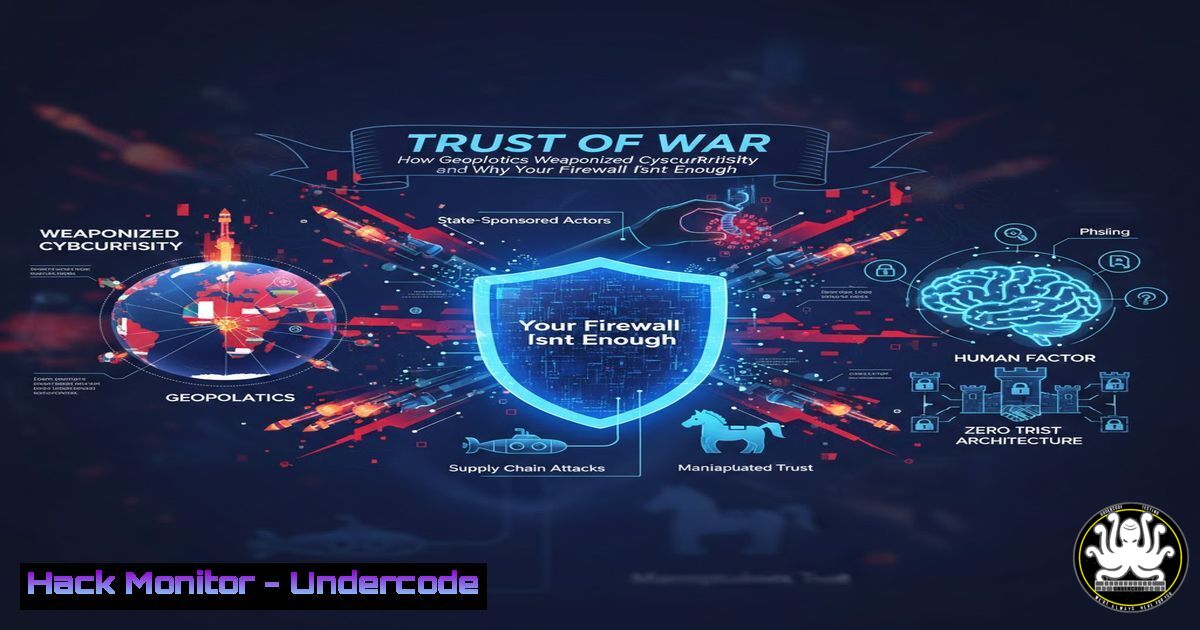
The global landscape has shifted from physical battlegrounds to a silent war where trust is the primary currency and weapon. This “Trust of War,” as coined by geopolitical analysts, redefines national security not through military might alone, but through control over technology standards, data flows, and critical digital infrastructure. For cybersecurity professionals, this means the threat model has expanded to include supply chain compromises, normative subversion, and state-level coercion baked into the very technologies we depend on.
Learning Objectives:
- Understand how geopolitical “trust” calculations directly translate to technical vulnerabilities in software and hardware.
- Learn to identify and mitigate risks stemming from technological dependencies and supply chain architecture.
- Implement technical controls and audit processes that align with a “zero-trust” geopolitical stance.
You Should Know:
1. From Diplomatic Trust to Technical Zero-Trust Architecture
The geopolitical concept that “sharing a technology creates a vulnerability” has a direct technical corollary: the Zero-Trust security model. It operates on the principle of “never trust, always verify,” ensuring that no user, device, or network flow is implicitly trusted, regardless of its origin.
Step-by-step guide:
Step 1: Identify Critical Data & Assets: Map out where your most sensitive data resides. This is your “crown jewels” inventory that a state actor might target through a compromised partner.
Command (Linux): Use tools like `find` to locate sensitive file types: `find / -name “.key” -o -name “.pem” -o -name “.db” -type f 2>/dev/null`
Command (Windows – PowerShell): `Get-ChildItem -Path C:\ -Include .config, .pwd, .cred -Recurse -ErrorAction SilentlyContinue`
Step 2: Micro-segmentation: Instead of a flat network, create segmented zones. This limits lateral movement if a supplier’s VPN connection is compromised.
Tooling: Utilize cloud security groups (AWS VPC, Azure NSGs) or on-prem firewalls like `iptables` to enforce strict rules.
Example iptables rule to isolate a subnet: `iptables -A FORWARD -s 10.0.2.0/24 -d 10.0.1.0/24 -j DROP`
Step 3: Implement Strict Access Controls: Enforce Multi-Factor Authentication (MFA) universally and apply the principle of least privilege using Role-Based Access Control (RBAC).
2. Auditing Technological Dependencies and Supply Chain Risks
Geopolitical loyalty is expressed through technology stacks. Your organization’s use of a specific cloud provider, software library, or hardware manufacturer creates a “dependency,” which can be weaponized.
Step-by-step guide:
Step 1: Software Bill of Materials (SBOM): Generate an SBOM for all your applications to see every component you depend on.
Tool: Use `syft` or `trivy` to generate SBOMs.
Command: `syft your-application:latest -o cyclonedx-json > sbom.json`
Step 2: Vulnerability and Origin Scanning: Scan your SBOM and container images not just for CVEs, but also for the origins of components, flagging those from geopolitical adversaries.
Command (Grype): `grype sbom:sbom.json`
Process: Cross-reference component maintainers and corporate origins with your organization’s geopolitical risk assessment.
Step 3: Hardening Base Images: Use minimal, hardened OS images to reduce the attack surface.
Example: Use `docker-slim` to minify a fat container: `docker-slim build –http-probe your-application:latest`
3. Cloud Infrastructure as a Geopolitical Battleground
The post identifies cloud as a key “infrastructure of dependency.” Your data’s sovereignty and resilience are directly tied to the provider’s legal jurisdiction and physical data center locations.
Step-by-step guide:
Step 1: Enforce Data Encryption at Rest and in Transit:
AWS CLI (Encrypt S3 Bucket): `aws s3api put-bucket-encryption –bucket your-bucket –server-side-encryption-configuration ‘{“Rules”: [{“ApplyServerSideEncryptionByDefault”: {“SSEAlgorithm”: “AES256”}}]}’`
Azure CLI (Storage Account Encryption): `az storage account update –name
Step 2: Configure Logging for Anomaly Detection: Log all administrative actions to detect unauthorized access, potentially from a state-sponsored actor leveraging a legal loophole.
AWS CloudTrail: Ensure it is enabled and logged to an immutable, separate account.
Azure: Enable Azure Activity Log and Diagnostic Settings for all critical resources.
Step 3: Multi-Region Deployment for Resilience: Deploy critical workloads across regions in politically aligned blocs to mitigate the risk of a single jurisdiction being compromised.
- Securing the API: The New Frontier of Digital Influence
APIs are the connective tissue of modern digital ecosystems and a primary vector for exploiting “trust” between systems. An insecure API is a backdoor into your digital sovereignty.
Step-by-step guide:
Step 1: API Inventory and Security Testing: Discover all your APIs, including shadow IT.
Tool: Use `OWASP ZAP` or `APIsec` to scan for vulnerabilities.
Command (ZAP Baseline Scan): `zap-baseline.py -t https://your-api-endpoint.com`
Step 2: Implement Strong Authentication & Rate Limiting: Use OAuth 2.0 and enforce strict rate limiting to prevent data exfiltration.
Example (NGINX Rate Limiting):
limit_req_zone $binary_remote_addr zone=api:10m rate=10r/s;
location /api/ {
limit_req zone=api burst=20 nodelay;
proxy_pass http://api_backend;
}
Step 3: Validate and Sanitize All Inputs: Treat all API inputs as malicious. Use strict schema validation with tools like JSON Schema.
5. Proactive Threat Hunting for State-Level TTPs
Moving beyond passive defense, actively hunt for Tactics, Techniques, and Procedures (TTPs) associated with Advanced Persistent Threats (APTs) linked to geopolitical rivals.
Step-by-step guide:
Step 1: Leverage MITRE ATT&CK Framework: Map your security monitoring to known APT TTPs.
Step 2: Query for Lateral Movement: Hunt for signs of Pass-the-Hash or PsExec usage.
Command (Windows Event Log Query via PowerShell):
Get-WinEvent -FilterHashtable @{LogName='Security'; ID=4624, 4648} | Where-Object { $_.Properties[bash].Value -eq 3 } Check for Network Logon Type 3
Step 3: Analyze Network Traffic for C2 Beacons: Use tools like Wireshark or Zeek to look for periodic, low-level communications to unknown external IPs, a hallmark of a compromised system calling home.
What Undercode Say:
- Key Takeaway 1: Cybersecurity is no longer just an IT function; it is a core component of geopolitical risk management. The security controls you implement are a direct defense against national-level strategies to create technological dependence.
- Key Takeaway 2: The “Trust of War” mandates a shift from a perimeter-based defense to a resilience-focused posture. This involves assuming breach, rigorously auditing your supply chain, and architecting systems to withstand the coercion of a technology supplier.
The analysis reveals that the battleground has fundamentally changed. The most significant attacks may not be noisy data breaches but silent, strategic compromises of a technology standard or a critical open-source library, creating a backdoor for a nation-state for years to come. Defending against this requires a blend of deep technical skills and high-level strategic awareness, understanding that a line of code or a configuration file can be as consequential as a diplomatic treaty.
Prediction:
In the next 3-5 years, we will see a formalization of “Digital Alliances” and “Technological Blocs,” complete with shared security protocols and vetted supply chains. Cyber conflicts will escalate from data theft to the deliberate and overt degradation of critical infrastructure (e.g., power, water) during periods of geopolitical tension as a demonstration of power and a test of technological resilience. Organizations that fail to align their cybersecurity posture with this new reality will find themselves not just hacked, but strategically isolated and economically crippled by the very dependencies they failed to manage.
🎯Let’s Practice For Free:
IT/Security Reporter URL:
Reported By: Yoann Dufour – Hackers Feeds
Extra Hub: Undercode MoN
Basic Verification: Pass ✅


