Listen to this Post
Introduction:
For decades, the air gap has been the gold standard for securing the most sensitive systems—defense networks, nuclear facilities, and financial trading floors. The assumption was simple: no network connection means no data exfiltration. TrojPix, a novel electromagnetic (EM) covert-channel attack unveiled by researchers at Shandong University and Quan Cheng Laboratory, shatters that assumption. By manipulating on-screen pixels in ways invisible to the human eye, this user-mode malware turns an ordinary HDMI cable into a covert radio transmitter, exfiltrating sensitive data from air-gapped computers over distances of up to 208 meters—even through concrete walls—at a staggering 8.1 Mbps. This isn’t just another theoretical attack; it’s a fundamental challenge to the physics of isolation that forces a complete rethinking of how we secure our most critical assets.
Learning Objectives:
- Understand the technical mechanism behind TrojPix, including pixel-to-sample mapping and TMDS signaling exploitation.
- Assess the operational impact of high-speed electromagnetic exfiltration on air-gapped and logically segregated environments.
- Identify practical mitigation strategies, including physical-layer controls, emissions monitoring, and supply chain countermeasures.
You Should Know:
- The Physics of the Leak: How TrojPix Turns Pixels into Radio Waves
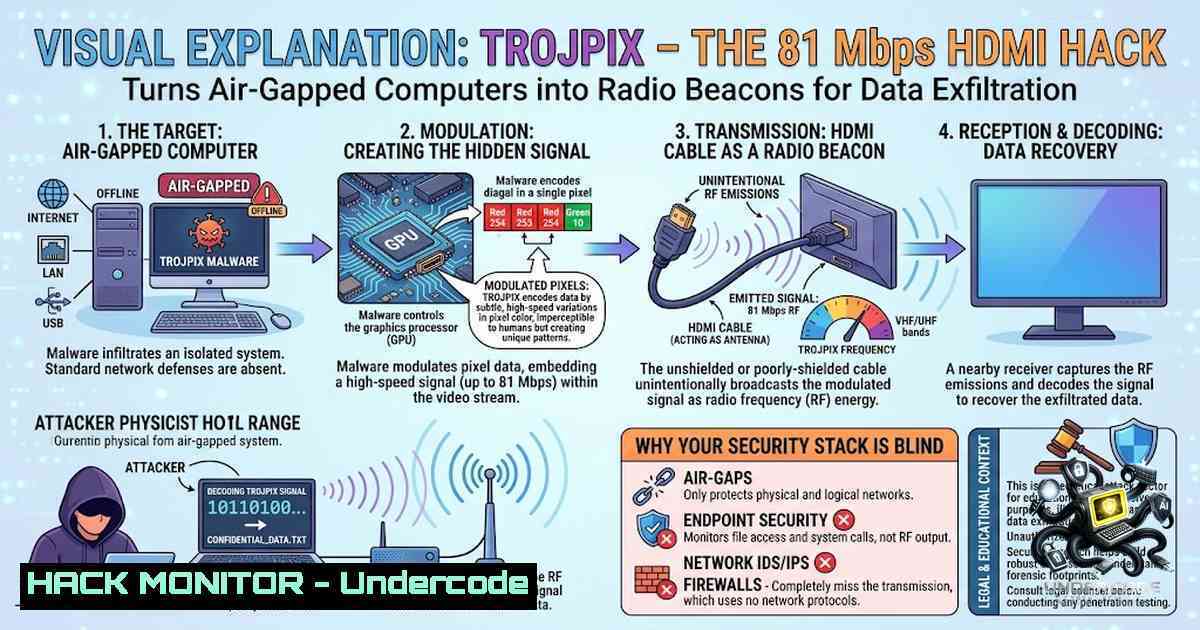
TrojPix exploits the fundamental physics of video transmission. When a computer sends an image to a monitor, it doesn’t transmit raw pixel data directly. Instead, it uses a protocol like TMDS (Transition Minimized Differential Signaling), which packs pixel data into a fixed pattern to ensure clean image delivery. This packing involves high-frequency electrical switching that naturally generates electromagnetic radiation. Normally, this radiation is just noise. TrojPix, however, takes control of this noise.
The malware, running as an ordinary user-mode program without requiring admin rights, modifies the least significant bit (LSB) of the color values in each pixel. These changes are so subtle that they are imperceptible to the human eye—in tests, 50 people could not distinguish a leaking screen from a clean one. However, these tiny alterations change the radio frequency emissions emanating from the video cable. By carefully synchronizing these pixel modifications with the sampling rate of an attacker’s receiver—a technique called “Pixel-to-Sample Mapping”—the malware ensures that each change translates into a clean, readable data bit on the other end. The cable effectively becomes a radio transmitter, and the screen, to the naked eye, looks completely normal.
This attack can operate in two modes. One mode makes the screen appear switched off while data streams out, stopping the moment the mouse moves to avoid detection. The other hides the signal within a seemingly innocuous image displayed on the screen. Either way, the data exfiltration is silent, invisible, and requires no specialized hardware on the victim’s side.
- The Speed of Exfiltration: Why 8.1 Mbps Changes the Game
Prior EM-based covert channels, such as AirHopper, GSMem, and BitWhisper, achieved speeds of only bits or kilobits per second. The previous best in this class topped out around 300 kilobits per second. TrojPix achieves 8.1 Mbps—a 27-fold increase. At this speed, a 100 MB file can be exfiltrated in under two minutes. The attack has been validated across nine monitor brands and fifteen different cables, demonstrating its broad applicability. Furthermore, the signal can penetrate a 30 cm concrete wall with minimal degradation, with accuracy dropping only from 99.96% to 99.14%.
This speed is not just an incremental improvement; it’s a paradigm shift. Slow exfiltration channels gave defenders a window of opportunity—dwell time—during which other controls like physical sweeps or endpoint anomaly detection might catch the intrusion. At 8.1 Mbps, the exfiltration completes before an incident response team can finish triaging the initial malware alerts. The attack is fast, long-range, and operates on a channel that traditional security tools simply cannot see.
- Why Your Security Stack Is Blind: The Visibility Gap
TrojPix is a data-exfiltration channel, not an initial compromise vector. It requires malware to already be running on the target machine. However, this is a condition that ransomware crews, insiders, and supply-chain compromises achieve every day. The critical issue is what happens after the compromise. None of your EDR, NDR, DLP, or SIEM correlation rules are watching this channel. The data never touches a network interface card, never generates a DNS query or TLS handshake. It leaves as radio waves from a cable that was never a network interface, decoded by a receiver that was never on your network.
This creates a profound visibility gap. Traditional security models assume that if data can’t leave over the wire, it can’t leave. TrojPix demonstrates that this assumption is dangerously flawed. The attack exploits the physical infrastructure of the system itself, turning a standard component into an unintended side-channel. Defenders are left blind to the most critical phase of the attack: the actual theft of data.
- Mitigation Strategies: Patching Physics Is Not an Option
You cannot patch this away. Copper carries current, current gives off radio, and that is physics. The fixes that work are physical and procedural, requiring a shift from compliance-driven security to engineering-driven security.
- Physical Layer Controls: The most effective mitigation is to restrict physical access to air-gapped systems. This includes implementing strict access controls to the physical rooms housing these systems and conducting regular physical sweeps for unauthorized radio receivers.
- Emissions Monitoring: Deploy RF monitoring equipment to detect anomalous electromagnetic emissions in secure facilities. This is analogous to network intrusion detection but for the physical layer.
- Cable and Peripheral Hardening: Use shorter, higher-quality shielded video cables to reduce unintentional radiation. Some organizations may consider using fiber-optic video extenders, which do not conduct electricity and therefore do not emit the same type of RF signals.
- Operational Procedures: Implement strict policies for screen usage. For instance, screensavers should be enabled, and systems should be configured to blank the screen when not in active use to prevent the “screen-off” exfiltration mode.
- Supply Chain Security: Since TrojPix requires malware to be present on the system, robust supply chain security and endpoint protection remain critical. This includes application whitelisting, regular vulnerability scanning, and strict controls on software installation.
- A Broader Lesson for the Enterprise: It’s Not Just About Air Gaps
It’s easy to dismiss TrojPix as a problem only for intelligence agencies or nuclear facilities. However, the real boundary it exposes is between “assumed contained” and “actually monitored”. This describes a significant portion of the average enterprise: PCI-segmented cardholder environments, trading floors, hospital networks, and defense contractor enclaves. Even logically separated VLANs, which are not routed to the internet, operate under the assumption that if data can’t leave over the wire, it can’t leave.
TrojPix forces a re-evaluation of what “isolation” truly means. It’s not a one-time architectural decision but a continuously verified property. Every system has monitors and video cables, and every system operates under the assumption that the physical layer is secure. TrojPix proves that this assumption is no longer valid. The attack is a stark reminder that security must be holistic, encompassing not just the logical network but the physical emissions of the hardware itself.
What Undercode Say:
- Key Takeaway 1: TrojPix demonstrates that air-gapped systems are not immune to data exfiltration. The attack exploits the physics of video transmission to create a high-speed, long-range covert channel that is invisible to traditional security controls. This forces a fundamental rethinking of how we secure our most sensitive assets.
- Key Takeaway 2: The speed of TrojPix (8.1 Mbps) is a game-changer. It collapses the dwell time that defenders previously relied on to detect and respond to intrusions, turning slow, noisy exfiltration into a fast, silent data heist.
Analysis: TrojPix is not just a technical curiosity; it’s a wake-up call for the entire cybersecurity industry. It highlights the growing gap between our logical security controls and the physical reality of the systems we are trying to protect. For years, we have focused on securing networks, endpoints, and applications, often neglecting the electromagnetic emissions that are an inherent byproduct of any electronic device. TrojPix shows that attackers are now exploiting this gap with devastating efficiency. The challenge for defenders is to bridge this gap, integrating physical-layer monitoring and controls into their security architectures. This requires a shift in mindset from “air gap as a compliance checkbox” to “air gap as a continuously verified engineering property.” Organizations must start treating every piece of active silicon as a potential leak source and implement defenses that account for the physics of their infrastructure, not just the logic of their networks.
Prediction:
- -1: In the short term, TrojPix will severely undermine trust in air-gapped systems, forcing organizations to invest heavily in physical-layer monitoring and controls that are currently expensive and difficult to implement at scale.
- +1: The research will accelerate the development of new defensive technologies, including advanced RF monitoring systems and physically secure cable designs, creating a new market for “physics-aware” security solutions.
- -1: The attack will be rapidly adopted by sophisticated adversaries, leading to a wave of high-profile data breaches in sectors that rely heavily on air-gapped networks, such as defense, finance, and critical infrastructure.
- +1: TrojPix will serve as a catalyst for a broader industry conversation about the need for a more holistic approach to security that bridges the gap between logical and physical controls, ultimately leading to more resilient systems.
▶️ Related Video (60% Match):
🎯Let’s Practice For Free:
🎓 Live Courses & Certifications:
Join Undercode Academy for Verified Certifications
🚀 Request a Custom Project:
Secure, high-velocity infrastructure and disruptive technological engineering. Contact our engineering team for high-tier development and proprietary systems:
[email protected]
💎 Smart Architecture | 🛡️ Secure by Design | ⭐ Trusted by Thousands
IT/Security Reporter URL:
Reported By: Chandrakant Kumar – Hackers Feeds
Extra Hub: Undercode MoN
Basic Verification: Pass ✅


