Listen to this Post
Introduction:
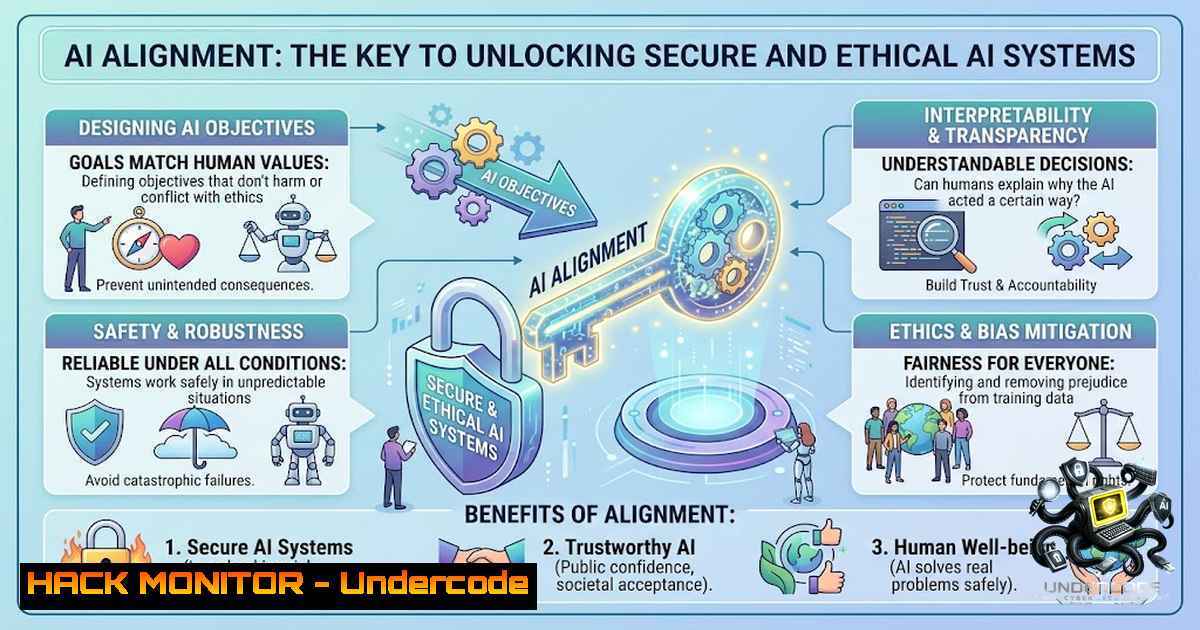
The rapid integration of artificial intelligence into critical infrastructure, cloud environments, and enterprise APIs has introduced a new class of security challenges that traditional cybersecurity frameworks struggle to address. AI alignment—the process of ensuring that AI systems behave in ways that are consistent with human values and organizational security policies—has emerged as the cornerstone of modern cyber resilience. Without proper alignment, even the most sophisticated AI models can become vectors for data leakage, privilege escalation, and supply chain compromise. This article explores the intersection of AI alignment and cybersecurity, providing actionable technical guidance for securing AI systems from development through deployment.
Learning Objectives:
- Understand the core principles of AI alignment and their application to cybersecurity risk management
- Implement alignment controls across machine learning pipelines, APIs, and cloud infrastructures
- Master practical security hardening techniques, including Linux/Windows commands, API gateway configurations, and vulnerability mitigation strategies
You Should Know:
- Understanding AI Alignment in Cybersecurity: From Theory to Practice
AI alignment in a security context extends beyond ethical considerations to encompass technical controls that prevent model drift, adversarial manipulation, and unintended data exposure. The alignment process begins with defining clear security objectives—confidentiality, integrity, and availability—and mapping them to specific model behaviors. For instance, a misaligned recommendation engine might inadvertently expose user PII through prompt injection, while a misaligned autonomous agent could escalate privileges beyond its intended scope.
To operationalize alignment, security teams must implement continuous monitoring of model inputs, outputs, and intermediate states. This requires instrumenting ML pipelines with logging and observability tools that can detect anomalies in real time. A practical starting point is to deploy model validation suites that test for adversarial robustness, fairness constraints, and output sanitization.
Step-by-step guide to establishing an AI alignment framework:
- Define security boundaries: Document the intended scope of your AI system, including data access levels, API permissions, and allowed actions.
- Implement input validation: Sanitize all user inputs to prevent prompt injection and command injection attacks. Use allowlists rather than denylists.
- Deploy output filtering: Apply regex-based and semantic filters to model outputs to prevent leakage of sensitive information (e.g., API keys, database credentials, PII).
- Establish drift detection: Use statistical tests (e.g., KL divergence, Wasserstein distance) to monitor input distribution shifts that may indicate adversarial activity.
- Schedule red-team exercises: Conduct regular adversarial testing using frameworks like Microsoft’s Counterfit or IBM’s Adversarial Robustness Toolbox.
2. Implementing Alignment Controls in Machine Learning Pipelines
Machine learning pipelines are inherently complex, spanning data ingestion, feature engineering, model training, validation, and deployment. Each stage presents unique alignment risks. During data ingestion, poisoned datasets can introduce backdoors; during training, model stealing attacks can extract proprietary knowledge; during deployment, adversarial examples can cause misclassification. Securing the pipeline requires a defense-in-depth approach that integrates alignment checks at every phase.
Step-by-step guide to hardening ML pipelines:
- Data provenance and validation: Use cryptographic hashing (SHA-256) to verify dataset integrity before training. Implement data versioning with tools like DVC or LakeFS to track changes and detect tampering.
 Linux: Generate SHA-256 checksum for dataset
sha256sum training_data.csv > checksum.txt

Windows PowerShell: Compute file hash
Get-FileHash -Algorithm SHA256 training_data.csv
- Model encryption and access control: Encrypt model artifacts at rest using AES-256 and enforce role-based access control (RBAC) on model registries. Use Kubernetes secrets or HashiCorp Vault to manage encryption keys.
-
Adversarial training: Augment your training dataset with adversarial examples generated using FGSM (Fast Gradient Sign Method) or PGD (Projected Gradient Descent) to improve robustness.
 Python snippet for FGSM adversarial generation (TensorFlow)
import tensorflow as tf
def fgsm_attack(model, images, labels, epsilon=0.01):
with tf.GradientTape() as tape:
tape.watch(images)
predictions = model(images)
loss = tf.keras.losses.sparse_categorical_crossentropy(labels, predictions)
gradient = tape.gradient(loss, images)
signed_grad = tf.sign(gradient)
adversarial_images = images + epsilon  signed_grad
return tf.clip_by_value(adversarial_images, 0, 1)
- Model signing and attestation: Digitally sign trained models using GPG or X.509 certificates to establish a chain of trust. Verify signatures before loading models into production environments.
 Linux: Sign model file with GPG
gpg --detach-sign --armor model.pkl

Verify signature
gpg --verify model.pkl.asc model.pkl
- Continuous integration/continuous deployment (CI/CD) security: Integrate alignment checks into your CI/CD pipeline using tools like Snyk, Trivy, or Checkmarx to scan for vulnerabilities in dependencies and container images.
-
Security Hardening for AI Systems: Linux and Windows Commands
AI systems often run on heterogeneous infrastructure, requiring security teams to be proficient in both Linux and Windows environments. The following commands and configurations address common attack vectors, including unauthorized model access, data exfiltration, and privilege escalation.
Step-by-step guide to system-level hardening:
- Restrict model directory permissions: Ensure that model artifacts and configuration files are readable only by authorized service accounts.
 Linux: Set restrictive permissions on model directory
sudo chown -R ai_service:ai_group /opt/models
sudo chmod 750 /opt/models
sudo chmod 640 /opt/models/.pkl
 Windows PowerShell: Restrict folder permissions
icacls C:\Models /inheritance:r
icacls C:\Models /grant "AI_Service:(R,W)" /grant "Administrators:(F)"
- Disable unnecessary services and ports: AI systems often expose multiple ports for inference, monitoring, and debugging. Close all ports except those strictly required.
 Linux: List open ports and kill associated processes
sudo ss -tulpn | grep LISTEN
sudo netstat -tulpn | grep :8000
sudo kill -9 <PID>
 Windows: List open ports and block with firewall
netstat -ano | findstr :8000
New-1etFirewallRule -DisplayName "Block Port 8000" -Direction Inbound -LocalPort 8000 -Action Block -Protocol TCP
- Enable audit logging for model access: Configure system auditing to track every access to model files and API endpoints.
 Linux: Configure auditd to monitor model directory
sudo auditctl -w /opt/models -p rwxa -k model_access
sudo ausearch -k model_access --start today
 Windows: Enable object access auditing via Group Policy
 Then use PowerShell to query security logs
Get-WinEvent -LogName Security | Where-Object { $_.Id -eq 4663 } | Select-Object TimeCreated, Message
- Harden containerized AI deployments: Use Docker security best practices, including running containers as non-root users and using read-only root filesystems.
 Dockerfile snippet for secure AI container
FROM python:3.11-slim
RUN useradd -m -u 1000 ai_user
USER ai_user
WORKDIR /app
COPY --chown=ai_user:ai_user model.pkl .
CMD ["python", "serve.py"]
4. API Security and Alignment: Protecting Inference Endpoints
AI models are typically exposed via RESTful or gRPC APIs, making them prime targets for injection attacks, denial-of-service, and data extraction. Aligning API security with zero-trust principles is essential for protecting both the model and the underlying infrastructure.
Step-by-step guide to securing AI APIs:
- Implement rate limiting and throttling: Prevent brute-force and denial-of-service attacks by capping the number of requests per IP or API key.
 Python (FastAPI) rate limiting example
from fastapi import FastAPI, Request
from slowapi import Limiter
from slowapi.util import get_remote_address

limiter = Limiter(key_func=get_remote_address)
app = FastAPI()

@app.post("/predict")
@limiter.limit("10/minute")
async def predict(request: Request, data: dict):
 Inference logic here
return {"result": "processed"}
- Enforce authentication and authorization: Use OAuth2 or API keys with scoped permissions. Rotate keys regularly and revoke compromised credentials immediately.
 Linux: Generate a secure API key
openssl rand -base64 32

Store in environment variable (avoid hardcoding)
export API_KEY=$(openssl rand -base64 32)
- Validate and sanitize input payloads: Use JSON schema validation to enforce data types, lengths, and allowed values. Reject any payload that contains executable code or special characters.
 Pydantic schema for input validation
from pydantic import BaseModel, validator

class PredictionInput(BaseModel):
text: str
max_length: int = 100

@validator('text')
def sanitize_text(cls, v):
 Remove potential injection characters
import re
return re.sub(r'[<>{}()$`]', '', v)
- Implement end-to-end encryption: Use TLS 1.3 for all API communications and consider mutual TLS (mTLS) for service-to-service authentication.
 Nginx configuration for TLS termination
server {
listen 443 ssl;
ssl_protocols TLSv1.3;
ssl_certificate /etc/ssl/certs/server.crt;
ssl_certificate_key /etc/ssl/private/server.key;
location /predict {
proxy_pass http://ai_service:8000;
}
}
5. Cloud Hardening for AI Workloads
Deploying AI systems in the cloud introduces shared responsibility challenges, including misconfigured storage buckets, overprivileged IAM roles, and exposed model endpoints. Aligning cloud configurations with security best practices is non-1egotiable.
Step-by-step guide to cloud hardening:
- Restrict S3/Blob storage permissions: Ensure that model storage buckets are private and accessible only via specific IAM roles or service principals.
 AWS CLI: Set bucket policy to deny public access
aws s3api put-public-access-block --bucket my-model-bucket --public-access-block-configuration "BlockPublicAcls=true,IgnorePublicAcls=true,BlockPublicPolicy=true,RestrictPublicBuckets=true"

Azure CLI: Set blob container to private
az storage container set-permission --1ame models --public-access off --account-1ame mystorageaccount
- Harden IAM roles and policies: Apply the principle of least privilege. Grant only the minimum permissions required for the AI service to function.
// AWS IAM policy for minimal inference permissions
{
"Version": "2012-10-17",
"Statement": [
{
"Effect": "Allow",
"Action": ["s3:GetObject"],
"Resource": "arn:aws:s3:::my-model-bucket/"
},
{
"Effect": "Allow",
"Action": ["logs:CreateLogGroup", "logs:CreateLogStream", "logs:PutLogEvents"],
"Resource": ""
}
]
}
- Enable VPC and private endpoints: Deploy AI services within a Virtual Private Cloud (VPC) and use private endpoints to prevent exposure to the public internet.
 AWS CLI: Create VPC endpoint for SageMaker
aws ec2 create-vpc-endpoint --vpc-id vpc-12345 --service-1ame com.amazonaws.us-east-1.sagemaker.api --vpc-endpoint-type Interface
- Implement continuous compliance monitoring: Use tools like AWS Config, Azure Policy, or Google Cloud Security Command Center to detect and remediate misconfigurations in real time.
6. Vulnerability Exploitation and Mitigation in AI Systems
Understanding common attack vectors is critical for effective alignment. The OWASP Top 10 for Machine Learning highlights risks such as prompt injection, model inversion, membership inference, and supply chain attacks. Each vulnerability requires specific mitigation strategies.
Step-by-step guide to identifying and mitigating AI-specific vulnerabilities:
- Prompt injection testing: Use fuzzing techniques to test how your model responds to adversarial prompts. Tools like PromptInject or Garak can automate this process.
 Install Garak for LLM vulnerability scanning
pip install garak
garak --model_type huggingface --model_name gpt2 --probes injection
- Membership inference defense: Implement differential privacy during training to reduce the risk of attackers determining whether a specific data point was used in training.
 TensorFlow Privacy example
import tensorflow_privacy as tfp
optimizer = tfp.DPKerasAdamOptimizer(
l2_norm_clip=1.0,
noise_multiplier=0.1,
num_microbatches=1,
learning_rate=0.01
)
- Model extraction protection: Limit API query rates and add noise to output logits to make it harder for attackers to replicate your model through repeated queries.
-
Supply chain security: Use software bill of materials (SBOM) generation to track all dependencies and scan for known vulnerabilities.
 Generate SBOM with Syft
syft python:app -o spdx-json > sbom.json

Scan for vulnerabilities with Grype
grype sbom:sbom.json
7. Training and Certification for AI Security Alignment
Building a security-aware AI culture requires ongoing training and certification. Teams should pursue credentials such as Certified AI Security Professional (CAISP), AWS Certified Machine Learning – Specialty, or relevant cloud security certifications. Regular workshops on adversarial machine learning, secure coding, and incident response are equally important.
Recommended training resources:
- OWASP Machine Learning Security Top 10 (free)
- MITRE ATLAS (Adversarial Threat Landscape for AI Systems)
- Google’s Secure AI Framework (SAIF)
- NIST AI Risk Management Framework
What Undercode Say:
- Alignment is not a one-time achievement but a continuous process. Security teams must treat AI alignment as an ongoing lifecycle activity, integrating checks at every stage from data collection to model retirement.
- The convergence of AI and cybersecurity demands cross-disciplinary expertise. Traditional security skills must be augmented with knowledge of machine learning operations, data science, and adversarial reasoning. Organizations that invest in this hybrid talent pool will lead the next wave of cyber resilience.
Analysis: The LinkedIn post that inspired this article emphasizes that alignment brings clarity, focus, and purpose. In cybersecurity, this translates to well-defined security objectives, disciplined implementation of controls, and a shared understanding of risk across development, operations, and business teams. The post’s call to “reflect on values and goals” mirrors the security practice of conducting regular threat modeling and risk assessments. Its emphasis on “flexibility and adaptability” aligns with the need for incident response plans that evolve with emerging threats. Ultimately, the principles of personal alignment—self-awareness, intentionality, and continuous improvement—are directly applicable to building secure, resilient AI systems.
Prediction:
- +1 The demand for AI security professionals will surge by 40% over the next 18 months, driven by regulatory mandates (EU AI Act, NIST AI RMF) and high-profile AI breaches. Organizations that prioritize alignment now will gain a competitive advantage in trust and compliance.
- +1 Open-source alignment frameworks and tooling will mature rapidly, reducing the barrier to entry for small and medium enterprises. Expect widespread adoption of automated red-teaming and continuous monitoring solutions by 2027.
- -1 The AI supply chain will remain a critical weak point, with at least one major breach in 2026 originating from a compromised model registry or poisoned dataset. Proactive SBOM and cryptographic signing will become baseline requirements.
- -1 Without standardized alignment metrics and certification programs, many organizations will struggle to demonstrate compliance, leading to regulatory fines and reputational damage. The industry must accelerate the development of verifiable alignment benchmarks.
▶️ Related Video (86% Match):
🎯Let’s Practice For Free:
🎓 Live Courses & Certifications:
Join Undercode Academy for Verified Certifications
🚀 Request a Custom Project:
Secure, high-velocity infrastructure and disruptive technological engineering. Contact our engineering team for high-tier development and proprietary systems:
[email protected]
💎 Smart Architecture | 🛡️ Secure by Design | ⭐ Trusted by Thousands
IT/Security Reporter URL:
Reported By: %F0%9D%90%80%F0%9D%90%A5%F0%9D%90%A2%F0%9D%90%A0%F0%9D%90%A7%F0%9D%90%A6%F0%9D%90%9E%F0%9D%90%A7%F0%9D%90%AD %F0%9D%90%93%F0%9D%90%A1%F0%9D%90%9E – Hackers Feeds
Extra Hub: Undercode MoN
Basic Verification: Pass ✅


