Listen to this Post
Introduction:
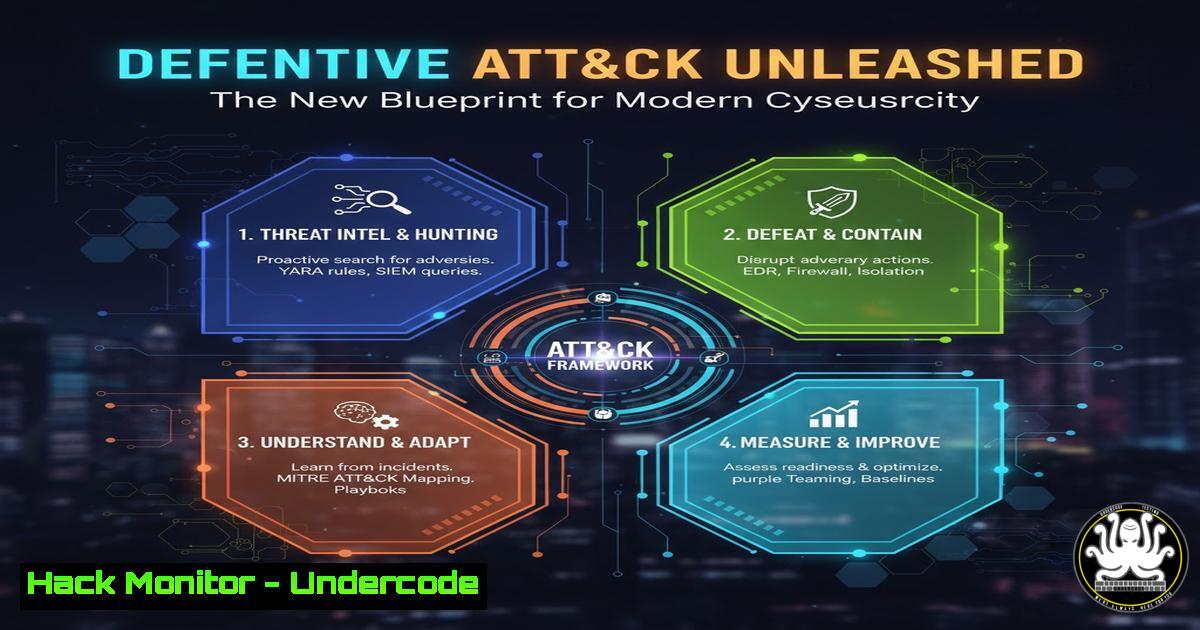
The cybersecurity landscape is shifting from a reactive to a proactive posture, and the recent unveiling of Defensive ATT&CK at ATT&CKcon 6.0 marks a pivotal moment in this evolution. This major update to the MITRE ATT&CK framework finally codifies the defender’s perspective, transforming high-level adversary behaviors into actionable detection logic. By bridging the gap between theoretical attack patterns and practical defensive engineering, it empowers security teams to build more resilient and threat-informed defenses.
Learning Objectives:
- Understand the core components and structure of the new Defensive ATT&CK framework.
- Learn how to translate Defensive ATT&CK data sources and detection objects into concrete SIEM queries and log analytics.
- Apply the framework to harden cloud environments, secure APIs, and engineer robust behavioral detections.
You Should Know:
1. Mapping Data Sources to Detection Rules
A core innovation of Defensive ATT&CK is its detailed data source mapping. Instead of a generic “process monitoring,” it specifies objects like `Process.command_line` and File.hash. Here’s how to leverage this in a SIEM.
Verified Command / Query:
// Azure Sentinel KQL Example: Detecting Suspicious Certificate Dumping
SecurityEvent
| where EventID == 4688
| where ProcessName contains "mimikatz"
or CommandLine contains "crypto::certificates"
| project TimeGenerated, Computer, SubjectUserName, CommandLine
Step-by-step guide:
This Kusto Query Language (KQL) rule detects potential credential access via certificate dumping, a technique often used by tools like Mimikatz. The query filters Windows Security Event Logs (Event ID 4688 for new processes) for the process name “mimikatz” or a command line containing a specific Mimikatz module command. It then projects the most relevant fields for an analyst to review. This directly implements a detection for a technique like T1552.004 - Unsecured Credentials: Private Keys.
2. Hunting for Persistence via Service Creation
Adversaries often establish persistence by creating new services. Defensive ATT&CK breaks down the `Windows Service` data source into actionable components.
Verified Command / Code Snippet:
 PowerShell Hunt: Discover Recently Created Services
Get-WmiObject -Class Win32_Service | Where-Object { $<em>.PathName -like "cmd" -or $</em>.PathName -like "powershell" -or $_.PathName -like "bitsadmin" } | Select-Object Name, State, PathName, StartMode, ProcessId
Step-by-step guide:
This PowerShell command queries the WMI `Win32_Service` class to find services whose executable path (PathName) contains command-line interpreters or suspicious utilities like bitsadmin. This is a common persistence mechanism. The command filters and displays the service name, its current state, the full path to the executable, its start mode, and its process ID for further investigation.
3. Cloud Hardening: Restricting S3 Bucket Policies
In cloud environments, misconfigured storage is a primary attack vector. Defensive ATT&CK encourages detections focused on configuration state.
Verified Command / Code Snippet:
 AWS CLI Command to Check for Public S3 Buckets
aws s3api list-buckets --query "Buckets[].Name" --output text | tr '\t' '\n' | while read bucket; do
echo "Checking $bucket";
aws s3api get-bucket-policy-status --bucket "$bucket" --output text;
done
Step-by-step guide:
This Bash script uses the AWS CLI to iterate through all S3 buckets in an account. For each bucket, it checks the policy status, which will indicate if the bucket is public. A result showing `POLICYSTATUS True` and `ISPUBLIC True` indicates a misconfigured, publicly writable bucket, which aligns with defensive guidance against data exposure techniques like T1530 - Data from Cloud Storage.
4. API Security: Detecting Anomalous Authentication Patterns
Defending APIs requires analyzing authentication logs for brute-force attacks or token theft.
Verified Command / Code Snippet:
// SQL Query for API Gateway Logs (Example)
SELECT source_ip, COUNT() as failed_attempts
FROM api_gateway_logs
WHERE http_method = 'POST'
AND status_code = 401
AND url LIKE '%/oauth/token%'
AND event_time > NOW() - INTERVAL '5' MINUTE
GROUP BY source_ip
HAVING COUNT() > 10;
Step-by-step guide:
This SQL-like query is designed for API gateway logs. It hunts for potential credential stuffing attacks by identifying source IP addresses that have generated more than 10 failed authentication attempts (HTTP 401) to an OAuth token endpoint within a 5-minute window. This operationalizes the detection of T1110 - Brute Force.
5. Linux Threat Mitigation: Auditing for Privilege Escalation
Linux persistence and privilege escalation often involve crontab or systemd service manipulation.
Verified Command / Code Snippet:
 Linux Audit Command: Check for World-Writable Scripts in Cron Jobs
for user in $(cut -f1 -d: /etc/passwd); do
sudo crontab -u $user -l 2>/dev/null | grep -v '^' | while read job; do
echo $job | awk '{print $6}' | xargs -I {} find {} -perm -o+w 2>/dev/null
done
done
Step-by-step guide:
This Bash script audits all user crontabs for a critical privilege escalation vulnerability. It lists every cron job for every user, extracts the command or script path (the 6th field in a cron job line), and then checks if that file is world-writable (-perm -o+w). If an adversary can modify a script that is run by root, they can easily escalate privileges, making this a crucial hardening check.
6. Vulnerability Exploitation & Mitigation: Logging Process Injection
Detecting exploitation attempts in real-time requires deep system monitoring. Defensive ATT&CK provides the context for what to log.
Verified Command / Code Snippet:
 Sysmon Configuration Snippet for Process Injection Detection (XML)
<RuleGroup name="" groupRelation="or">
<ProcessAccess onmatch="include">
<TargetImage condition="end with">lsass.exe</TargetImage>
<CallTrace condition="contains">C:\Windows\System32\kernel32.dll</CallTrace>
</ProcessAccess>
<CreateRemoteThread onmatch="include">
<TargetImage condition="end with">explorer.exe</TargetImage>
<StartFunction condition="begin with">0x</StartFunction>
</CreateRemoteThread>
</RuleGroup>
Step-by-step guide:
This XML snippet is for a Sysmon configuration file. It creates two powerful detections. The first rule logs any process that opens a handle to `lsass.exe` (a common precursor to credential dumping). The second rule detects the creation of a remote thread into a common process like explorer.exe, which is a classic technique for process injection (T1055). The `CallTrace` and `StartFunction` fields help filter out legitimate activity.
7. Network Security: Detecting Data Exfiltration over DNS
Data theft often occurs over covert channels like DNS, which are frequently allowed through firewalls.
Verified Command / Code Snippet:
 Python Snippet to Detect High DNS Query Volume (Conceptual)
from collections import defaultdict
 ... (log ingestion logic)
dns_logs = ingest_dns_logs()
query_count = defaultdict(int)
for log in dns_logs:
query_count[log['src_ip']] += 1
for ip, count in query_count.items():
if count > 1000:  Threshold
alert(f"Potential DNS Exfiltration from {ip}: {count} queries")
Step-by-step guide:
This conceptual Python code demonstrates a logic for detecting data exfiltration via DNS tunneling. It ingests DNS query logs, counts the number of queries per source IP address, and triggers an alert if a threshold (e.g., 1000 queries) is exceeded within a given timeframe. This is a foundational pattern for detecting T1048 - Exfiltration Over Alternative Protocol.
What Undercode Say:
- Key Takeaway 1: Defensive ATT&CK is a force multiplier for detection engineering, moving the community from discussing “what” attackers do to standardizing “how” we detect it.
- Key Takeaway 2: The framework’s real power lies in its granular data source definitions, which provide a common language and technical foundation for building high-fidelity alerts across on-premise, cloud, and hybrid environments.
The introduction of Defensive ATT&CK represents the maturation of the cybersecurity defense field. For years, defenders have been reverse-engineering the MITRE ATT&CK framework to build detections. This update flips the script, providing a vendor-agnostic, practitioner-driven blueprint for effective security monitoring. It directly addresses the “how” that has long been missing, promising to reduce the time-to-detection and level the playing field against sophisticated adversaries. By codifying defensive knowledge, it prevents teams from reinventing the wheel and allows them to focus on the unique threats to their environment.
Prediction:
The formalization of Defensive ATT&CK will catalyze a renaissance in automated detection engineering and AI-driven security operations within the next 2-3 years. We will see the emergence of security tools that can automatically generate and test detection rules based on the framework’s data source mappings. This will drastically reduce the mean time to detect (MTTD) for novel attack techniques, forcing adversaries to develop even more stealthy and complex tradecraft. Ultimately, Defensive ATT&CK will become the foundational language for measuring and benchmarking the efficacy of SOCs and security products worldwide.
🎯Let’s Practice For Free:
IT/Security Reporter URL:
Reported By: Lex Crumpton – Hackers Feeds
Extra Hub: Undercode MoN
Basic Verification: Pass ✅


