Listen to this Post
Introduction:
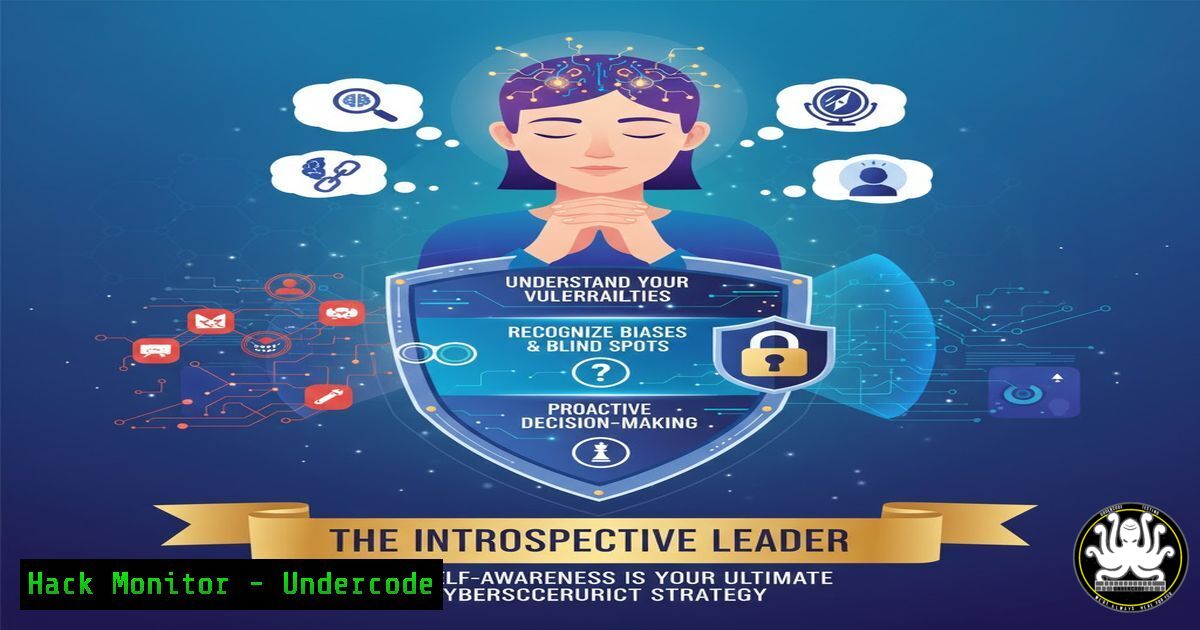
In an era of sophisticated social engineering and insider threats, the most critical vulnerability in any organization may not be a software flaw but a lack of self-awareness among its leaders. True cybersecurity resilience requires leaders who understand their own cognitive biases, emotional triggers, and communication blind spots to effectively foster a robust security culture and make sound decisions under pressure. This article reframes leadership introspection as a non-negotiable component of a modern defense-in-depth strategy.
Learning Objectives:
- Understand the direct link between executive self-awareness and organizational security posture.
- Learn technical controls that enforce accountability and mitigate risks stemming from human factors.
- Develop a framework for continuous self-assessment to improve security decision-making.
You Should Know:
- Auditing Your Own Digital Footprint and Administrative Actions
A leader’s lack of awareness about their own digital exposure can create attack vectors. Regularly audit your administrative actions and public footprint.
Verified Commands & Tutorials:
LinkedIn Privacy Check: Manually review your public profile via `View profile as…` to see what attackers can glean for social engineering.
PowerShell (Windows): Audit your own login history and executed commands.
 Get recent logon events for your account
Get-WinEvent -FilterHashtable @{LogName='Security'; ID=4624; Data='YOUR_USERNAME'} -MaxEvents 10 | Format-Table TimeCreated, ID, Message -Wrap

Get your own PowerShell command history
Get-History
Bash (Linux): Review your shell history and sudo commands.
 View your command history
history

Check your own sudo commands from the audit log
sudo grep $(whoami) /var/log/auth.log
Step-by-step guide:
Leaders must first understand their own digital trail. On LinkedIn, use the “View profile as…” feature to audit publicly available information that could be weaponized for spear-phishing. On your corporate system, use the provided PowerShell or Bash commands to review your recent authentication events and command history. This practice mirrors the principle of “least privilege” and “need-to-know” applied to oneself, ensuring you are conscious of your own actions and their visibility.
- Enforcing Principle of Least Privilege with Technical Controls
A self-aware leader recognizes the risk of over-privileged accounts, including their own. Implementing and adhering to the principle of least privilege is a direct technical manifestation of disciplined leadership.
Verified Commands & Tutorials:
PowerShell: Check your current group memberships and effective permissions.
 Check your current user's group memberships
whoami /groups

Check effective permissions on a specific directory
Get-Acl C:\SensitiveData | Format-List
Bash (Linux): Check your group memberships and sudo rights.
 Check your group memberships
groups

Check your sudo privileges
sudo -l
Azure CLI (Cloud): List your assigned roles in Azure.
 List role assignments for the currently signed-in user
az role assignment list --assignee $(az account show --query user.name -o tsv) --include-inherited --output table
Step-by-step guide:
Understanding your own privileges is the first step to reducing them. Regularly run the `whoami /groups` or `groups` command to see what access levels your account possesses. Use the Azure CLI command to audit your cloud permissions. A self-aware leader proactively works with IT to ensure their account has only the permissions absolutely necessary for their role, dramatically reducing the attack surface if their account is compromised.
3. Mitigating Human Error Through Automated Configuration Enforcement
Leadership self-discipline is reflected in the enforcement of automated, reproducible security configurations, removing the variability of human judgment from baseline security.
Verified Commands & Tutorials:
CIS Benchmarks: Apply CIS-CAT tools or equivalent to scan for compliance.
PowerShell Desired State Configuration (DSC): A configuration to ensure a critical security policy is enabled.
Configuration EnforceSecurityBaseline
{
Node 'localhost'
{
Registry 'DisableLMHash'
{
Ensure = 'Present'
Key = 'HKLM:\SYSTEM\CurrentControlSet\Control\Lsa'
ValueName = 'NoLMHash'
ValueType = 'Dword'
ValueData = '1'
}
}
}
EnforceSecurityBaseline
Ansible (Linux): A playbook to enforce a core security setting.
- name: Harden SSH configuration
hosts: all
become: yes
tasks:
- name: Disable SSH password authentication
lineinfile:
path: /etc/ssh/sshd_config
regexp: '^?PasswordAuthentication'
line: 'PasswordAuthentication no'
notify: restart ssh
handlers:
- name: restart ssh
systemd:
name: sshd
state: restarted
Step-by-step guide:
A leader’s commitment to consistency is automated through tools like DSC and Ansible. The provided PowerShell DSC script enforces a specific registry key to improve authentication security, while the Ansible playbook proactively disables SSH password authentication across all servers. By codifying security policies, leaders ensure their intent is executed precisely, mitigating risks introduced by manual, ad-hoc configuration.
4. Cognitive Bias Detection in Security Incident Response
A leader’s self-awareness must extend to recognizing their own cognitive biases—like confirmation bias or urgency bias—during a security incident, which can lead to flawed analysis and response.
Verified Commands & Tutorials:
SIEM Query (Splunk-like): Actively seek disconfirming evidence.
 Instead of just searching for confirmed IOCs, also look for related anomalies
index=main "suspicious_process.exe" OR (source="sysmon" process_name= ParentCommandLine="powershell")
| stats count by host, process_name, ParentCommandLine
| where count < 10  Find rare occurrences that might be related
YARA Rule: A rule to detect file-less attack patterns, challenging the bias of looking only for traditional malware.
rule Suspicious_Script_Execution_Pattern {
meta:
description = "Detects potential file-less execution via scripting hosts"
strings:
$a = "cmd.exe /c" nocase
$b = "powershell -ep bypass" nocase
$c = "wscript.shell" nocase
condition:
any of them and filesize < 200KB
}
Step-by-step guide:
During an incident, it’s natural to focus on evidence that confirms the initial hypothesis. To combat this, use broad SIEM queries that not only hunt for known indicators but also for anomalous parent-child process relationships, as shown. Similarly, deploying YARA rules that detect script-based attacks forces the team to look beyond conventional file-based malware. This technical process institutionalizes the practice of seeking disconfirming evidence.
- Cultivating a Just Culture with Secure Feedback Channels
A self-aware leader fosters psychological safety, which is critical for reporting security concerns. This requires providing secure, anonymous channels for feedback and incident reporting.
Verified Commands & Tutorials:
OpenSSH SCP/SFTP: Securely transfer files to a designated report server.
 Securely copy a file (e.g., a report) to a trusted server
scp -P 22 confidential_report.pdf [email protected]:/incoming_reports/
PGP Encryption: Encrypt a whistleblower report before submission.
 Encrypt a file for a specific recipient's public key
gpg --encrypt --recipient [email protected] report.txt
Simple HTTPS Form with Logging Bypass: Implement a static, client-side only reporting form that submits to a secure, external service like Signal or a hardened internal endpoint with minimal logging to protect anonymity.
Step-by-step guide:
Enable a “just culture” by providing technical means for safe reporting. Employees can use SCP to securely deposit sensitive information on a designated server. For maximum anonymity, instruct them on using GnuPG (GPG) to encrypt reports directly to the security team’s public key before submission via any channel. This demonstrates a leader’s awareness of the fear of reprisal and their technical commitment to mitigating it.
6. Continuous Security Posture Assessment with Self-Service Tools
An introspective leader doesn’t assume security is static but continuously seeks to understand the current posture. Empowering teams with self-service assessment tools decentralizes this awareness.
Verified Commands & Tutorials:
Nmap: Perform an authorized self-scan of your own systems to understand exposed services.
 Scan a specific target to see open ports from your perspective
nmap -sS -T4 -p- [bash]
Nikto: A simple web server vulnerability scanner.
 Basic scan of a web server
nikto -h http://yourserver.com
AWS Trusted Advisor (via CLI): Check for security best practices in your own AWS environment.
aws support describe-trusted-advisor-checks --language en
 Then use the check ID to get results
aws support describe-trusted-advisor-check-result --check-id <check_id_from_above>
Step-by-step guide:
Proactive leaders use tools like Nmap and Nikto (within authorized scope) to gain a firsthand view of their team’s external attack surface. Running an `nmap` scan reveals exactly what ports are open and services are listening. Similarly, using the AWS CLI to query Trusted Advisor checks provides a continuous, automated assessment of the cloud security posture, turning abstract concerns into concrete, actionable data.
What Undercode Say:
- Leadership’s Blind Spot is the Attacker’s Foothold. Failure to engage in honest self-assessment creates strategic-level vulnerabilities that no amount of technical control can fully compensate for. The commands and controls listed are meaningless if the leader cannot first command and control their own biases and assumptions.
- Technical Controls are an Extension of Leadership Discipline. Tools like DSC, Ansible, and privilege auditing are not just IT tasks; they are the material manifestation of a leader’s commitment to consistency, accountability, and humility. Codifying security is the ultimate act of acknowledging human fallibility.
The paradigm of cybersecurity leadership is shifting from purely technical proficiency to psychological and strategic acuity. The most secure organizations will be led by individuals who have the courage to confront their own digital footprints, cognitive biases, and privilege creep. The technical controls we implement are merely reflections of the internal controls we exercise. By starting with introspection, leaders can build a security culture that is not only compliant but also resilient, adaptive, and genuinely secure from the inside out.
Prediction:
The future of cybersecurity will see a convergence of leadership development and technical security training. Executive “cyber-self-awareness” audits will become as standard as network penetration tests. We will see the rise of AI-driven tools that analyze leader communication and decision-making patterns for cognitive biases that could lead to security failures, forcing a new level of accountability and transforming leadership introspection from a soft skill into a quantifiable, critical defense metric.
🎯Let’s Practice For Free:
IT/Security Reporter URL:
Reported By: Chris Lank – Hackers Feeds
Extra Hub: Undercode MoN
Basic Verification: Pass ✅


