
Listen to this Post
Introduction:
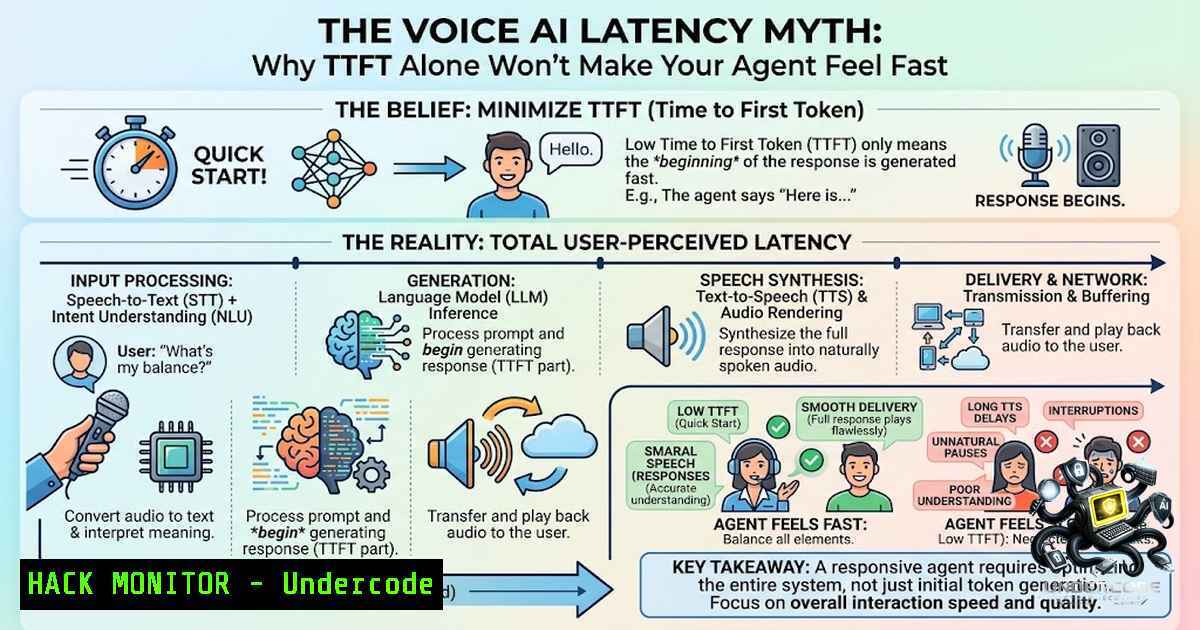
The benchmark race for inference APIs has long been dominated by Time to First Token (TTFT), a metric that measures the speed of initial response generation. However, for conversational voice agents, this focus creates a fundamental mismatch between lab-measured performance and real-world user experience. This article explores why TTFT is merely an entry point, not the finish line, and introduces Time-to-First-Sentence (TTFS) as the critical metric for building genuinely responsive voice-driven products.
Learning Objectives & Secrets:
- Objective 1: Understand the mechanical distinction between TTFT and TTFS, and why text-to-speech synthesis requires complete semantic units rather than partial tokens.
- Objective 2 Secret Tip: Optimize end-to-end voice latency by balancing four critical stages—STT, LLM inference, TTS, and network transport—rather than over-indexing on a single phase.
- Objective 3 Secret Tip: Implement practical measurement and monitoring techniques to diagnose which stage of your voice pipeline is the actual bottleneck for user-perceived slowness.
You Should Know:
- The TTFT/TTFS Breakdown: Why Completion Matters More Than Start
The core argument from the benchmark analysis is that TTFT measures only the interval between sending a request and receiving the first token back. While this works for standard chat applications where text streams are readable token-by-token, voice agents operate differently. Text-to-speech models cannot synthesize half a word; they require a complete clause or sentence to produce coherent audio. This is where Time-to-First-Sentence (TTFS) becomes the metric users actually feel, as demonstrated in LiveKit’s deployment analysis of Gemma 4. TTFT controls when generation begins, but tokens per second governs how quickly that crucial first sentence completes. A provider excelling at TTFT but lagging in token throughput will still feel slow.
To measure this on your own system, you can use the following Python script to simulate and log both TTFT and TTFS:
import time
import requests

def measure_ttft_ttfs(endpoint, payload):
start = time.time()
response = requests.post(endpoint, json=payload, stream=True)
ttft = None
first_sentence_complete = False
buffer = ""
for chunk in response.iter_content(chunk_size=128):
if ttft is None:
ttft = (time.time() - start)  1000
buffer += chunk.decode('utf-8', errors='ignore')
if '. ' in buffer or '? ' in buffer or '! ' in buffer:
if not first_sentence_complete:
ttfs = (time.time() - start)  1000
first_sentence_complete = True
break
return ttft, ttfs
- The Real Latency Budget: Deconstructing the 700ms–1.2s Target
For a single voice turn, the cost structure is unforgiving. Industry analysis divides the budget into four primary stages:
– Speech-to-Text (STT): ~100-200ms
– LLM Inference: ~300-500ms (with streaming)
– Text-to-Speech (TTS): ~100-200ms
– Network Overhead: ~50-150ms (WebRTC)
The practical end-to-end target lands between 700ms and 1.2 seconds. Kwindla Hultman Kramer, co-creator of the Pipecat voice framework, advises teams to target an 800ms median, with 1,500ms considered the acceptable ceiling for proof-of-concept work. His recommended split allocates roughly 200ms to each of the four critical components: transport and media processing, STT plus phrase endpointing, LLM inference, and TTS synthesis.
To benchmark each stage individually, use these Linux commands to measure network latency to your API endpoints:
 Measure network latency to your inference endpoint
ping -c 10 api.your-llm-provider.com

Trace the route to identify network hops
traceroute api.your-llm-provider.com

Use mtr for a combined ping/traceroute analysis
mtr -r -c 10 api.your-llm-provider.com
For Windows, use:
 Ping test
ping -1 10 api.your-llm-provider.com

Traceroute equivalent
tracert api.your-llm-provider.com

PathPing for combined analysis
pathping -1 api.your-llm-provider.com
3. Practical Optimization Strategies for Each Stage
Given the latency budget, here are actionable optimization strategies:
STT Optimization: Use phrase endpointing to detect when a user has finished speaking, rather than waiting for a fixed silence duration. Configure your STT provider to use dynamic silence thresholds. For Deepgram or AssemblyAI, you can set endpointing parameters:
{
"endpointing": true,
"endpointing_silence_timeout": 500,
"punctuate": true
}
LLM Inference Optimization: Prioritize providers with high tokens-per-second (TPS) throughput, as this directly impacts TTFS. Use speculative decoding or prompt caching where available. For OpenAI-compatible APIs, you can benchmark TPS with:
import time
import openai

def benchmark_tps(client, prompt, max_tokens=100):
start = time.time()
response = client.completions.create(
model="gpt-3.5-turbo-instruct",
prompt=prompt,
max_tokens=max_tokens,
stream=True
)
token_count = 0
for chunk in response:
token_count += len(chunk.choices[bash].text)
elapsed = time.time() - start
tps = token_count / elapsed
return tps
TTS Optimization: Use neural TTS models that can synthesize speech from the first complete sentence without waiting for the full response. Services like ElevenLabs or Azure TTS offer low-latency streaming modes. Ensure your TTS endpoint is geographically close to your users.
Network Optimization: Use WebRTC with ICE candidates optimized for low-latency paths. Implement client-side jitter buffers and forward error correction to handle packet loss without introducing delay.
4. API Selection Framework: Beyond the Single-Metric Race
The benchmark analysis reveals that the conventional single-metric race is fundamentally misleading. When evaluating voice stack vendors, consider these criteria:
- TTFT: Should be under 200ms for a good score, but not the deciding factor.
- Token Throughput: Minimum of 50 tokens/second to ensure TTFS under 500ms for a 20-token sentence.
- TTS Synthesis Efficiency: The time from receiving the final token to producing the first audio frame should be under 150ms.
- Global Edge Deployment: Providers with CDN or edge locations reduce network overhead.
To run a comprehensive benchmark, use the following script to simulate a multi-provider test:
!/bin/bash
 Run concurrent load tests on multiple endpoints
for endpoint in $ENDPOINTS; do
hey -1 100 -c 10 -m POST -H "Content-Type: application/json" -d '{"prompt": "What is the weather today?"}' $endpoint &
done
wait
5. Tools and Monitoring for Voice Latency
Implement continuous monitoring of your voice pipeline using tools like Datadog or Prometheus. Track these custom metrics:
– voice.ttft_ms: Time to first token
– voice.ttfs_ms: Time to first complete sentence
– voice.p50_ttfs, voice.p95_ttfs: Percentile distributions
– voice.stt_processing_ms, voice.llm_ttft_ms, voice.tts_synthesis_ms: Per-stage breakdowns
For local simulation of voice latency, use the Linux `tc` command to emulate network conditions:
 Add 100ms latency to your interface
sudo tc qdisc add dev eth0 root netem delay 100ms

Remove the rule
sudo tc qdisc del dev eth0 root netem

Simulate packet loss
sudo tc qdisc add dev eth0 root netem loss 5%
On Windows, use the `netsh` command for similar simulations:
 Add latency (requires administrative privileges)
netsh interface ipv4 set subinterface "Ethernet" mtu=1500 store=active
 For more complex simulations, use tools like Clumsy or WANem
6. Future-Proofing with TTFS as a Standard
As the industry moves toward more sophisticated voice agents, TTFS is likely to become the de facto benchmark for user-perceived performance. Developers should already be designing their evaluation pipelines around TTFS and end-to-end latency, rather than TTFT alone. This means testing with realistic voice interaction patterns—including interruptions, back-channeling, and multi-turn conversations—not just single-turn prompts.
What Undercode Say:
- Key Takeaway 1: TTFT is an essential metric to measure, but it should never be the only one that matters when designing voice-driven products. The distinction between when a model starts generating and when it can actually speak is what separates a conversational agent from a frustrating one.
- Key Takeaway 2: The latency budget is a holistic sum; optimizing a single stage at the expense of others yields diminishing returns. The winning provider must balance TTFT against token throughput and TTS synthesis efficiency to deliver the sub-second conversational experience that modern users expect.
The analysis further highlights that the competitive implications are profound: teams selecting inference APIs based purely on TTFT are optimizing for a performance characteristic that does not translate directly into user-perceived quality. As the benchmark rightly concludes, the evaluation framework must be holistic, considering the entire pipeline from speech input to audio output. The future of voice AI will belong not to the provider with the fastest first token, but to the one that delivers the fastest first spoken sentence.
Prediction:
- +1: The adoption of TTFS as a standard will drive innovation in TTS and streaming inference, leading to more natural and responsive voice agents across industries, from customer service to healthcare.
- +1: Open-source frameworks like Pipecat will accelerate experimentation, enabling smaller teams to achieve enterprise-grade voice latency through modular optimization.
- +1: The next generation of voice APIs will likely offer unified latency SLAs covering TTFT, TTFS, and token throughput, simplifying vendor selection for developers.
- -1: Providers that continue to market based solely on TTFT may face backlash as developers become more sophisticated and demand real-world performance metrics.
- -1: The added complexity of multi-metric optimization could increase the barrier to entry for startups, potentially consolidating the voice AI market around a few major providers.
- +1: Improved latency metrics will unlock new use cases, such as real-time language translation and interactive voice-based gaming, expanding the total addressable market for voice AI.
▶️ Related Video (80% Match):
🎯Let’s Practice For Free:
🎓 Live Courses & Certifications:
Join Undercode Academy for Verified Certifications
🚀 Request a Custom Project:
Secure, high-velocity infrastructure and disruptive technological engineering. Contact our engineering team for high-tier development and proprietary systems:
[email protected]
💎 Smart Architecture | 🛡️ Secure by Design | ⭐ Trusted by Thousands
IT/Security Reporter URL:
Reported By: https://lnkd.in/p/eHQbafHw – Hackers Feeds
Extra Hub: Undercode MoN
Basic Verification: Pass ✅


