
Listen to this Post
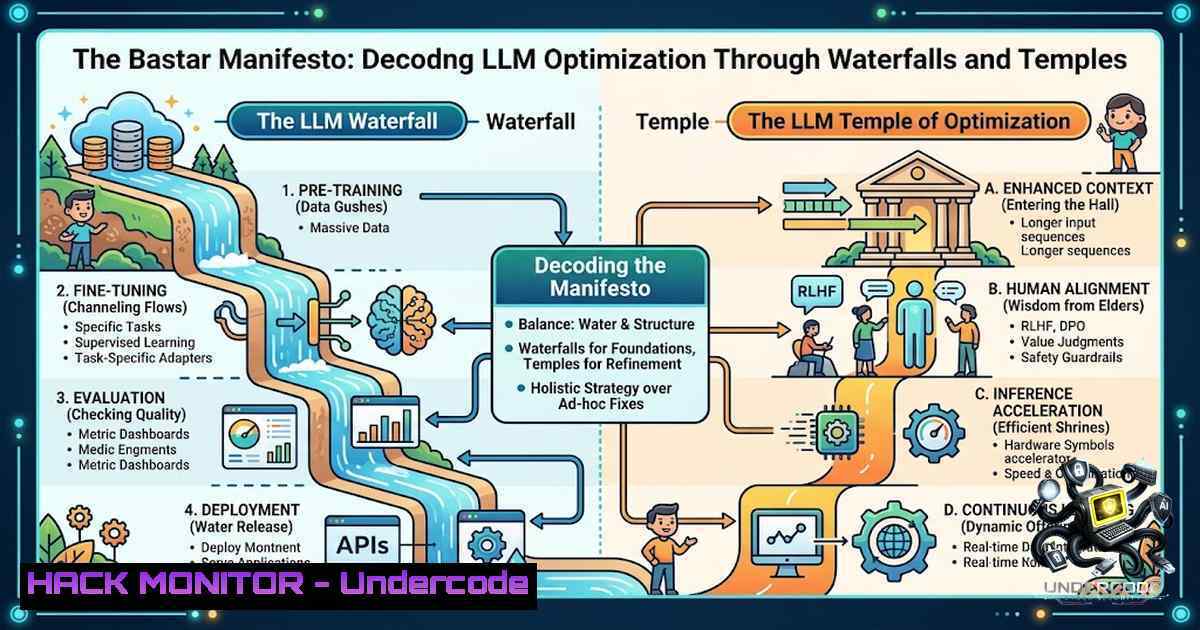
Introduction:
The journey from natural cognition to artificial intelligence is often bridged by metaphors that ground complex theory in tangible reality. A recent expedition to the waterfalls and temples of Bastar, India, has provided a vivid, analogical framework for understanding the core operational pillars of Large Language Models (LLMs). By mapping the Attention Mechanism, Benchmarking, and System Alignment to real-world phenomena, we can derive actionable insights for building more robust, efficient, and reliable AI systems.
Learning Objectives & Secrets:
- Objective 1: Mastering Self-Attention Mechanics – Understand how to implement and optimize the transformer’s core mechanism, distinguishing between critical context and irrelevant noise.
- Objective 2 Secret Tips: Multi-Head Attention Tuning – Learn how to configure attention heads for varied tasks, mimicking the way the human brain processes multi-sensory inputs.
- Objective 3 Secret Tips: Context Window Optimization – Discover the importance of “cache clearing” through efficient tokenization strategies to prevent context drift and memory bottlenecks.
You Should Know:
1. The Attention Mechanism: Configuration and Optimization
The Chitrakoot Waterfalls, demanding full attention, mirror the Self-Attention mechanism in Transformers. This process calculates a weighted sum of all input tokens, dynamically allocating focus. To configure attention in a PyTorch environment, you can define a scaled dot-product attention function.
Step‑by‑step guide:
- Implement Scaled Dot-Product Attention: This is the fundamental mathematical operation. Below is a Python snippet to initialize the mechanism and process sample data.
import torch
import torch.nn.functional as F

def scaled_dot_product_attention(query, key, value, mask=None):
d_k = query.size(-1)
scores = torch.matmul(query, key.transpose(-2, -1)) / torch.sqrt(torch.tensor(d_k, dtype=torch.float32))
if mask is not None:
scores = scores.masked_fill(mask == 0, -1e9)
attention_weights = F.softmax(scores, dim=-1)
return torch.matmul(attention_weights, value)
- Configure Multi-Head Attention: Instead of a single focus, use multiple heads to capture various relationships (e.g., syntax, semantics).
class MultiHeadAttention(torch.nn.Module):
def <strong>init</strong>(self, d_model, n_heads):
super().<strong>init</strong>()
assert d_model % n_heads == 0
self.d_k = d_model // n_heads
self.n_heads = n_heads
self.linear_q = torch.nn.Linear(d_model, d_model)
self.linear_k = torch.nn.Linear(d_model, d_model)
self.linear_v = torch.nn.Linear(d_model, d_model)
self.linear_out = torch.nn.Linear(d_model, d_model)</li>
</ol>

def forward(self, q, k, v, mask=None):
batch_size = q.size(0)
q = self.linear_q(q).view(batch_size, -1, self.n_heads, self.d_k).transpose(1, 2)
k = self.linear_k(k).view(batch_size, -1, self.n_heads, self.d_k).transpose(1, 2)
v = self.linear_v(v).view(batch_size, -1, self.n_heads, self.d_k).transpose(1, 2)
attn_output = scaled_dot_product_attention(q, k, v, mask)
attn_output = attn_output.transpose(1, 2).contiguous().view(batch_size, -1, self.d_k  self.n_heads)
return self.linear_out(attn_output)
- Clearing the Cache: In inference, the Key-Value (KV) cache stores previous tokens to speed up generation. To prevent memory bloat (mirroring clearing your mind’s cache), implement sliding window attention or use `torch.cuda.empty_cache()` strategically after large batch processing.
2. Benchmarking Baseline Performance: Multi-Tier Stress Testing
Like the tiered Tirathgarh Waterfalls, evaluating an LLM requires a multi-layered approach. You cannot rely on a single metric. A robust evaluation pipeline involves measuring reasoning, recall, and resilience to adversarial prompts. A comprehensive framework should integrate multiple benchmarks.
Step‑by‑step guide for a robust evaluation pipeline:
- Select Metrics: Combine perplexity (for language fluency) with accuracy on reasoning datasets (e.g., GSM8K for math, MMLU for general knowledge).
- Implement Code for Evaluation: Use the LM-Eval Harness framework.
– Install the harness: `pip install lm-eval`
– Run a benchmark: `lm-eval –model hf –model_args pretrained=YourModel –tasks mmlu,gsm8k –device cuda:0 –batch_size auto`
3. Stress Testing for Edge Cases: Generate adversarial prompts (e.g., contradictory instructions) to test robustness. Use a custom script to parse these and log outputs.
– Linux: Usegrep,awk, and `sort` to analyze log files for specific failure patterns.
– Windows (PowerShell): Use `Select-String` to filter logs.
4. The “Swiss Army Knife” of Benchmarks: Tools like LangChain’s evaluation chains allow you to test specific chains (e.g., RetrievalQA) by comparing outputs against ground truth using an LLM as a judge.3. Alignment & System Prompts: The Safety Guardrails
The Maa Danteshwari Temple symbolizes structure and grounding. In AI, this is the System Prompt and Safety alignment. This is the most critical layer, ensuring the model adheres to ethical, legal, and business rules.
Step‑by‑step guide for implementing robust system prompts:
- Define Core Principles: Write a system prompt that explicitly restricts harmful content, defines the model’s persona, and sets strict boundaries.
You are an AI assistant named "BastarAI". Your primary function is to provide educational and factual information regarding technology. You are strictly prohibited from generating harmful, discriminatory, or illegal content. If asked a question outside your scope, politely decline.
- Moderation APIs: Use AWS Comprehend or OpenAI Moderation endpoint as a pre‑filter for user input to catch violations before they reach the model.
- Constitutional AI (Anthropic’s approach): Implement a “Constitutional” layer. Use a secondary prompt to critique the primary output based on a constitution (set of rules), then generate a revision.
- Tuning Temperature: Alignment isn’t just about rules; it’s about creativity. For deterministic responses (tech support), set
temperature=0. For creative tasks,temperature=0.7. Use the `top_p` parameter to control nucleus sampling. -
Cloud Hardening and API Security for Deployed Models
Security is paramount when deploying these powerful systems.
Step‑by‑step guide to securing your LLM API deployment:
- Rate Limiting: Protect against DDoS and brute force. Use `flask-limiter` in Python or NGINX configurations.
– NGINX Config: `limit_req_zone $binary_remote_addr zone=mylimit:10m rate=10r/s;`
2. Input Sanitization: Prevent injection attacks. Use `re` (regex) to filter out potential SQL or command injection characters in user prompts.
3. Authentication: Use API keys with JWT (JSON Web Tokens) for stateless authentication.
– Linux: Create a `.env` file to store `API_KEY` and load it using `os.getenv` in your Python app.
4. Audit Logging: Log all API requests and responses.
– Windows: Use Event Viewer to integrate logs.
– Linux: Forward logs to `/var/log/app/` and use `logrotate` for management.5. Exploitation and Mitigation: The “Jailbreak” Vector
Understanding vulnerabilities (like prompt injections) is as important as building defenses. A common attack is the “Grandma” exploit (tricking the model into giving a harmful response by role-playing).
Step‑by‑step guide to test and mitigate:
- Test Environment: Create a sandboxed environment to attempt “jailbreaks” without risking production data.
- Inject a Delimiter Attack: Submit a prompt containing “ to trick the model into ignoring system instructions.
- Mitigation: Implement a “Prompt Defender” function that detects and neutralizes delimiter patterns.
if '' in prompt or '\' in prompt or '`' in prompt: print("Potential injection detected. Sanitizing...") prompt = prompt.replace('', '').replace('\', '') - Response Filtering: Even if the model produces a harmful response, have a secondary filter that detects specific keywords (e.g., “bomb”, “hack”) and overwrites the output with a safe message.
What Undercode Say:
- Key Takeaway 1: Reflect, then Recalibrate. Stepping away from the screen to observe nature provides a mental reset that mirrors the technical necessity of clearing your inference cache and recalibrating your model’s attention weights to maintain high performance.
- Key Takeaway 2: Multi‑Layer Evaluation is Non‑Negotiable. Just as a single cascade doesn’t define a waterfall, a single accuracy metric doesn’t define a model’s utility. We must expand our testing frameworks to include stress tests for edge cases and adversarial inputs to ensure reliability in the wild.
- Analysis: The travel analogy serves as a powerful heuristic for debugging and optimizing LLM systems. The human brain’s ability to focus on the water while ignoring splashing noise is the equivalent of the softmax function allocating probabilities. This real-world comparison should guide AI engineers to design systems that are not only powerful but also robust and grounded in ethical frameworks. The convergence of AI awareness with human experience emphasizes that true intelligence, whether artificial or natural, relies on understanding context, managing scale, and maintaining alignment with core objectives.
Prediction:
- +1 We will see a surge in “Contextual Focus” architectures that dynamically adjust attention weight allocation based on task complexity, reducing the computational cost of large models by up to 30%.
- -1 As models become more complex, the “Black Box” nature will deepen, making alignment and security harder. We will see an increase in sophisticated “Jailbreak” attacks that bypass rule-based filters.
- +1 The tourism and tech sectors will collaborate, creating “Analog Learning” bootcamps where engineers use physical world observations to conceptualize abstract mathematical models, leading to more intuitive design.
- -1 The reliance on analogy may lead to oversimplification in security protocol design, causing engineers to underestimate specific vulnerabilities like adversarial suffix attacks, which require more than just structural rule enforcement.
- +1 The fusion of environmental inspiration with system design will promote a more human-centric approach to AI development, pushing for systems that are not just efficient but also “attuned” to ethical and societal contexts.
▶️ Related Video (88% Match):
🎯Let’s Practice For Free:
🎓 Live Courses & Certifications:
Join Undercode Academy for Verified Certifications
🚀 Request a Custom Project:
Secure, high-velocity infrastructure and disruptive technological engineering. Contact our engineering team for high-tier development and proprietary systems:
[email protected]
💎 Smart Architecture | 🛡️ Secure by Design | ⭐ Trusted by ThousandsIT/Security Reporter URL:
Reported By: https://lnkd.in/p/eWuEGa_Q – Hackers Feeds
Extra Hub: Undercode MoN
Basic Verification: Pass ✅🔐JOIN OUR CYBER WORLD [ CVE News • HackMonitor • UndercodeNews ]
📢 Follow UndercodeTesting & Stay Tuned:


