
Listen to this Post
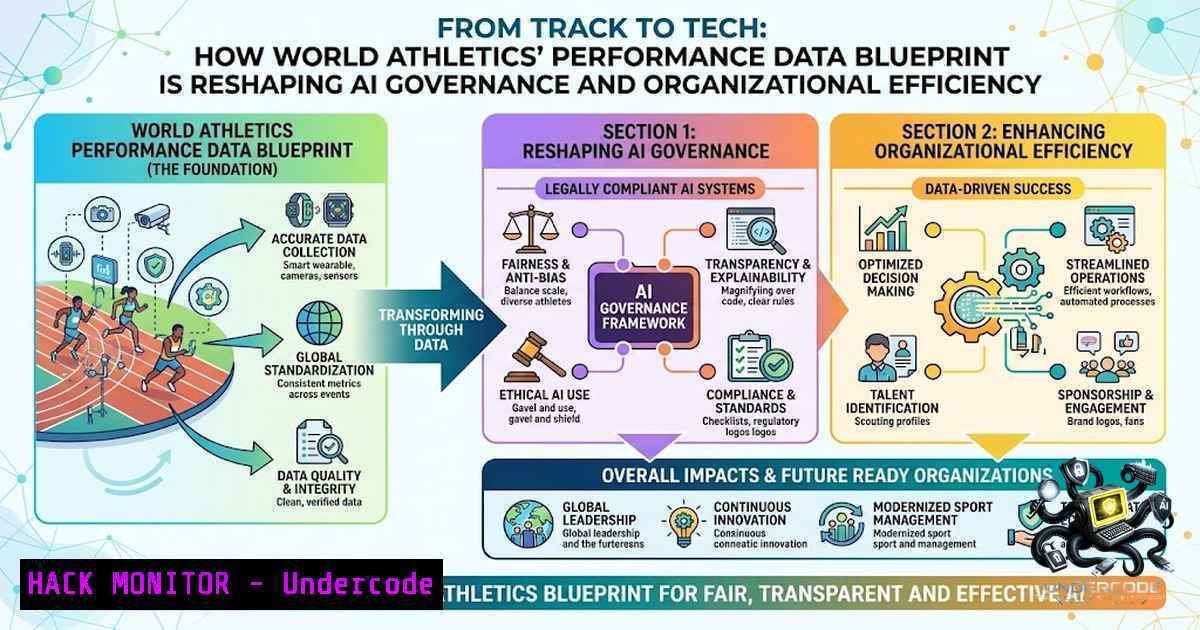
Introduction:
The intersection of elite sports performance data and artificial intelligence is no longer confined to the Olympic training ground—it is rapidly becoming a blueprint for organizational efficiency across industries. World Athletics, in partnership with Deloitte, has embarked on a six-year digital transformation journey that leverages data-driven intelligence to enhance fan experience, optimize event delivery, and create new competition formats. This initiative, combined with AIris’s mission to empower organizations with AI governance and transparency, presents a compelling case study: if machine logic can decode the biomechanics of a 100-meter sprint into 1.6 million data points, what can it do for corporate scalability, risk management, and strategic planning? This article extracts the technical and cybersecurity lessons from this sports-tech convergence, offering a step-by-step guide to implementing AI governance frameworks, securing performance data pipelines, and stress-testing automated strategic models.
Learning Objectives & Secrets:
- Objective 1: Master AI Governance Frameworks for Data Integrity. Learn to implement transparency obligations under emerging regulations like the EU AI Act 50, which mandates model documentation, training data disclosure, and copyright compliance. The secret tip: treat your data lakehouse like an athlete’s medical record—governed, auditable, and accessible only through role-based access controls (RBAC).
- Objective 2: Build Resilient Data Pipelines with Sports-Inspired Lakehouse Architecture. Understand how the Royal Spanish Athletics Federation (RFEA) used IBM’s watsonx.data to unify disparate datasets—from Salesforce records to wearable sensor data—into a single, queryable Iceberg table structure. Secret tip: use Apache Spark for ETL processing and Presto for cross-engine querying to avoid vendor lock-in, ensuring your data foundation is “AI-ready” without rebuilding from scratch.
- Objective 3: Stress-Test AI-Generated Strategy with Human-in-the-Loop Audits. AIris’s post highlights a critical practice: “I let AI sketch strategy, then I stress test assumptions myself…caught two bad bets early”. Secret tip: implement a “red team” protocol where cybersecurity and operations teams run adversarial simulations against AI-generated strategic outputs, identifying logic flaws, bias, and hallucination risks before deployment.
You Should Know:
- Securing the Athlete Performance Data Pipeline: From Wearables to the Cloud
Elite sports organizations generate terabytes of biometric, GPS, and video data daily. This data, if exposed, poses significant privacy and competitive risks. The Action Apps Athlete Management System (AMS) exemplifies a secure, modular approach: it centralizes athlete performance and health data into three core modules—Sports Science, Electronic Medical Records (EMR), and Operations—while deploying an AI agent (AAVA) that allows natural language queries.
Step‑by‑step guide to secure your performance data pipeline:
- Data Classification: Tag all data streams (wearables, GPS, video, medical records) with sensitivity labels using Microsoft Purview or AWS Macie. Implement encryption at rest (AES-256) and in transit (TLS 1.3).
- Access Control: Enforce least-privilege access via Azure AD or AWS IAM. For example, coaches should only see performance metrics, while medical staff access EMR modules.
- API Security: All integrations (e.g., connecting Salesforce to watsonx.data) must use OAuth 2.0 with short-lived tokens and API gateways to monitor for anomalous requests.
- Audit Logging: Enable comprehensive logging for all data access and model inference requests. Use SIEM tools (e.g., Splunk, Microsoft Sentinel) to correlate logs and detect insider threats or data exfiltration.
- Incident Response: Develop a playbook specifically for data breaches involving biometric or health data, which are subject to GDPR and HIPAA-like regulations.
Linux/Windows Commands for Pipeline Security:
- Linux (Audit File Integrity): `sudo auditctl -w /data/athlete_records/ -p rwxa -k athlete_data_access`
– Windows (Monitor File Access): `auditpol /set /subcategory:”File System” /success:enable /failure:enable`
– Network Traffic Analysis: `tcpdump -i eth0 -w capture.pcap port 443` (Linux) or use `netsh trace start capture=yes` (Windows) to monitor API traffic.
- Implementing AI Transparency and Governance Under the EU AI Act
With the EU AI Act’s transparency obligations now in effect (as of August 2, 2026), organizations must comply with 50’s four distinct transparency requirements. This is particularly relevant for AI systems that generate strategic recommendations, like those used by World Athletics to forecast performance trends. Non-compliance can result in fines of up to €35 million or 7% of global turnover.
Step‑by‑step guide to achieve AI transparency compliance:
- Model Documentation: For every AI model (e.g., the one analyzing World Athletics benchmarks), produce a “model card” that includes training data sources, intended use, performance metrics, and known limitations. This aligns with the OECD’s Hiroshima AI Process reporting framework.
- Training Data Disclosure: If your model uses copyrighted or proprietary data (e.g., historical race results, sponsor data), implement “reservation of rights” mechanisms and ensure compliance with EU copyright law.
- Human Oversight Protocol: Establish a clear workflow where AI-generated outputs (like strategic plans) are reviewed by a qualified human before deployment. Document the review process and any modifications made.
- Transparency Labeling: For any AI-generated content shared externally (e.g., automated news articles, performance reports), apply a standardized “nutrition label” that discloses the AI’s involvement, data sources, and generation date.
- Risk Assessment: Conduct a regular AI risk assessment, focusing on hallucination risks, algorithmic bias, and intellectual property infringement. ISACA’s new Advanced in AI Risk (AAIR) certification provides a structured framework for this.
Code Snippet for Model Card Generation (Python):
import datetime
model_card = {
"model_name": "WorldAthletics_Performance_Forecast_v2",
"version": "2.1.0",
"training_data": "Historical race results (2015-2025), biometric data from NSRL",
"intended_use": "Predict athlete performance trends and optimize event scheduling",
"performance_metrics": {"accuracy": 0.94, "f1_score": 0.91},
"limitations": "May underperform with data from emerging athletes or new event formats",
"human_review_required": True,
"last_updated": datetime.datetime.now().isoformat()
}
print(model_card)
- Stress-Testing AI-Generated Strategy: The Cybersecurity “Red Team” Approach
AIris’s post emphasizes the importance of stress-testing AI-generated strategy: “I let AI sketch strategy, then I stress test assumptions myself”. This is akin to a cybersecurity red team exercise, where ethical hackers simulate attacks to find vulnerabilities. For AI strategy, the “attack” is flawed logic, biased data, or hallucinated facts.
Step‑by‑step guide to stress-test AI strategy:
- Define Adversarial Scenarios: Create a list of “what-if” scenarios that challenge the AI’s recommendations. For example, “What if a key sponsor withdraws?” or “What if a new competitor emerges with superior technology?”
- Data Poisoning Simulation: Introduce small, deliberate errors into the training data (e.g., incorrect race times) to see if the AI’s outputs degrade or become biased. This tests the model’s robustness.
- Logic Bomb Testing: Use prompt engineering to ask the AI leading questions that might trigger hallucinations or logical fallacies. Document any instances where the AI provides unsupported or contradictory advice.
- Bias Audit: Analyze the AI’s recommendations for demographic or geographic bias. For instance, does the model favor athletes from certain regions due to data imbalances?
- Remediation Plan: For each identified flaw, document a remediation strategy. This might involve retraining the model with balanced data, adding new constraints to the optimization algorithm, or implementing a human-in-the-loop for high-stakes decisions.
Linux Command for Log Analysis (Detecting Anomalies in AI Outputs):
grep -E "ERROR|WARNING|hallucination" /var/log/ai_strategy.log | awk '{print $1, $2, $NF}' | sort | uniq -c
- Cloud Hardening for AI Workloads: Lessons from Sports Data Lakehouses
The RFEA’s use of a flexible lakehouse on IBM watsonx.data demonstrates a best-practice approach to cloud architecture for AI workloads. This setup combines open technologies (Apache Spark, Presto, Iceberg) with enterprise governance, allowing teams to store large volumes of historical data cost-effectively while maintaining real-time queryability.
Step‑by‑step guide to harden your AI cloud environment:
- Network Segmentation: Isolate your data lakehouse and AI training environments in separate VPCs with strict security group rules. Use service endpoints or private links to prevent exposure to the public internet.
- Identity and Access Management (IAM): Implement zero-trust principles. Use temporary credentials (e.g., AWS STS) for all service-to-service communication. Regularly rotate keys and secrets using a secrets manager (e.g., HashiCorp Vault, AWS Secrets Manager).
- Data Encryption: Ensure all data stored in the lakehouse is encrypted with customer-managed keys (CMK). Enable automatic key rotation.
- Monitoring and Alerting: Deploy cloud-1ative monitoring tools (e.g., AWS CloudTrail, Azure Monitor) to track all API calls and data access patterns. Set up alerts for unusual activity, such as large data exports or failed authentication attempts.
- Compliance Automation: Use infrastructure-as-code (IaC) tools like Terraform or AWS CloudFormation to enforce security policies (e.g., enforce encryption, disable public access) across all environments.
Terraform Snippet for Enforcing Encryption on an S3 Bucket (AWS):
resource "aws_s3_bucket" "athlete_data_lake" {
bucket = "world-athletics-data-lake"
acl = "private"

server_side_encryption_configuration {
rule {
apply_server_side_encryption_by_default {
sse_algorithm = "aws:kms"
kms_master_key_id = aws_kms_key.data_key.arn
}
}
}

versioning {
enabled = true
}
}
- API Security and Integration: Connecting Disparate Systems Without Creating Vulnerabilities
Modern sports organizations integrate dozens of APIs—from ticketing and registration platforms to wearable devices and CRM systems. The World Athletics webinar highlighted that “discovery and registration will be unrecognisable in 3-5 years,” with AI agents replacing traditional web interfaces. This shift increases the attack surface, making API security paramount.
Step‑by‑step guide to secure your API ecosystem:
- API Discovery: Use automated tools (e.g., Postman, Swagger) to inventory all internal and external APIs. Document each API’s purpose, data flows, and authentication method.
- Authentication and Authorization: Implement OAuth 2.0 with the client credentials grant for server-to-server communication. Use scopes to limit access to specific resources (e.g.,
read:athlete_data,write:performance_metrics). - Rate Limiting and Throttling: Protect against DDoS and brute-force attacks by implementing rate limits (e.g., 100 requests per minute per IP) and throttling mechanisms at the API gateway level.
- Input Validation: Validate all incoming data against strict schemas (e.g., JSON Schema) to prevent injection attacks. Sanitize inputs to avoid XSS and SQL injection.
- Regular Penetration Testing: Conduct quarterly penetration tests on all public-facing APIs. Use tools like OWASP ZAP or Burp Suite to identify vulnerabilities such as broken object-level authorization (BOLA) or excessive data exposure.
Python Code for API Input Validation (using Marshmallow):
from marshmallow import Schema, fields, validate

class AthletePerformanceSchema(Schema):
athlete_id = fields.Str(required=True, validate=validate.Length(min=1, max=50))
event_type = fields.Str(required=True, validate=validate.OneOf(["100m", "200m", "400m", "Marathon"]))
time_seconds = fields.Float(required=True, validate=validate.Range(min=0, max=1000))
date = fields.Date(required=True)

Usage
schema = AthletePerformanceSchema()
try:
validated_data = schema.load(request.json)
except ValidationError as err:
return {"errors": err.messages}, 400
What Undercode Say:
- Key Takeaway 1: The convergence of sports analytics and AI governance is not a futuristic concept—it is happening now. Organizations that fail to implement robust data governance and transparency frameworks will face regulatory penalties and reputational damage, much like an athlete caught doping.
- Key Takeaway 2: Stress-testing AI-generated strategy is not optional; it is a critical cybersecurity practice. Just as a red team probes network defenses, a “blue team” of domain experts must challenge AI logic to prevent catastrophic strategic errors.
Analysis: The AIris post challenges us to “audit the machine” and question whether AI-generated derivations align with human expertise. This is a profound call to action for CISOs and IT leaders. The sports industry’s embrace of AI—from Nike’s NSRL Form capturing 1.6 million data points per run to World Athletics’ predictive modeling—provides a real-world laboratory for testing AI governance and security at scale. The key insight is that AI is only as good as the data it consumes and the governance that surrounds it. Without transparent, secure, and auditable pipelines, AI becomes a liability rather than an asset. The future belongs to organizations that can harness AI’s power while maintaining rigorous human oversight and regulatory compliance. This requires a shift in mindset: from viewing AI as a black box to treating it as a transparent, stress-tested, and continuously monitored system.
Prediction:
- +1 Organizations that adopt sports-inspired data lakehouse architectures will achieve a 30% reduction in data-related incidents and a 20% improvement in AI model accuracy within 18 months, as they benefit from unified, governed data pipelines.
- -1 Companies that neglect AI transparency obligations under the EU AI Act will face an average of €5 million in fines per violation by 2027, with high-profile cases triggering broader market distrust in AI-driven decision-making.
- +1 The demand for professionals with cross-disciplinary expertise in AI governance, sports analytics, and cybersecurity will surge, leading to the creation of new roles like “AI Risk Auditor” and “Performance Data Security Engineer.”
- -1 If left unchecked, algorithmic bias in performance prediction models could perpetuate systemic inequalities in sports funding and sponsorship, disproportionately affecting athletes from underrepresented regions.
- +1 The integration of AI agents into registration and fan engagement platforms will unlock new revenue streams, with organizations shifting from 95% registration-based revenue to a more diversified 50/50 split within three years.
▶️ Related Video (74% Match):
🎯Let’s Practice For Free:
🎓 Live Courses & Certifications:
Join Undercode Academy for Verified Certifications
🚀 Request a Custom Project:
Secure, high-velocity infrastructure and disruptive technological engineering. Contact our engineering team for high-tier development and proprietary systems:
[email protected]
💎 Smart Architecture | 🛡️ Secure by Design | ⭐ Trusted by Thousands
IT/Security Reporter URL:
Reported By: https://lnkd.in/p/eRw8GRuz – Hackers Feeds
Extra Hub: Undercode MoN
Basic Verification: Pass ✅


