
Listen to this Post
Introduction:
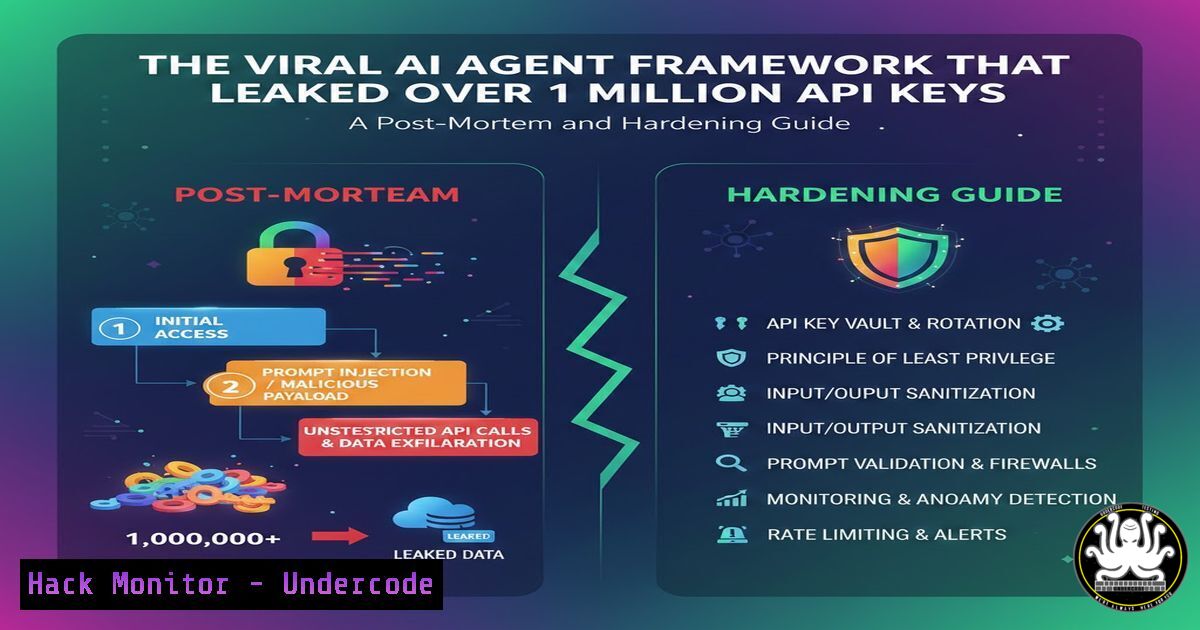
The explosive adoption of agentic AI frameworks has introduced a new frontier of cybersecurity risk, moving beyond traditional software vulnerabilities into the realm of autonomous system compromise. A recent incident, where a single hacker extracted API keys from over a million installations of a popular AI agent framework, underscores a critical shift: our security models are ill-equipped for the “trusted localhost” assumptions and autonomous execution chains of AI agents. This breach serves as a stark case study in the convergence of AI innovation and fundamental security neglect.
Learning Objectives:
- Understand the critical security flaw stemming from the “trusted localhost” assumption in AI agent frameworks.
- Learn to audit and harden local agent endpoints to prevent unauthorized remote access and secret exfiltration.
- Implement secure API key management and monitoring specifically for autonomous AI systems.
You Should Know:
1. Deconstructing the “Trusted Localhost” Catastrophe
The core failure was a flawed architectural assumption: that services bound to `localhost` (127.0.0.1) are safe from external attack. In the breached framework, the management API, which had access to the system’s environment variables (including cloud API keys), was listening on this interface without authentication. This is a catastrophic misstep in any networked application.
Step-by-step guide:
Attack Path Simulation: An attacker who achieved even limited Remote Code Execution (RCE) on a target machine could query this local API. Using a simple `curl` command, they could steal secrets.
 Attacker's command on compromised host
curl http://127.0.0.1:8000/admin/env
 Returns: {"OPENAI_API_KEY":"sk-...", "AWS_ACCESS_KEY_ID":"ASIA..."}
Defensive Audit: System administrators must actively audit all services bound to localhost.
 Linux/ macOS - List all processes listening on network ports, including localhost
sudo netstat -tulpn | grep LISTEN
sudo lsof -i -P -n | grep LISTEN
 Windows
netstat -ano | findstr LISTENING
Identify any non-essential services exposing admin interfaces on localhost without strict authentication.
2. Hardening Local Service Authentication and Network Policy
A local service should never be implicitly trusted. Mandate authentication, implement network isolation, and use Unix socket permissions where possible.
Step-by-step guide:
Implement Mandatory API Authentication: Ensure every management endpoint requires a strong token or certificate.
Example: Use a secret token passed in headers.
curl -H "Authorization: Bearer $(cat /etc/agent/admin.token)" http://127.0.0.1:8000/admin/health
Bind to Unix Sockets (Linux/macOS): More secure than TCP, as access is controlled via filesystem permissions.
 Configure your service to bind to a socket file
bind = "unix:/run/agent/admin.sock"
 Set restrictive permissions
chmod 660 /run/agent/admin.sock
chown agent:appgroup /run/agent/admin.sock
- Securing the AI Agent’s Execution Environment and Secret Management
AI agents interact with external services, necessitating secure secret injection. Environment variables are prone to leakage through logs, debug endpoints, or child processes.
Step-by-step guide:
Use Dedicated Secret Managers: Integrate with systems like HashiCorp Vault, AWS Secrets Manager, or Azure Key Vault.
Example fetching a secret at runtime (Python with Vault):
import hvac
client = hvac.Client(url='https://vault.example.com')
secret = client.secrets.kv.read_secret_version(path='ai-agent/prod')
api_key = secret['data']['data']['OPENAI_API_KEY']
Employ Minimal-Principle IAM Roles (Cloud): For cloud APIs, use short-lived credentials via IAM roles attached to the compute instance (e.g., EC2 Instance Profile, GCP Service Account) instead of long-lived access keys.
- Implementing Robust Logging and Anomaly Detection for AI Systems
Agentic AI’s non-deterministic behavior requires logging that captures decision chains, tool usage, and external calls for security audits.
Step-by-step guide:
Structured Logging Implementation: Log all agent actions, including invoked functions and target APIs.
 Python logging example
import logging
logging.basicConfig(level=logging.INFO)
logger = logging.getLogger("ai_agent")

Log an agent's action
logger.info(
"AGENT_ACTION",
extra={
"action": "call_api",
"target": "https://api.openai.com/v1/chat/completions",
"token_usage": 45,
"session_id": "abc123"
}
)
Create Detection Rules: In your SIEM (e.g., Splunk, Elasticsearch), create alerts for abnormal behavior.
Example Sigma rule concept: Alert if the AI agent process spawns an unexpected shell or makes network calls to untrusted destinations outside its defined toolset.
5. Proactive Vulnerability Assessment for AI Frameworks
Before deploying any AI framework, conduct a dedicated security assessment focusing on its agentic capabilities.
Step-by-step guide:
- Architecture Review: Diagram the framework’s components. How do agents, the orchestrator, and external tools communicate?
- Local & Network Scanning: Use `nmap` to scan the framework’s ports from inside the container or host.
Scan localhost from within the deployment environment
nmap -sV -p 1-65535 127.0.0.1
- Tool Permissions Audit: Review the permissions granted to the AI agent. Can it read arbitrary files? Can it execute system commands? The principle of least privilege is paramount.
What Undercode Say:
- The Perimeter is Now the Prompt. The attack surface has shifted from the network edge to the AI agent’s reasoning loop and its granted tool permissions. A single malicious prompt or tool output can initiate a compromise chain.
- Autonomy Demands Unprecedented Audit Trails. You cannot secure what you cannot see. Immutable, detailed logging of an agent’s “thought process” and actions is no longer a debugging luxury but a core security requirement.
Analysis:
This breach is not an anomaly but a harbinger. As AI agents move from prototypes to production, they are inheriting the worst of legacy IT security debt—hardcoded secrets, exposed endpoints, excessive permissions—while operating with a dangerous degree of autonomy. The future impact extends beyond API key theft. We will see AI agents leveraged as initial access vectors, lateral movement tools, and data exfiltration channels within compromised networks. The mitigation requires a paradigm shift: treating the AI agent framework not as a simple application, but as a privileged, potentially hostile subsystem that must be jailed, meticulously observed, and allowed to interact with the world only through the narrowest possible apertures. Security must be “born-native” in these systems, not bolted on after a viral launch.
▶️ Related Video (74% Match):
🎯Let’s Practice For Free:
IT/Security Reporter URL:
Reported By: Confidencestaveley Yesterday – Hackers Feeds
Extra Hub: Undercode MoN
Basic Verification: Pass ✅


