
Listen to this Post
Introduction:
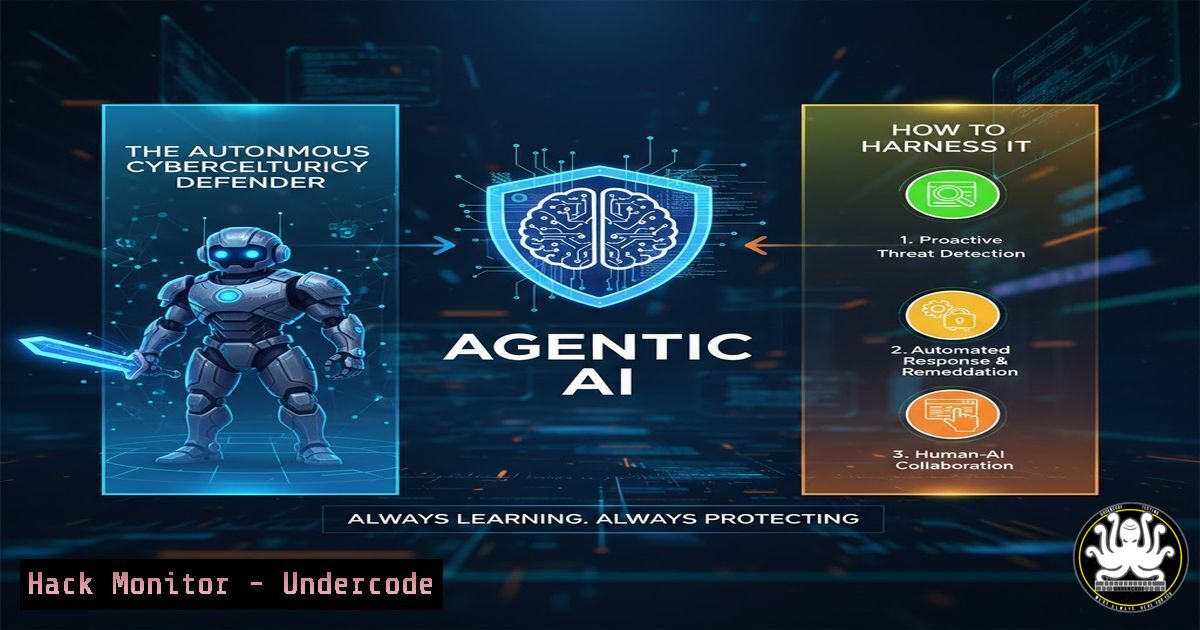
The cybersecurity landscape is undergoing a fundamental shift as Artificial Intelligence evolves from a passive analytical tool into an active, autonomous defender. Known as “Agentic AI,” these systems can now perceive threats, make decisions, and execute countermeasures without constant human intervention. This transition promises to close the critical gap between threat detection and response, but it also introduces new complexities in governance, trust, and potential adversarial manipulation.
Learning Objectives:
- Understand the core architecture and operational loop of an Agentic AI system in a security context.
- Learn to implement a basic autonomous threat-hunting agent using popular security platforms and APIs.
- Identify the critical security hardening and oversight measures required to deploy Agentic AI safely.
You Should Know:
1. The Anatomy of an Autonomous Security Agent
Agentic AI operates on a perceive-decide-act loop, integrated directly into security telemetry and control planes. Unlike traditional SIEM alerts, the AI agent is granted sanctioned permissions to query logs, isolate endpoints, and update firewall rules based on its analysis.
Step‑by‑step guide explaining what this does and how to use it.
Step 1: Foundation – The Perception Layer
The agent must be fed structured data. This often involves configuring a log aggregator like Elastic Stack or a cloud-native service like AWS Security Hub.
 Example: Ingesting a Syslog stream into Elasticsearch for the AI agent to analyze
 On a Linux log forwarder (rsyslog configuration: /etc/rsyslog.d/99-security.conf)
. @<ELASTIC_AGENT_IP>:5140
Step 2: Decision Engine Core
This is typically a machine learning model trained on normal vs. malicious behavior. For a proof-of-concept, you can use OpenAI’s API with a structured prompt acting as a decision layer.
import openai
import json

security_log_snippet = "User 'svc_account' from IP 198.51.100.3 failed authentication 15 times in 2 minutes."

response = openai.ChatCompletion.create(
model="gpt-4",
messages=[
{"role": "system", "content": "You are a security AI agent. Analyze the log. If it's critical, respond with a JSON containing 'action': 'block_ip' and 'target': '[bash]'."},
{"role": "user", "content": security_log_snippet}
]
)
decision = json.loads(response.choices[bash].message.content)
 Output might be: {"action": "block_ip", "target": "198.51.100.3"}
2. Hands-On: Building a Simple Autonomous Response Agent
We’ll create a Python-based agent that monitors failed SSH logins and temporarily blocks IPs via the local firewall.
Step‑by‑step guide explaining what this does and how to use it.
Step 1: Monitor Auth Logs
The agent tails the secure log (Linux) or Security Event Log (Windows) for failed login events.
 Linux: Tail /var/log/secure or /var/log/auth.log
import subprocess, re, json

def tail_log(logfile):
p = subprocess.Popen(['tail', '-F', logfile], stdout=subprocess.PIPE, stderr=subprocess.PIPE)
while True:
line = p.stdout.readline().decode()
if 'Failed password' in line:
ip_match = re.search(r'from (\d+.\d+.\d+.\d+)', line)
if ip_match:
offending_ip = ip_match.group(1)
execute_response(offending_ip)
Step 2: Decision & Autonomous Action
The agent decides (using a simple threshold) and executes a firewall block.
import iptc  Python-iptables library
from datetime import datetime, timedelta

def execute_response(ip):
 Simple rule: If >5 failures in last 10 min, block for 1 hour.
if get_failure_count(ip) > 5:
block = iptc.Chain(iptc.Table(iptc.Table.FILTER), 'INPUT')
rule = iptc.Rule()
rule.src = ip
rule.target = iptc.Target(rule, "DROP")
block.insert_rule(rule)
schedule_unblock(ip, 3600)  Unblock in 1 hour
log_action(f"Blocked IP {ip} at {datetime.now()}")
3. Integrating with Cloud Security Posture Management (CSPM)
Agentic AI excels in cloud environments by auto-remediating misconfigurations. Here’s how to set up a basic auto-fixer for public S3 buckets in AWS.
Step‑by‑step guide explaining what this does and how to use it.
Step 1: Configure AWS Config Rule and Lambda
Create an AWS Config rule to detect non-compliant, publicly accessible S3 buckets.
Step 2: Author the Remediation Lambda Function
The Lambda function (the AI agent’s action arm) will automatically apply a bucket policy to block public access.
import boto3

def lambda_handler(event, context):
s3 = boto3.client('s3')
bucket_name = event['detail']['resourceId']

Autonomous Remediation Action
s3.put_public_access_block(
Bucket=bucket_name,
PublicAccessBlockConfiguration={
'BlockPublicAcls': True,
'IgnorePublicAcls': True,
'BlockPublicPolicy': True,
'RestrictPublicBuckets': True
}
)
 Log the action for audit trail
print(f"Remediated public S3 bucket: {bucket_name}")
- The Adversarial Frontier: Poisoning and Evasion of Agentic AI
Attackers will target the AI’s learning and perception systems. Data poisoning and model evasion are critical threats.
Step‑by‑step guide explaining what this does and how to use it.
Step 1: Understand the Attack Vector
An attacker might inject benign-looking log entries during training to “teach” the AI that their malicious activity is normal.
Step 2: Implement Defensive Measures – Anomaly Detection on Training Data
Use statistical analysis to screen training data before the model ingests it.
 Simple Python check for outlier log entries using Z-score (conceptual)
import pandas as pd
from scipy import stats
import numpy as np

def detect_poisoned_entries(log_dataset):
z_scores = np.abs(stats.zscore(log_dataset['frequency']))
filtered_entries = log_dataset[(z_scores < 3)]  Remove outliers beyond 3 std dev
return filtered_entries
5. Governance and the Human Firewall: Oversight Protocols
Autonomy requires robust oversight. Implement a “Human-in-the-Loop” (HITL) approval circuit for critical actions.
Step‑by‑step guide explaining what this does and how to use it.
Step 1: Create an Approval Workflow
Before executing severe actions (like disabling a user account), the agent must generate a ticket in a system like Jira or ServiceNow for a human to approve.
Step 2: Code the Conditional Execution
Modify your agent’s `execute_response` function to check action severity.
def execute_response(decision_json):
action = decision_json['action']
target = decision_json['target']

SEVERE_ACTIONS = ['disable_account', 'quarantine_host', 'network_segment']

if action in SEVERE_ACTIONS:
ticket_id = create_approval_ticket(action, target)
await_approval(ticket_id)  Pauses execution until ticket approved
else:
 Execute low-risk actions immediately (e.g., log, tag asset)
carry_out_action(action, target)
What Undercode Say:
- Autonomy is a Spectrum, Not a Switch: The most effective Agentic AI deployments use graduated autonomy. Low-risk, high-volume tasks (log tagging, blocking known-bad IPs) are fully automated, while high-impact actions require human confirmation.
- The Attack Surface Just Got More Abstract: Securing the Agentic AI itself becomes paramount. This includes hardening its API endpoints, rigorously auditing its training data pipeline, and continuously monitoring its decisions for drift or manipulation.
The move towards autonomous cyber defense is inevitable and will massively scale our ability to defend dynamic environments. However, it inverts traditional security models: the defender’s core logic is now an active, learning system that itself must be protected. The next major cyber incidents may not involve stolen data, but corrupted AI defenders that willingly open the gates. Success hinges on building these systems with immutable audit logs, explainable decision trails, and fail-safe circuits that default to a secure state.
Prediction:
Within two years, Agentic AI will become the standard first responder for SOC teams, cutting mean time to respond (MTTR) to near zero for commodity attacks. This will force a premium on novel, “AI-aware” attacks designed to deceive or poison these systems, sparking a new arms race in adversarial machine learning. Security professionals will shift from frontline incident responders to AI trainers, overseers, and ethics auditors, focusing on the integrity of the autonomous defense loop itself.
▶️ Related Video (86% Match):
🎯Let’s Practice For Free:
IT/Security Reporter URL:
Reported By: Kee Wee – Hackers Feeds
Extra Hub: Undercode MoN
Basic Verification: Pass ✅


