Listen to this Post
Introduction:
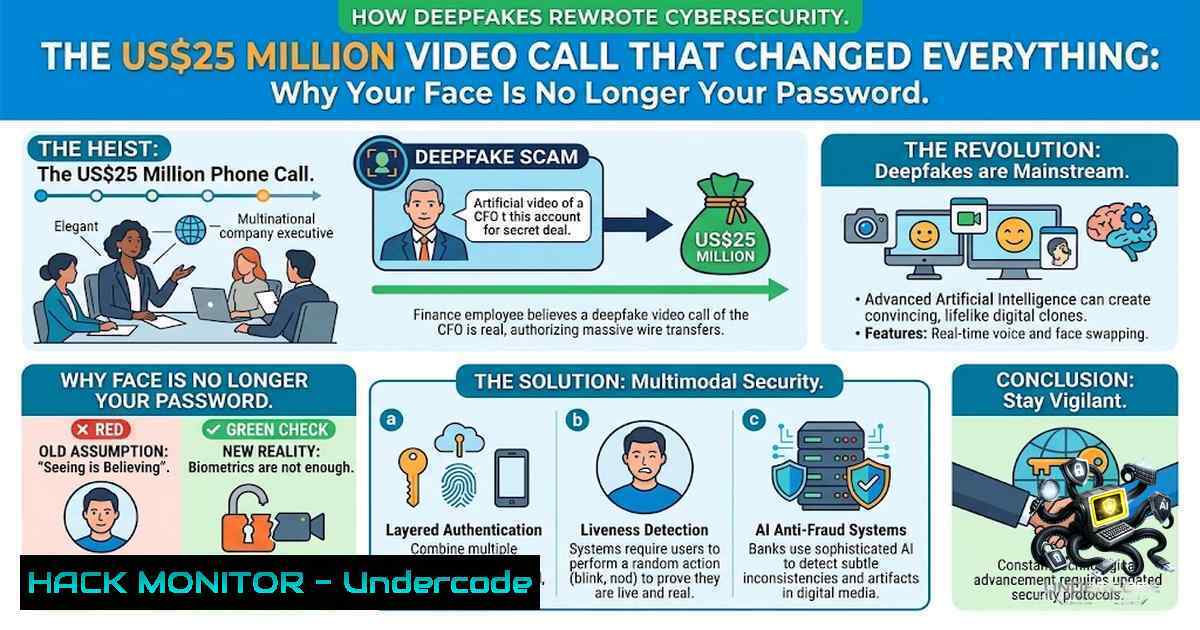
On a routine video call in Hong Kong, a finance employee saw his CFO and colleagues, checked their faces carefully, and wired US$25 million. Every person on that call was an AI deepfake. In Kozhikode, a man received a WhatsApp video call from a former colleague and sent ₹40,000 for a hospital emergency—the colleague never called. Same weapon. Two very different price tags. One conclusion: the human face has become the master key to money, and it can now be forged for a few dollars. Indians lost over ₹22,000 crore to cyber fraud in each of the last two years. Deepfake incidents in India grew 280% in a single year. In June 2026, the Ministry of Home Affairs formally warned banks, NBFCs and fintechs that deepfakes are being used to defeat liveness checks and pass video-KYC. The era of trusting what you see is over.
Learning Objectives:
- Understand the mechanics of deepfake-enabled fraud, including presentation attacks, injection attacks, and synthetic identity creation
- Master command-line and API-based tools for detecting synthetic media across Linux and Windows environments
- Implement a layered defense strategy incorporating certified liveness detection, injection attack defense, and cloud-hardening controls
You Should Know:
- The Anatomy of the Attack: Presentation vs. Injection
The Hong Kong deepfake heist wasn’t a simple screen replay. Attackers harvested existing video and audio files from online conferences and virtual company meetings, then built deepfakes of the CFO and colleagues. The finance worker, convinced the call was real, transferred HK$200 million across 15 transactions.
This case illustrates two distinct attack surfaces. Presentation attacks involve showing a fake face to a real camera using printed photos, screen replays, or 3D masks. Injection attacks are a different problem entirely: synthetic video is inserted directly into the transport layer, bypassing the camera before any liveness check ever sees it. A liveness system operating on the output of a virtual camera driver is checking whether injected synthetic video looks alive—that’s not identity proofing.
Injection attack attempts rose 783% in 2024. Commercially available deepfake tools cost as little as $20 to deploy. One in six surveyed bypass tools is already KYC-grade.
Step-by-Step: Detecting Injection Attacks with Forensic Tools
Linux – Metadata Forensics with Exiftool:
 Install exiftool
sudo apt install libimage-exiftool-perl

Extract comprehensive metadata from suspicious video
exiftool -a -u -g1 suspicious_video.mp4 | grep -E "Creator|Software|History|Compressor"

Look for editing software signatures like "DeepFaceLab", "FaceSwap", or "After Effects"
exiftool -Software -History suspicious_video.mp4
Linux – PixelProof Deep Analysis (Forensic-Grade Image Analysis):
 Clone and install PixelProof - detects AI-generated and Photoshopped images
git clone https://github.com/mytechnotalent/pixelproof.git
cd pixelproof
python3 -m venv .venv
source .venv/bin/activate
pip install .

Run full forensic analysis with PDF report
python deep_analysis.py suspect_photo.png --pdf --provenance

Output includes: ELA visualization, tamper probability, confidence score, and fusion verdict
PixelProof exposes manipulation through metadata inspection, Error Level Analysis (ELA), noise profiling, steganography detection, and more. It detects missing camera info, Photoshop resource blocks, and inconsistent noise levels across regions.
Windows PowerShell – Detecting Deepfake Audio:
 Run as Administrator
 Detect unnatural silence patterns in audio files (common in AI-generated speech)
Get-ChildItem -Path "C:\Audio\" -Filter ".wav" | ForEach-Object {
ffmpeg -i $_.FullName -af "silencedetect=n=-50dB:d=0.5" -f null - 2>&1 |
Select-String "silence"
}

Analyze file integrity and origins
Get-FileHash -Path "C:\Audio\suspicious.wav" -Algorithm SHA256
These commands use FFmpeg to detect unnatural pauses in audio files—irregular silence patterns often indicate manipulation.
2. Why Liveness Alone Is No Longer Enough
The hard truth for 2026 is that the liveness checks most Video KYC systems shipped with were built for a threat that has been superseded. The RBI mandates that V-CIP systems detect a live person and prevent spoofing, but it does not prescribe the method—so many implementations settle for a single blink test that a screen recording defeats.
Selfie-based identity proofing was never designed to withstand an adversary with access to a diffusion model and a virtual camera driver. It was designed to confirm a document-to-face match, and for a long time, that was enough. It isn’t anymore.
Step-by-Step: Implementing Multi-Stage Liveness Detection
Multi-Stage Liveness Detection Pipeline (Temporal • Spatial • Frequency Analysis):
 Clone the multi-stage liveness detection project
git clone https://github.com/Chanthus587/multi-stage-liveness-detection-pipeline-temporal-spatial-frequency-analysis-.git
cd multi-stage-liveness-detection-pipeline-temporal-spatial-frequency-analysis-
pip install -r requirements.txt

Run the main detection pipeline
python main.py

Or launch the GUI
python app.py
This system identifies deepfake or spoofed inputs using temporal behavior analysis, spatial feature consistency, and frequency domain anomalies. It detects inconsistencies over time such as unnatural motion or blinking patterns, analyzes frame-level features including facial structure, and identifies artifacts in the frequency domain common in synthetic media.
API-Based Deepfake Detection with Reality Defender:
 Submit media for analysis via API
curl -X POST "https://api.realitydefender.com/v1/detect" \
-H "Authorization: Bearer YOUR_API_KEY" \
-H "Content-Type: application/json" \
-d '{"media_url": "https://example.com/suspicious_video.mp4"}'
The API returns a confidence score indicating whether the media is synthetic.
- The Defense That Works: Certified Liveness and Injection-Attack Defense
The question to ask a Video KYC vendor in 2026 is not “do you do liveness.” It’s “can you stop injection attacks”. Injection Attack Detection (IAD) and Deepfake Detection (DFD) protect verification flows against fraud that bypasses or fools the camera.
Standards now exist. CEN/TS 18099 is the first true benchmark for injection attack detection, a requirement now included in NIST 800-63-4. Achieving certification under this standard demonstrates that a vendor can detect attempts to bypass the camera by feeding prerecorded or synthetic content directly into the verification pipeline.
Step-by-Step: Hardening Cloud APIs Against Deepfake Bypass
AWS CLI – Facial Analysis for Inconsistencies:
 Analyze facial landmarks for inconsistencies
aws rekognition detect-faces \
--image "S3Bucket=suspicious-images,Name=fake_id.jpg" \
--attributes "ALL"

Detect labels and suspicious content
aws rekognition detect-labels \
--image "S3Bucket=suspicious-images,Name=suspect.jpg" \
--max-labels 10
Enable Amazon Rekognition to analyze facial landmarks for inconsistencies and combine with multi-factor authentication to prevent synthetic identity attacks.
API Security Hardening (Fintech Context):
Essential API security controls include:
- Strong authentication on every endpoint—never trust client-side validation alone
- Input validation—prevent injection attacks by sanitizing all user input
- Rate limiting to prevent automated misuse or bulk content generation
A robust deepfake detection API for KYC should evaluate the device environment for indicators of fraud: emulators, rooted or jailbroken phones, VPN connections, and spoofed GPS coordinates.
- The Strategic Imperative: Sun Tzu’s Art of War for Fraud Prevention
Over 2,500 years ago, Sun Tzu understood that victory doesn’t happen on the battlefield—it happens in preparation, intelligence, and understanding your adversary. The general who wins makes many calculations in his temple before the battle is fought.
Applying this to fraud prevention means:
- Know yourself: Map your entire fraud battlefield—RBI data, I4C reports, UPI statistics, mule account networks, digital arrest patterns
- Know your enemy: Understand that deepfakes are evolving faster than defensive tools, requiring continuous updates to detection methods
- Prepare strategically: Implement a 90-day, 12-month, and 36-month campaign plan
Step-by-Step: Cloud Hardening for Identity Verification
Google Cloud – Stopping AI Voice Clones:
The strategic action plan requires board-level mandates:
1. Decouple IT support speed from security verification
- Implement multi-factor verification—never authenticate a high-risk action (fund transfer, credential reset, data access) on voice or video alone
3. Require a second channel for verification
Threat groups use AI to bypass traditional multi-factor authentication prompts and then use AI again to traverse hybrid cloud and on-premise environments mere minutes after gaining initial access.
Linux – Monitoring for Deepfake-Enabled Intrusions:
 Monitor for suspicious process injection
sudo sysctl kernel.yama.ptrace_scope=1

Audit camera access
sudo auditctl -w /dev/video0 -p rwxa -k camera_access

Check for virtual camera drivers
lsmod | grep v4l2loopback
modinfo v4l2loopback

Monitor network connections from video processing tools
sudo netstat -tunap | grep -E "ffmpeg|python|deepfake"
5. The 90-Day Action Plan
Based on the threat intelligence and defense frameworks discussed, organizations should implement this 90-day campaign:
Days 1-30: Assessment
- Conduct a full audit of current identity verification systems
- Test existing liveness detection against deepfake and injection attack scenarios
- Map all API endpoints handling identity data
Days 31-60: Implementation
- Deploy certified liveness detection with IAD capabilities
- Implement API security controls (strong authentication, input validation, rate limiting)
- Enable deepfake detection for voice and video channels
Days 61-90: Testing and Refinement
- Run deepfake-enabled crisis simulation exercises
- Monitor and tune detection thresholds
- Train staff on recognizing deepfake indicators
What Undercode Say:
- Key Takeaway 1: The human face has become the master key to money, and it can now be forged for a few dollars. Traditional identity verification—whether a blink test, an OTP, or a human reviewer—no longer holds against AI-generated synthetic media.
-
Key Takeaway 2: The defense that works combines certified liveness detection, injection-attack defense, and multi-factor verification across independent channels. Standards like CEN/TS 18099 and NIST 800-63-4 now provide the benchmark for what “good” looks like.
Analysis: The democratization of AI tools means even low-skilled attackers can create convincing deepfakes. “Deepfake-as-a-Service” kits are available for less than ₹5,000, enabling fraudsters to bypass the “blink” and “head-turn” tests of standard Video-KYC modules. The $25 million Hong Kong heist establishes a floor for targeted deepfake fraud, not a ceiling. Banks and financial institutions must recognize that liveness detection is now table stakes—but it is typically applied at authentication, not across the entire identity lifecycle. Organizations that treat deepfake defense as a compliance checkbox rather than a strategic imperative will be the next headline. The 280% growth in deepfake incidents in India is not a statistic—it’s a warning shot. Investments in AI defense tools are critical, but human vigilance remains irreplaceable. The future of fraud prevention requires moving from reactive detection to proactive, biologically-grounded verification that attackers cannot replicate.
Prediction:
- +1 The market for certified liveness and injection-attack detection will exceed $5 billion by 2028 as regulatory mandates (RBI, NIST, CEN) force financial institutions to upgrade legacy KYC systems
- +1 Biometric verification will shift from visual artifact detection to biological invariant verification—using remote photoplethysmography (rPPG) to detect heart rate signals and physiological plausibility that deepfakes cannot simulate
- -1 Deepfake-driven fraud could cost enterprises over $10 billion annually by 2026, with India’s banking sector bearing a disproportionate share given its rapid digital payment adoption and 2.8 million reported digital payment frauds between 2021 and 2025
- -1 The median time from successful intrusion to threat actor hand-off has collapsed from eight hours in 2022 to just 22 seconds today—meaning detection windows are shrinking faster than most organizations can respond
- +1 Blockchain-based verification systems and cryptographic attestation will emerge as the ultimate defense, ensuring that the person on the call is not just real, but the right person
▶️ Related Video (76% Match):
🎯Let’s Practice For Free:
🎓 Live Courses & Certifications:
Join Undercode Academy for Verified Certifications
🚀 Request a Custom Project:
Secure, high-velocity infrastructure and disruptive technological engineering. Contact our engineering team for high-tier development and proprietary systems:
[email protected]
💎 Smart Architecture | 🛡️ Secure by Design | ⭐ Trusted by Thousands
IT/Security Reporter URL:
Reported By: Amitabhsr Next – Hackers Feeds
Extra Hub: Undercode MoN
Basic Verification: Pass ✅


