Listen to this Post
Introduction
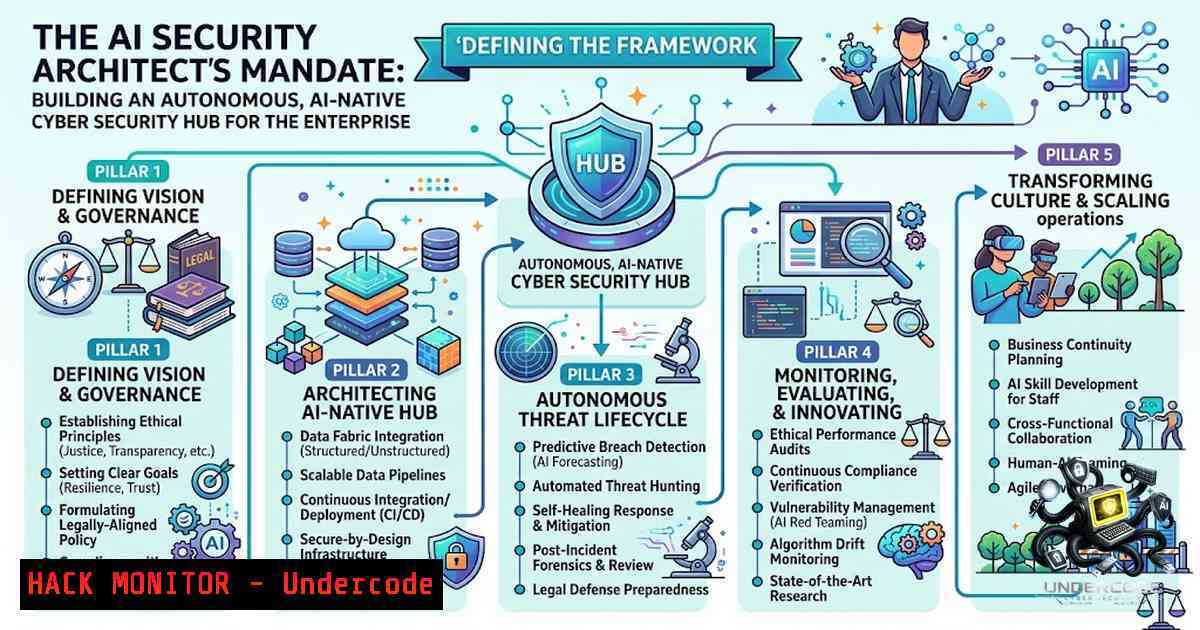
As artificial intelligence rapidly transitions from experimental projects to mission-critical enterprise infrastructure, the attack surface has fundamentally shifted. Traditional security perimeters collapse when data flows freely among internal systems, third-party GenAI services, and autonomous agents. Organizations now face an urgent imperative: establish dedicated Cyber Security Hubs that embed AI-driven security operations, threat detection, and response directly into the fabric of the enterprise. NTT DATA’s recent initiative to build a cutting-edge Cyber Security Hub in a large enterprise AI environment underscores this critical shift—a move that demands Senior Cyber Security Architects who can shape security strategy, AI-driven operations, and enterprise-wide cyber capabilities from the ground up.
Learning Objectives
- Design and implement an AI-1ative Security Operations Center (SOC) architecture that integrates SIEM, SOAR, and autonomous threat detection
- Apply Zero Trust principles and MITRE ATLAS frameworks to secure AI/ML pipelines, LLM deployments, and multi-agent workflows
- Execute cloud hardening, identity management, and continuous monitoring strategies across AWS, Azure, and GCP environments
You Should Know
1. Architecting the AI-1ative Security Operations Center (SOC)
The modern SOC must evolve beyond traditional log aggregation into an intelligent, autonomous defense layer. Abstract Security’s AI-1ative composable SIEM exemplifies this paradigm shift: built around streaming data, modular services, and AI embedded across the workflow, it transforms SIEM from a single destination for logs into a control layer that decides what data is kept, where it goes, and how quickly it turns into action. For security teams, this translates to reduced engineering overhead and faster investigations. As Aaron Shelmire, co-founder and Chief Threat Research Officer at Abstract Security, notes, “This allows security teams to focus on the security work that’s at hand, rather than getting bogged down in the data swamp”.
Step-by-Step Guide: Building an AI-Powered Detection Engineering Pipeline
- Deploy a SIEM Lab: Use open-source tools like Wazuh or Elastic Security as your foundational SIEM platform. For a full lab environment, consider the AI Detection Engineering template on GitHub, which deploys Elasticsearch, Kibana, and a log simulator in Docker.
-
Integrate an AI Agent: Deploy an LLM (e.g., Llama 3.1 via Ollama) on a dedicated node. Configure the Ollama service to bind to `0.0.0.0` to enable cross-VM API calls:
sudo systemctl edit ollama.service
Add: Environment="OLLAMA_HOST=0.0.0.0"
sudo systemctl daemon-reload && sudo systemctl restart ollama
-
Build the Bridge Script: Create a Python script that monitors the SIEM’s alert file (e.g., `/var/ossec/logs/alerts/alerts.json` for Wazuh) and sends high-severity events to the LLM for analysis:
import requests import json Tail alerts.json, extract level 3+ events, send to Ollama API response = requests.post('http://ai-1ode:11434/api/generate', json={'model': 'llama3.1', 'prompt': alert_data}) -
Automate Detection Tuning: Implement a feedback loop where the AI agent validates detections against simulated attack telemetry, tunes thresholds, and deploys updated Sigma rules mapped to MITRE ATT&CK.
-
Stream Telemetry to SIEM: Instrument every step with standardized telemetry and stream to your SIEM for centralized monitoring and automated containment.
2. Implementing Zero Trust for AI Systems
Zero Trust for AI requires continuous verification of every user, service, and data source across the entire AI lifecycle—from training pipelines to inference APIs. For autonomous AI agents, this means treating them as untrusted by default, granting minimal permissions, and monitoring behavior continuously.
Step-by-Step Guide: Zero Trust Implementation for AI Agents
- Assign Unique Workload Identities: Use SPIFFE/SPIRE to issue short-lived SVIDs and enforce mTLS between services so that every call is authenticated cryptographically.
-
Separate User and Agent Authentication: Implement OIDC/OAuth with MFA for users, and propagate user context as signed claims that agents can pass to downstream policy engines.
-
Enforce Least Privilege with ABAC/RBAC: Externalize policy decisions using attribute-based access control. For cloud environments, implement Service Control Policies (SCPs) in AWS or Azure Policy to restrict resource access.
-
Sandbox Agent Execution: Contain autonomy through sandboxing, resource/time limits, and network egress allowlists. Use tools like gVisor or Firecracker for container isolation.
-
Continuous Monitoring and Attestation: Require attestation of agent code and behavior. Implement risk-adaptive gates where high-risk actions trigger human intervention.
3. Cloud Security Hardening Across Multi-Cloud Environments
A Cyber Security Hub in an enterprise AI environment inevitably spans multiple cloud platforms. Hardening cloud infrastructure requires automated audits and CIS benchmark compliance. The security-hardening-cloud project on GitHub provides Terraform modules implementing CIS benchmarks for AWS, GCP, and Azure.
Step-by-Step Guide: Multi-Cloud Security Hardening
1. Enable Comprehensive Audit Logging:
- AWS: `aws cloudtrail create-trail –1ame MyTrail –s3-bucket-1ame my-bucket`
– Azure: `az monitor diagnostic-settings create –resource $RESOURCE_ID –1ame MySetting –logs ‘[{“category”: “AuditEvent”, “enabled”: true}]’`
– GCP: `gcloud logging sinks create my-sink storage.googleapis.com/my-bucket –log-filter=’logName:”cloudaudit”‘`
2. Configure Threat Detection:
- AWS: Enable GuardDuty: `aws guardduty create-detector –enable`
– Azure: Enable Microsoft Defender for Cloud to assess and enforce best-practice security configurations using built-in Azure policy initiatives - GCP: Enable Security Command Center: `gcloud scc activate`
3. Harden IAM and Access Controls:
- Enforce strong password policies and MFA
- Implement IMDSv2 on EC2 instances to prevent metadata service abuse
- Use AWS Config or Azure Policy to monitor configuration compliance
4. Run Automated Hardening Scripts:
chmod +x scripts/harden-aws.sh
./scripts/harden-aws.sh
- Securing the AI Lifecycle: From Data to Deployment
AI systems introduce unique vulnerabilities that demand new security primitives. Data poisoning can corrupt models before training, prompt injections can manipulate core logic, and model hijacking blends old and new threats.
Step-by-Step Guide: AI Lifecycle Security
- Data Protection and Lineage: Implement strict access controls for training data and model code. Ensure traceability from input to output, including defenses against data and model poisoning. Use tools like Apache Atlas or Amundsen for data lineage tracking.
-
Secure Model Training: Isolate training environments with network controls and tenancy boundaries. Encrypt data at rest and in transit using KMS (AWS KMS, Azure Key Vault, or GCP Cloud KMS).
-
Runtime Protection for Inference: Deploy AI-specific DLP solutions and vector database–aware access controls. Implement input validation and output sanitization to defend against excessive agency risks (OWASP LLM06).
-
Continuous Monitoring: Detect anomalies, drift, or misuse before they escalate. Monitor query patterns, inference APIs, and user interaction with AI systems.
-
Threat Modeling with MITRE ATLAS and OWASP Frameworks
The MITRE ATLAS framework catalogs real-world adversarial tactics and techniques targeting AI systems. As of version 5.1.0 (November 2025), it includes 16 tactics, 84 techniques, 56 sub-techniques, 32 mitigations, and 42 real-world case studies. The October 2025 update added 14 new agentic AI techniques targeting autonomous AI agent attack surfaces.
Step-by-Step Guide: Applying MITRE ATLAS
- Map Your AI Attack Surface: Identify which ATLAS techniques apply to your environment—prompt injection, tool misuse, memory leakage, and model-in-the-loop manipulation.
-
Implement Mitigations: Use the ATLAS mitigations matrix to prioritize controls. Start with OWASP Top 10 for LLM Applications v2025 as your baseline.
-
Red Team Before and After Go-Live: Conduct adversarial testing on a cadence. Measure, fix, and re-test.
-
Integrate with SIEM: Stream ATLAS-aligned telemetry to your SIEM. Use the AI Detection Engineering pipeline to automate detection rule generation mapped to ATLAS techniques.
6. Enterprise-Wide Cyber Capability Building
Establishing a Cyber Security Hub requires more than technology—it demands a strategic approach to people, processes, and partnerships. The hub should connect the existing cybersecurity ecosystem, infrastructure, and initiatives.
Step-by-Step Guide: Building Cyber Capability
- Define AI-Assisted Security Use Cases: Design triage, prioritization, and escalation workflows that leverage AI for Tier 1 and Tier 2 SOC activities.
-
Conduct Regular Security Awareness Training: Educate employees about common threats and best practices, including phishing simulations.
-
Establish Incident Management Workflows: Ensure each step in the process is part of a larger strategy. Define clear roles, responsibilities, and communication channels.
-
Implement Continuous Improvement: Use metrics to measure SOC performance, alert fatigue, and mean time to respond (MTTR). Adjust processes based on data.
What Undercode Say
-
AI security is not traditional security plus AI—it’s a fundamentally new discipline that demands rethinking identity, data protection, and threat modeling from first principles. The opacity of model behavior and the scale of enterprise AI adoption allow “shadow AI” to proliferate beyond visibility.
-
The future SOC is autonomous, not automated. Agentic AI architectures can optimize SOC processes without manual intervention in most processing phases. However, human oversight remains critical—risk-adaptive gates and auditable interventions keep control firmly in human hands.
Analysis: The convergence of AI and cybersecurity presents both unprecedented opportunities and risks. Attackers are beginning to use AI to expand the sophistication of their attacks, while defenders must adopt autonomous, proactive security models that operate at machine speed. Organizations that fail to embed AI security by design—across data pipelines, model training, and runtime inference—will find themselves vulnerable to AI-specific attacks that traditional defenses cannot address. The establishment of dedicated Cyber Security Hubs, like the one NTT DATA is building, represents a strategic response to this new reality. Success requires not just technical expertise but a cultural shift toward security-first AI adoption, continuous monitoring, and cross-functional collaboration between security, data science, and engineering teams.
Prediction
- +1 The demand for AI Security Architects will surge by 300% over the next 24 months as enterprises rush to secure LLM deployments and multi-agent workflows. Organizations that invest early in AI-1ative SOC capabilities will gain a significant competitive advantage in threat detection and response speed.
-
+1 Open-source AI-SOC pipelines (integrating Wazuh, Ollama, and TheHive) will become the standard for mid-market enterprises, democratizing access to autonomous security operations and reducing reliance on expensive commercial SIEM solutions.
-
-1 The proliferation of “shadow AI”—unvetted AI agents deployed without IT or security oversight—will lead to a wave of data breaches and compliance violations in 2026–2027, particularly in regulated industries.
-
-1 Adversaries will increasingly target AI supply chains and model registries, exploiting vulnerabilities in MLOps pipelines to inject backdoors or exfiltrate training data. Organizations without robust AI lifecycle security will face catastrophic model compromise.
-
+1 MITRE ATLAS and OWASP Top 10 for LLMs will become mandatory compliance frameworks, driving standardization in AI security practices and enabling better cross-organizational threat intelligence sharing.
-
+1 The integration of agentic AI into SOC workflows will reduce false positive rates by 70% or more, transforming security analyst productivity and enabling smaller teams to manage enterprise-scale threat landscapes.
▶️ Related Video (78% Match):
https://www.youtube.com/watch?v=-IzN_X8DImM
🎯Let’s Practice For Free:
🎓 Live Courses & Certifications:
Join Undercode Academy for Verified Certifications
🚀 Request a Custom Project:
Secure, high-velocity infrastructure and disruptive technological engineering. Contact our engineering team for high-tier development and proprietary systems:
[email protected]
💎 Smart Architecture | 🛡️ Secure by Design | ⭐ Trusted by Thousands
IT/Security Reporter URL:
Reported By: Sonia Musolino – Hackers Feeds
Extra Hub: Undercode MoN
Basic Verification: Pass ✅


