
Listen to this Post
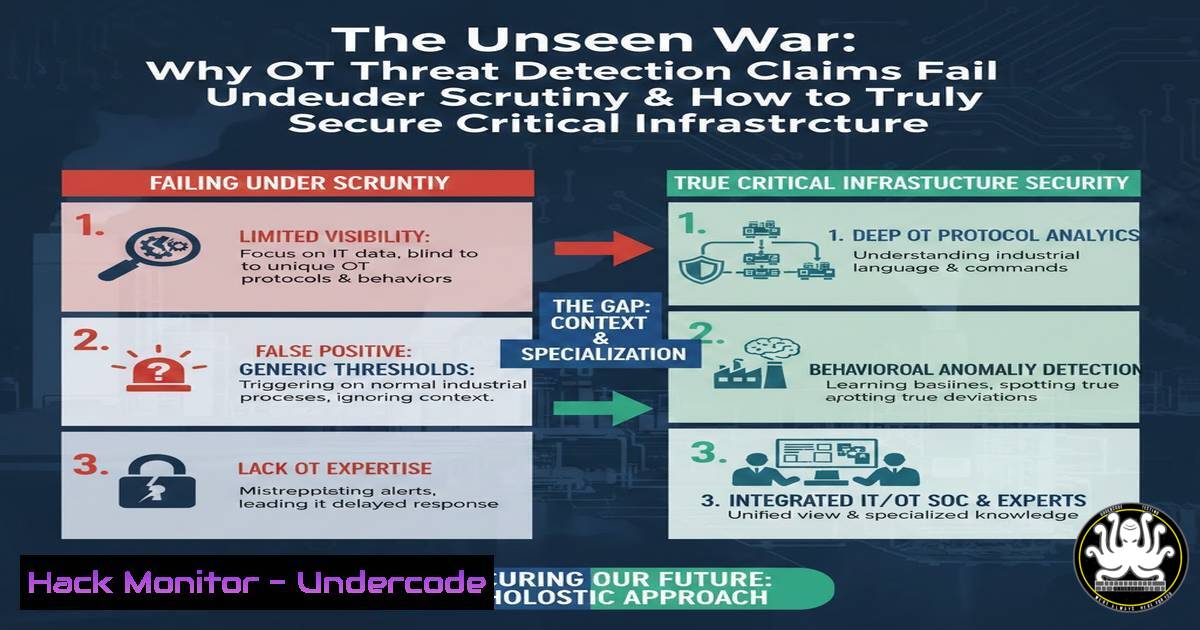
Introduction:
Operational Technology (OT) cybersecurity vendors often market their threat detection solutions with impressive claims of thwarting attacks. However, industry experts on platforms like LinkedIn are raising critical questions about the lack of transparent, independently verified data on actual cyber-physical attack prevention. This article delves into the reality behind the marketing, examining the challenges of OT threat validation and providing actionable technical guidance for building a defensible industrial environment.
Learning Objectives:
- Understand the critical gap between vendor claims and independently verified OT security incident data.
- Learn to implement foundational network visibility and segmentation controls that are more impactful than opaque detection tools.
- Master practical commands and configurations for hardening OT networks and detecting true anomalies.
You Should Know:
1. The Data Black Hole: Scrutinizing Vendor Claims
The post highlights a pervasive issue: vendors publish self-reported numbers, but independent, peer-reviewed data on OT detection efficacy is virtually non-existent. This creates a “trust me” market where ROI is difficult to prove. The first step isn’t buying a tool; it’s establishing a baseline you can measure yourself.
Step-by-step guide:
First, establish network visibility to create your own truth. On a passive monitoring sensor or span port, use tools like `tcpdump` to capture initial traffic.
 Capture traffic on interface eth0, saving to a file for baseline analysis
sudo tcpdump -i eth0 -w ot_baseline_capture.pcap -c 10000
Analyze this with Wireshark or Zeek to profile normal OT protocols (MODBUS, DNP3, S7comm). Document all communicating assets and their typical traffic patterns. This independent baseline is your reference point against which any vendor’s “detections” must be compared.
2. Foundational Hardening: Segmentation Over Silver Bullets
Before investing in advanced detection, enforce micro-segmentation. A properly configured firewall is more valuable than an unproven anomaly detection alert. In OT environments, this often means whitelisting exact protocol commands between specific assets.
Step-by-step guide:
On a Linux-based firewall (e.g., using iptables), create explicit allow rules for OT traffic. First, deny all by default on the OT interface (eth1):
sudo iptables -A INPUT -i eth1 -j DROP
sudo iptables -A FORWARD -i eth1 -j DROP
Then, allow only specific MODBUS TCP traffic from a known engineering workstation (192.168.1.10) to a PLC (192.168.1.100):
sudo iptables -A FORWARD -i eth1 -p tcp -s 192.168.1.10 -d 192.168.1.100 --dport 502 -j ACCEPT
On Windows-hosted firewalls, use PowerShell:
New-NetFirewallRule -DisplayName "Allow MODBUS to PLC-1" -Direction Inbound -Protocol TCP -LocalPort 502 -RemoteAddress 192.168.1.10 -Action Allow -Profile Any
3. Implementing Transparent Logging for Auditable Security
If a solution “detects and thwarts” an attack, there must be an auditable trail. Configure your OT assets and security appliances to log critical events to a dedicated, secure SIEM.
Step-by-step guide:
For Linux-based collectors, configure `rsyslog` to forward OT device logs. Edit /etc/rsyslog.conf:
 Enables UDP reception for devices that only support syslog
module(load="imudp")
input(type="imudp" port="514")
 Forward all OT facility logs to central SIEM
. @10.10.10.50:514
For Windows event collection from HMI/SCADA servers, use the built-in `wevtutil` to query critical system logs and forward them:
 Query recent critical and error events from System log
wevtutil qe System /q:"[System[(Level=1 or Level=2)]]" /f:text /rd:true
4. Practical Anomaly Detection with Open-Source Tools
Leverage lightweight, scriptable tools to create your own detection logic based on your known baseline. This demystifies what “detection” entails.
Step-by-step guide:
Use `zeek` (formerly Bro) with a custom policy to detect anomalous MODBUS function codes. Create a file modbus-detection.zeek:
@load protocols/modbus
event modbus_message(c: connection, headers: ModbusHeaders, is_orig: bool)
{
if (headers$func_code == 0x10)  Write Multiple Registers
{
local src = c$id$orig_h;
if (src != 192.168.1.10)  Not the authorized engineering station
{
print fmt("POTENTIAL ATTACK: Unauthorized MODBUS write from %s at %s", src, c$start_time);
}
}
}
Run Zeek with this policy: zeek -i eth0 -C modbus-detection.zeek.
5. API Security for Cloud-Connected OT Systems
Modern OT systems often have data historians or maintenance interfaces exposed via APIs. These are prime targets and must be secured independently of network-layer detection.
Step-by-step guide:
Harden a REST API endpoint (e.g., a Node.js service for OT data) by implementing strict authentication and rate limiting. Use the `express-rate-limit` package:
const rateLimit = require('express-rate-limit');
const apiLimiter = rateLimit({
windowMs: 15  60  1000, // 15 minutes
max: 100, // Limit each IP to 100 requests per window
message: 'Too many requests from this IP',
skipSuccessfulRequests: false,
});
app.use('/api/ot-data', apiLimiter); // Apply to OT data endpoint
Additionally, validate all input against a strict schema to prevent command injection via API parameters.
6. Vulnerability Mitigation: Patching in an OT Environment
Detection is secondary to prevention. Patching OT systems requires a careful, validated process to avoid downtime.
Step-by-step guide:
- Isolate & Test: Create a mirrored test environment (virtualized or spare hardware). Apply patches here first.
- Validate Integrity: After patching a Windows-based HMI, check critical service dependencies:
Get-Service -Name "OPCHDA", "Wonderware" | Select-Object Name, Status, StartType
- Controlled Deployment: Use OT-aware patch management tools or manual procedures during scheduled maintenance windows. Document the hash of the patch file before deployment and verify it on the target system.
7. Building an Independent Validation Framework
The core demand from the experts is verifiable data. Build an internal framework to test any detection solution’s claims.
Step-by-step guide:
Set up a safe testbed with a PLC simulator (e.g., `pycomm3` for Allen-Bradley, `snap7` for Siemens) and a threat simulator like Caldera’s ATLAS framework. Run known-bad TTPs (Tactics, Techniques, and Procedures) from MITRE ATT&CK for ICS, such as unauthorized ladder logic uploads.
 Example snippet using snap7 to simulate a benign vs. malicious write
import snap7
client = snap7.client.Client()
client.connect('192.168.1.100', 0, 1)  PLC IP, Rack, Slot
 Benign write to a data block
client.db_write(1, 0, b'\x00\x10')
 Malicious write attempt to a critical system block (to be detected)
client.db_write(0, 0, b'\x00\xFF')
Measure if your (or your vendor’s) detection solution triggers with a true positive and no false alarm for the benign activity. This creates your own evidence base.
What Undercode Say:
Trust Must Be Earned, Not Marketed: The absence of independent, peer-reviewed data on OT attack prevention is a critical industry vulnerability. Security decisions cannot be based on vendor anecdotes.
Focus on Controls, Not Just Detection: A robust security posture is built on immutable fundamentals—segmentation, least privilege, and comprehensive logging. These provide proven防御 (defense) where detection promises often fail.
The expert skepticism shown in the LinkedIn thread is warranted and healthy. The OT security market is maturing, but claims of “thwarting attacks” remain largely unverified theater. The resources spent on opaque detection platforms may be better invested in fundamental hygiene, skilled personnel, and open-source tools that provide complete transparency. Until vendors submit their solutions to independent, adversarial testing under frameworks like the MITRE Engenuity ATT&CK Evaluations for ICS, their numbers should be considered marketing, not metrics. The future belongs to architectures that are secure by design and verifiable by evidence.
Prediction:
The growing expert demand for transparency will catalyze the formation of independent OT security testing consortia by 2026-2027. Similar to how AV-TEST and ICS-CERT operate for IT and ICS advisories, these bodies will establish standardized testbeds and publish comparative data on OT detection solution efficacy. This will trigger a market shakeout, favoring vendors who design for verifiable security over those relying on fear, uncertainty, and doubt (FUD). Regulatory frameworks will begin to mandate evidence-based security validation for critical infrastructure, moving the entire industry from promises to proofs.
▶️ Related Video (72% Match):
🎯Let’s Practice For Free:
IT/Security Reporter URL:
Reported By: Ralph Langner – Hackers Feeds
Extra Hub: Undercode MoN
Basic Verification: Pass ✅


