
Listen to this Post
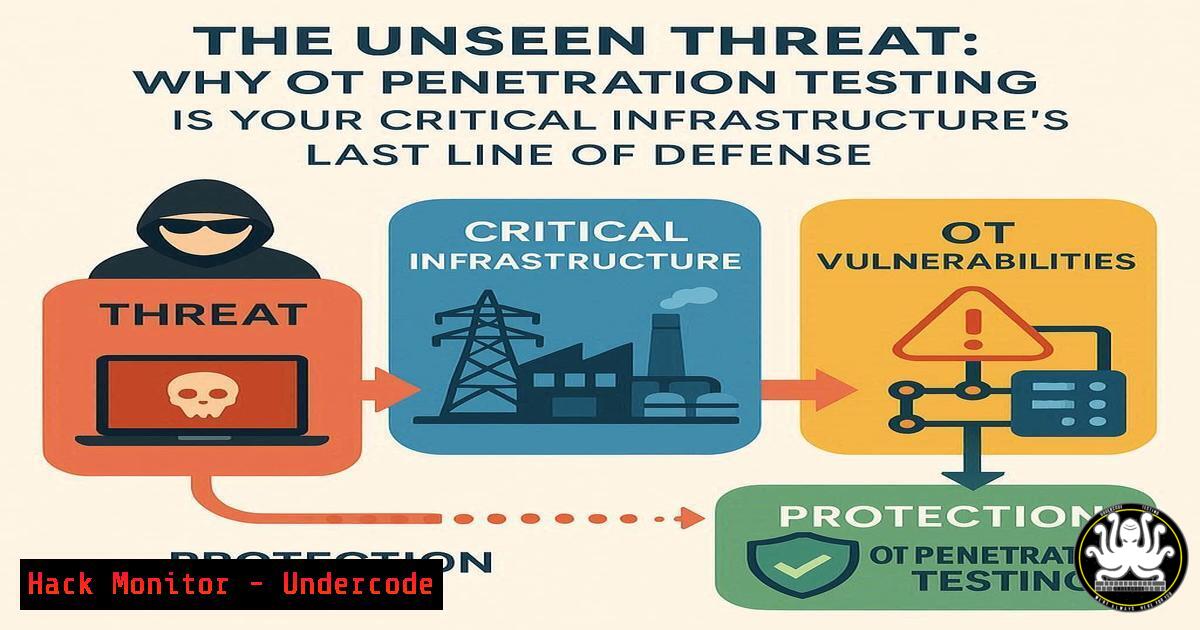
Introduction:
Operational Technology (OT) environments, which control our most vital industrial processes, are no longer isolated air-gapped systems. The convergence of IT and OT networks has exposed critical infrastructure to a new wave of cyber threats. Traditional IT security tools are often blind to the unique protocols and legacy systems that underpin these environments, making specialized OT penetration testing not just a best practice, but a necessity for national security.
Learning Objectives:
- Understand the fundamental tools and techniques used in an OT penetration test.
- Identify the most common and critical vulnerabilities plaguing industrial control systems.
- Learn practical commands and mitigation strategies to harden OT networks against real-world attacks.
You Should Know:
1. Network Discovery and Asset Identification
The first step in any OT penetration test is passive and active discovery to map the attack surface without disrupting processes.
Verified Commands & Tools:
nmap -sU --script snmp-info <OT_Target_IP>: Discovers SNMP-enabled devices and extracts system information.onesixtyone -c communitystrings.txt <OT_Target_Range>: Bruteforces SNMP community strings.arp-scan --localnet: Passively discovers devices on the local network segment.
– `Wireshark` filter: `eth.type == 0x88ba` – Captures IEC 61850 GOOSE packets.
Step-by-Step Guide:
Begin with passive reconnaissance using tools like `Wireshark` to sniff network traffic for industrial protocols (e.g., Modbus TCP, S7comm). This avoids sending packets that could destabilize sensitive equipment. Once passive mapping is complete, proceed with low-intensity active scans. For example, use the `nmap` command above with the `-sU` flag for UDP scans to find programmable logic controllers (PLCs) and RTUs using SNMP. The `onesixtyone` tool is crucial for identifying the often-default “public” and “private” community strings that grant read/write access.
2. Exploiting Insecure Industrial Protocols
Legacy industrial protocols were designed for reliability, not security, and often lack authentication or encryption.
Verified Commands & Tools:
python3 modbus-cli.py -r <HOST> -p 502 --read 0 10: Reads 10 holding registers starting at address 0 from a Modbus device.napalm --host <PLC_IP> --username admin --password admin "show plc": Uses the NAPALM network automation library to interface with a PLC.python plcscan.py -t <TARGET> -p S7: Scans for Siemens S7 PLCs and gathers device information.
Step-by-Step Guide:
After identifying a Modbus TCP device on port 502, use a tool like `modbus-cli` to interact with it. The command shown connects to the target and reads the first 10 holding registers. These registers could contain critical process values, setpoints, or even control logic. An attacker can write to these registers using the `–write` flag to manipulate the physical process, such as changing a temperature setpoint to a dangerous level. Always test for the ability to write to coils (discrete outputs) that may directly control actuators or valves.
3. Gaining Footholds via Engineering Workstations
Engineering workstations are high-value targets as they often have direct control and programming access to field devices.
Verified Commands & Tools:
searchsploit siemens tia portal: Searches for known exploits in the Siemens TIA Portal engineering software.metasploit > use exploit/windows/scada/ge_proficy_cimplicity_mes: Metasploit module targeting GE Cimplicity.pth-winexe -U <DOMAIN>/<USER>%<NTLM_HASH> //<TARGET_IP> cmd: Pass-the-hash attack to gain command execution on a Windows-based engineering workstation.
Step-by-Step Guide:
If an attacker can compromise the corporate IT network, they can pivot to the OT network. Using tools like `Responder` or `Impacket` to capture NTLM hashes is a common technique. Once a hash is captured from a user who may have access to the OT zone, the `pth-winexe` command can be used for lateral movement. This command uses the Pass-the-Hash technique to authenticate to the engineering workstation without needing the plaintext password, granting the attacker a command shell and potentially full control over the PLC programming environment.
4. PLC Program Extraction and Manipulation
Extracting the running logic from a PLC allows an attacker to understand the process and embed malicious code.
Verified Commands & Tools:
snap7_client -db_get 1 <PLC_IP>: Uses the Snap7 library to download data block 1 from a Siemens S7-1200/1500 PLC.python2 s7_upload_1500.py <PLC_IP>: Script to upload the entire project from an S7-1500 PLC.python mbtget.py -a <PLC_IP> -f 5 -t 4 -c 1 -r 100: Reads 100 coils from a Modbus device, which can help map the control logic.
Step-by-Step Guide:
Using the Snap7 library, an attacker can connect to a Siemens S7 PLC. The `snap7_client` tool with the `-db_get` flag allows for the download of specific data blocks. In a more advanced attack, the `s7_upload_1500.py` script can be used to pull the entire project file from vulnerable S7-1500 controllers. This extracted logic can be reverse-engineered offline to find weaknesses, and then malicious code can be written and downloaded back to the PLC, creating a persistent and deeply embedded threat.
5. Vulnerability Scanning with OT-Aware Tools
Using standard IT scanners on OT networks can cause outages. Specialized OT scanners are required.
Verified Commands & Tools:
./otscanner --script safe -p 502,20000,44818 --rate-limit 10 <target_range>: Runs a safe-scans-only OT scanner.cls-softing -i <IP> -d: Connects to a CoDeSys gateway to enumerate devices.shodan search "port:502 GRMM": Uses Shodan CLI to find exposed Melsec-Q PLCs on the internet.
Step-by-Step Guide:
Configure an OT-aware scanner like `otscanner` with a limited packet rate (--rate-limit 10) and specify only OT-relevant ports (-p 502,20000,44818). The `–script safe` flag ensures it only uses benign identification queries. Running a Shodan search via its CLI, as shown, is a critical step in an external assessment to discover if any OT assets are inadvertently exposed to the public internet, a surprisingly common finding with severe consequences.
6. Hardening and Mitigation Strategies
Penetration testing is useless without remediation. The following are critical hardening steps.
Verified Commands & Configurations:
- Windows FW: `netsh advfirewall set allprofiles state on`
– Cisco IOS: `access-list 110 deny tcp any any eq 22 log`
– Siemens S7: Set `PUT/GET` communication to “Disabled” in TIA Portal HW configuration. - Network Segmentation: `iptables -A FORWARD -s
-d -j DROP`
Step-by-Step Guide:
Implement strict network segmentation. On a Linux-based gateway, use the `iptables` command shown to explicitly block all traffic originating from the IT network destined for the OT network, only allowing specific, whitelisted communications. On OT endpoints, enable the host firewall using the `netsh` command. For PLCs, a fundamental hardening step is to disable the “PUT/GET” communication feature in the Siemens TIA Portal, which prevents unauthorized remote read/write access that many exploitation tools rely on.
7. Continuous Monitoring and Anomaly Detection
Securing an OT environment is an ongoing process that requires continuous monitoring.
Verified Commands & Tools:
– `zeek -i eth0 -C` : Runs the Zeek (formerly Bro) network security monitor on an interface to generate protocol logs.
– suricata -c /etc/suricata/suricata.yaml -i ot_interface: Starts the Suricata IDS/IPS with OT-specific rules.
– Sigma Rule for PLC Stop: `detection: selection: function_code: 0x10` (Detects Modbus diagnostic ‘restart communications’ commands).
Step-by-Step Guide:
Deploy a network monitoring tool like `Zeek` on a SPAN port in the OT network. The command `zeek -i eth0 -C` will start it on interface `eth0` and log all connections and protocols. Analyze these logs for anomalies, such as connection attempts from unknown IPs or commands sent during unusual hours. Implement Sigma rules, like the one shown for detecting a Modbus ‘restart’ command, into your SIEM to alert on potentially malicious control commands that could halt a process.
What Undercode Say:
- The Air Gap is a Myth. Every test reveals pathways, however convoluted, from the corporate IT network to the OT floor. Relying on physical isolation is a catastrophic failure in strategy.
- Legacy Equals Vulnerability. The pervasive use of unsupported operating systems and unpatched, decade-old PLCs creates an attack surface that cannot be patched away, demanding compensatory defensive controls.
The analysis from recent engagements confirms that state-level actors are not just probing but actively mapping critical infrastructure OT networks. The techniques outlined are not theoretical; they are actively used in pre-positioning campaigns. The common thread is not advanced zero-days, but the exploitation of foundational security failures: weak credentials, unsegmented networks, and unmonitored industrial protocols. The regulatory push for mandatory testing is a direct response to this clear and present danger, forcing asset owners to confront risks they have long ignored.
Prediction:
The mandatory adoption of OT penetration testing will create a two-tiered landscape in critical infrastructure security. Organizations that proactively embrace it will develop resilient, defensible architectures. Those who do it only for compliance will remain vulnerable. We predict a short-term increase in the discovery of deeply embedded adversaries already present in OT networks. In the longer term, as defenses improve, attackers will pivot to softer targets in the water and food processing sectors and will increasingly develop malware designed specifically to evade the OT monitoring solutions now being deployed.
🎯Let’s Practice For Free:
IT/Security Reporter URL:
Reported By: Activity 7381830537801416704 – Hackers Feeds
Extra Hub: Undercode MoN
Basic Verification: Pass ✅


