
Listen to this Post
Introduction:
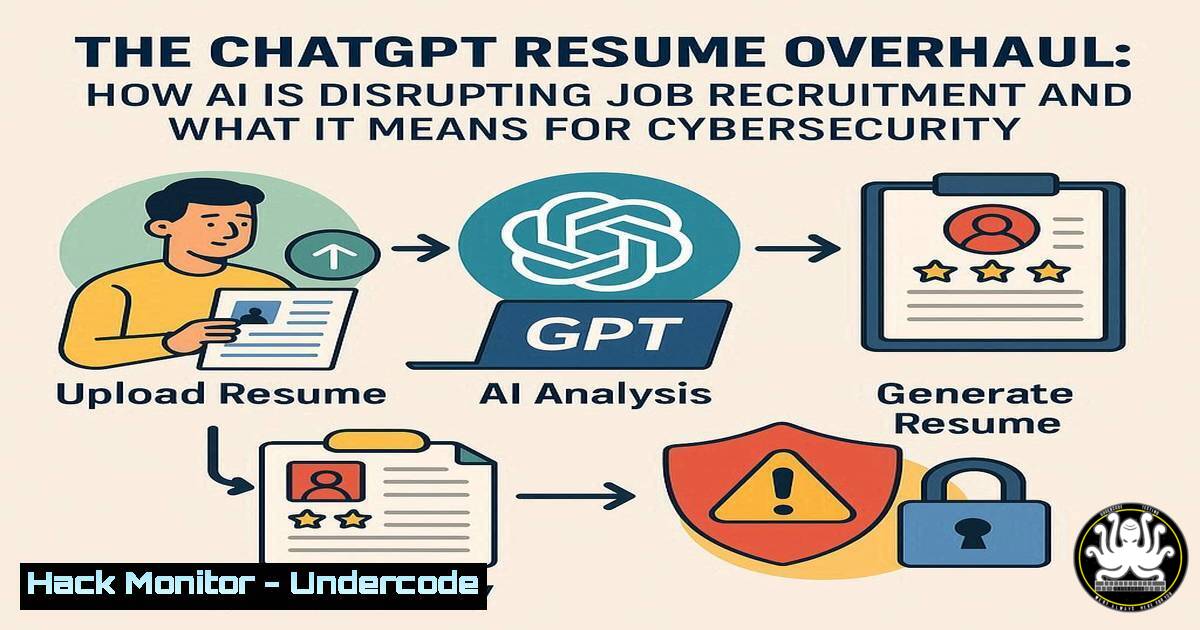
The use of generative AI for resume crafting is rapidly becoming a standard practice for job seekers. This trend, while boosting applicant success, introduces novel attack vectors for social engineering and poses significant challenges for corporate security teams tasked with verifying candidate credentials. The seamless ability to tailor applications and generate compelling narratives demands a new layer of vigilance in the hiring lifecycle.
Learning Objectives:
- Understand the cybersecurity implications of AI-generated resumes and application materials.
- Learn to identify potential indicators of AI-use and credential inflation in job applications.
- Implement technical and procedural controls to harden the recruitment process against AI-powered deception.
You Should Know:
1. Detecting AI-Generated Text with Statistical Analysis
While not foolproof, command-line tools can analyze writing style. A high “perplexity” score can indicate AI-generated text, as AI models often produce more predictable text than humans.
`pip install openai-detector`
`detect-gpt –api-key YOUR_API_KEY sample_text.txt`
Step-by-step guide:
This command uses a model trained to distinguish between human and AI-written text. First, install the package via pip. Replace `YOUR_API_KEY` with a valid API key for the service (if required). The `sample_text.txt` file should contain the text you wish to analyze, such as a cover letter or resume summary. The tool will output a probability score indicating the likelihood the text was AI-generated. Use this as one data point among many, not a definitive verdict.
2. Enhancing LinkedIn SSRF Defenses
With attackers using tailored resumes to phish recruiters, ensuring your external profile parsing services are secure is critical. Test for Server-Side Request Forgery (SSRF) vulnerabilities.
`gobuster dir -u https://internal-corporate-portal/ -w /usr/share/wordlists/dirb/common.txt -p http://yourendpoint.burpcollaborator.net`
Step-by-step guide:
This Gobuster command attempts to discover internal services via a potential SSRF flaw. The `-u` parameter is the target URL you control that fetches external content. The `-w` specifies a wordlist of common paths. The `-p` option forces the use of a proxy (like Burp Suite) to monitor all requests. If the application makes a request to your collaborator endpoint, it confirms SSRF susceptibility, which could be exploited by a malicious link in a resume.
3. Validating Certificate Authenticity
AI-generated resumes may list fraudulent certifications. Use command-line tools to verify the TLS certificates of linked learning platforms.
`openssl s_client -connect coursera.org:443 -servername coursera.org | openssl x509 -noout -subject -issuer -dates`
Step-by-step guide:
This OpenSSL command connects to a domain (e.g., coursera.org) and retrieves its SSL certificate details. The `-servername` extension is crucial for SNI. The output is piped to another OpenSSL command to extract key fields: the `subject` (who the cert is for), `issuer` (who signed it), and `dates` (validity period). Verify this information against the known legitimate certificate details of the educational provider to spot phishing sites linked from resumes.
4. Scripting ATS Keyword Analysis
Applicant Tracking Systems (ATS) rely on keywords. A malicious actor could use AI to stuff a resume with irrelevant but high-value security terms to bypass filters.
`cat resume.txt | tr ‘[:upper:]’ ‘[:lower:]’ | tr -sc ‘[:alnum:]’ ‘\n’ | sort | uniq -c | sort -nr`
Step-by-step guide:
This Linux command pipeline analyzes a text file (resume.txt). It first converts all text to lowercase, then translates non-alphanumeric characters into newlines, effectively splitting the text into one word per line. It then sorts the words, counts unique occurrences (uniq -c), and finally sorts the list by count in reverse order. This reveals the most frequently used words, helping identify potential keyword stuffing with terms like “SOC2,” “NIST,” or “Zero-Trust” that are not contextualized.
5. Python Script for Profile Consistency Checking
Automate the cross-referencing of information between a resume and public profiles like LinkedIn or GitHub.
`import requests
from bs4 import BeautifulSoup
linkedin_profile = “https://linkedin.com/in/example”
response = requests.get(linkedin_profile)
soup = BeautifulSoup(response.content, ‘html.parser’)
Add logic to extract job titles, tenures, and skills
print(soup.find(‘title’))`
Step-by-step guide:
This Python script uses the `requests` library to fetch a LinkedIn profile page and `BeautifulSoup` to parse the HTML. While a simple example that just prints the page title, it can be extended with logic to scrape specific data points like job titles, employment dates, and listed skills. Discrepancies between the resume and the public profile can be a red flag for credential inflation aided by AI.
6. YARA Rule for Identifying AI-Prompt Language
Create YARA rules to scan documents for phrases commonly associated with AI-generated content.
`rule AI_Generated_Resume_Indicators
{
meta:
description = “Detects common AI resume rewrite phrases”
strings:
$a = “results-driven”
$b = “orchestrated”
$c = “leveraged”
$d = “synergized”
$e = “quantifiable results”
condition:
3 of them
}`
Step-by-step guide:
YARA is a tool designed to help identify and classify malware, but it can be repurposed to scan for text patterns. This rule defines a set of strings (overused buzzwords that AI prompts often inject). The condition is met if any three of these strings are found within the document. This rule can be run against downloaded resume files as part of an automated screening process to flag potentially AI-generated content for manual review.
7. Hardening HR Systems with Logging and Monitoring
Implement robust logging on your career portal and ATS to detect scanning and automated attacks.
` Auditd rule to monitor access to resume database
-a always,exit -F arch=b64 -S open,openat,openat2 -F path=/ats/resumes/ -F perm=rw -k access_resume_db`
Step-by-step guide:
This `auditd` rule for Linux systems will generate a log entry any time the specified directory (/ats/resumes/) is accessed for reading or writing. The `-k` option tags the log with a keyword (access_resume_db) for easy searching. Monitoring these logs for unusual access patterns, especially from non-HR IP ranges or at strange times, can help detect a compromised account or an insider threat attempting to exfiltrate candidate data.
What Undercode Say:
- The democratization of AI-powered resume writing fundamentally lowers the barrier to entry for social engineering, making phishing lures more credible and targeted.
- Security teams must now treat the recruitment pipeline as a primary attack surface, requiring the same level of scrutiny as email gateways or perimeter defenses.
The shift from human-crafted to AI-optimized resumes is not merely a productivity hack; it’s a strategic threat. Attackers can now generate flawless, highly targeted application materials at scale, perfect for spear-phishing campaigns against HR and hiring managers. The linked “free courses,” while potentially legitimate, could also serve as a template for credential-stuffing attacks if the platforms are impersonated. The core vulnerability is no longer just poorly written code, but the inherent trust we place in professionally presented information. Defenses must evolve from verifying skills to verifying authenticity, incorporating behavioral analysis and continuous credential validation throughout the employee lifecycle.
Prediction:
Within two years, we will see the first major corporate breach directly attributed to a threat actor who used AI-generated resumes and social engineering to gain a foothold within an organization. This will catalyze a new market for AI-detection and verification tools specifically for HR tech, integrating directly into ATS platforms. The arms race between AI-powered deception and AI-powered defense will become a central battleground in corporate cybersecurity.
🎯Let’s Practice For Free:
IT/Security Reporter URL:
Reported By: Shristi Mishra – Hackers Feeds
Extra Hub: Undercode MoN
Basic Verification: Pass ✅


