
Listen to this Post
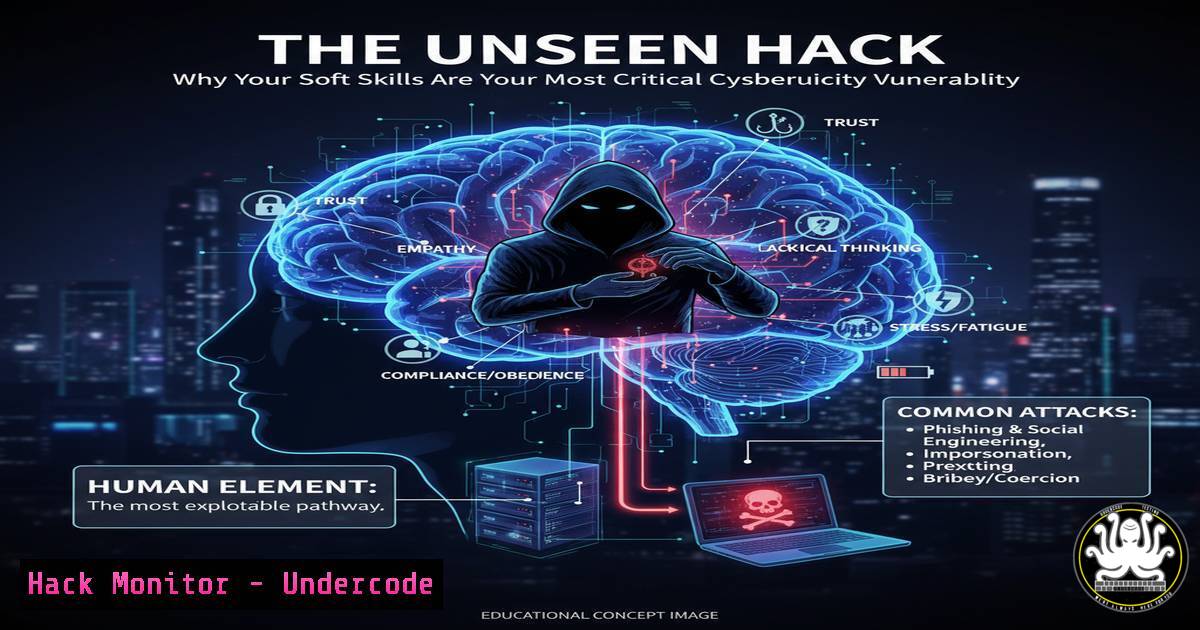
Introduction:
In the high-stakes world of cybersecurity, technical prowess is the visible arsenal—firewalls, intrusion detection systems, and encryption algorithms. However, the most devastating breaches often exploit a far more vulnerable attack surface: the human element and the organizational gaps created by poor communication, siloed teams, and a lack of critical thinking. This article explores how strengthening non-technical “soft” skills is not just a career booster but a fundamental component of a robust security posture, turning your team into a human firewall.
Learning Objectives:
- Understand how communication breakdowns and social engineering create critical security gaps.
- Learn to apply critical thinking and problem-solving frameworks to identify and mitigate sophisticated threats.
- Develop strategies for fostering a collaborative, adaptable, and security-conscious organizational culture.
You Should Know:
- The Social Engineering Kill Chain: Phishing Command & Control
Social engineering remains the primary vector for initial compromise. Understanding its mechanics is the first step toward defense.
Verified Command/Tool: `theHarvester` – OSINT Gathering
 Install theHarvester (Kali Linux pre-installed)
sudo apt-get install theharvester

Perform a basic reconnaissance against a target domain
theHarvester -d "target-company.com" -b google,linkedin -l 500
Step-by-step guide: This command performs open-source intelligence (OSINT) gathering. `-d` specifies the target domain. `-b` defines the data sources (in this case, Google and LinkedIn). `-l` limits the number of results. An attacker uses this to gather employee emails and names from public sources, which are then used to craft highly targeted spear-phishing emails. Defensively, you can use this tool to see what information about your organization is publicly available.
2. Operational Security (OPSEC) for IT Professionals
OPSEC is the process of protecting critical information by analyzing your digital footprint from an adversary’s perspective.
Verified Command: `shodan` CLI – Internet Exposure Check
 Install the Shodan CLI
pip install shodan

Initialize with your API key (requires a free account)
shodan init YOUR_API_KEY

Search for your organization's exposed services
shodan search "org:'Your Organization Name'"
Step-by-step guide: Shodan is a search engine for internet-connected devices. This command queries the Shodan database for all services, servers, and devices associated with your organization that are exposed to the internet. It helps identify forgotten databases, unsecured webcams, or misconfigured web servers that an attacker could exploit, allowing you to remediate them before they are discovered maliciously.
- Critical Thinking in Log Analysis: Hunting for Anomalies
Relying solely on automated alerts is insufficient. Critical thinking is required to hunt for subtle, multi-stage attacks.
Verified Command: PowerShell – Suspicious Process Discovery
 Get a list of all running processes, their IDs, and command lines
Get-WmiObject Win32_Process | Select-Object Name, ProcessId, CommandLine

Filter for potentially malicious scripts or uncommon locations
Get-WmiObject Win32_Process | Where-Object {$<em>.CommandLine -like "powershell -ep bypass" -or $</em>.Path -like "\temp\"} | Select-Object Name, ProcessId, Path
Step-by-step guide: The first command lists all running processes. The second filters for high-risk indicators, such as PowerShell execution with the execution policy bypassed (-ep bypass) or processes running from a user’s temp directory—common tactics for fileless malware and living-off-the-land (LOL) binaries. This manual investigation is a direct application of critical thinking to uncover threats that evade signature-based detection.
4. Incident Response Communication: Structured Handoffs
During a security incident, clear and precise communication is vital to avoid missteps and ensure a swift response.
Verified Template: Incident Report Snippet
INCIDENT TICKET: IR-2023-001
STATUS: ACTIVE
SEVERITY: HIGH
TIMELINE:
- T+0h: Unusual outbound traffic detected from `host-WS-104` (10.10.1.104) to IP <code>185.153.199.42</code>.
- T+0h15m: Host isolated from network via NAC policy.
- T+0h30m: Memory dump acquired. Disk image in progress.
NEXT STEPS: Analyze memory dump for malicious process injection. Await disk image for forensic analysis.
ACTION REQUIRED FROM NETWORK TEAM: Confirm host quarantine and review firewall logs for related connections.
Step-by-step guide: This structured format ensures that all team members, regardless of their shift or department, have the same context. It eliminates ambiguity, assigns clear ownership, and provides a chronological record of the event, which is crucial for both mitigation and post-incident reporting.
5. Infrastructure as Code (IaC) Security: Collaborative Hardening
IaC allows for consistent, version-controlled deployment of infrastructure, but misconfigurations can be propagated at scale.
Verified Code Snippet: Terraform – Secure S3 Bucket Configuration
resource "aws_s3_bucket" "secure_logs_bucket" {
bucket = "my-company-secure-logs-2023"
acl = "private"

Enable versioning for log integrity
versioning {
enabled = true
}

Block all public access
server_side_encryption_configuration {
rule {
apply_server_side_encryption_by_default {
sse_algorithm = "AES256"
}
}
}

Enforce TLS for data in transit
policy = <<EOF
{
"Version": "2012-10-17",
"Statement": [
{
"Effect": "Deny",
"Principal": "",
"Action": "s3:",
"Resource": [
"arn:aws:s3:::my-company-secure-logs-2023",
"arn:aws:s3:::my-company-secure-logs-2023/"
],
"Condition": {
"Bool": {
"aws:SecureTransport": "false"
}
}
}
]
}
EOF
}
Step-by-step guide: This Terraform code provisions an AWS S3 bucket with security best practices applied by default. It ensures the bucket is private, encrypts data at rest, maintains object versions for recovery, and uses a bucket policy to explicitly deny any requests that do not use TLS (SSL), preventing accidental data exposure. Using IaC fosters collaboration between development and security teams to “shift left” and embed security into the design phase.
6. API Security: The Criticality of Input Validation
APIs are the backbone of modern applications and a prime target due to weak authentication and flawed logic.
Verified Code Snippet: Node.js/Express – Basic Input Sanitization
const express = require('express');
const helmet = require('helmet');
const app = express();

app.use(helmet()); // Sets various security headers
app.use(express.json({ limit: '100kb' })); // Limit payload size

app.post('/api/v1/login', (req, res) => {
// Input validation and sanitization
const { username, password } = req.body;

// Validate input exists and is a string
if (typeof username !== 'string' || typeof password !== 'string') {
return res.status(400).json({ error: 'Invalid input types.' });
}

// Sanitize: Trim whitespace and enforce length limits
const sanitizedUsername = username.trim().substring(0, 50);
const sanitizedPassword = password.trim().substring(0, 100);

// ... Proceed with authentication logic using sanitized inputs ...
});
Step-by-step guide: This code demonstrates several key practices. The `helmet` library sets secure HTTP headers. The payload size is limited to prevent denial-of-service attacks. Most importantly, the input is both validated for type and sanitized by trimming and limiting length, which helps mitigate injection attacks and unexpected behavior caused by malformed data.
7. Leadership in Crisis: Coordinating a Tabletop Exercise
A leader’s ability to manage stress, delegate tasks, and maintain team morale during an incident is a soft skill that directly impacts technical outcomes.
Verified Guide: Tabletop Exercise Scenario Snippet
SCENARIO: "Midnight Sun"
NARRATIVE: A threat actor group has announced they will wipe all data from the company's primary cloud storage at 06:00 UTC tomorrow. They have provided sample data as proof.
INJECT 1 (T+0m): The CEO calls the CISO, demanding an immediate assessment.
QUESTION: What are the first three technical commands you run for triage? Who do you notify?
INJECT 2 (T+30m): A junior admin suggests paying the ransom to buy time.
QUESTION: How does the team lead facilitate this discussion, weighing the ethical, technical, and business impacts?
Step-by-step guide: Tabletop exercises simulate a security incident in a low-stakes environment. This scenario tests not just technical knowledge (what commands to run) but also leadership, communication, and ethical decision-making under pressure. The facilitator’s role is to guide the discussion, ensuring all perspectives are heard and a cohesive, documented response plan is developed.
What Undercode Say:
- The Human Layer is the New Perimeter: The most sophisticated technical defenses can be rendered useless by a single phishing email or a miscommunication during an incident response. Investing in security awareness, clear communication protocols, and critical thinking training provides a ROI that surpasses any single piece of security hardware.
- Adaptability is the Ultimate Defense: The threat landscape evolves daily. A team that is trained to think critically, collaborate across silos, and adapt its processes is inherently more resilient than one that only knows how to configure a specific, static toolset. The ability to learn and pivot is a strategic security control.
The analysis is clear: a narrow focus on technical skills creates a brittle security posture. The modern cybersecurity professional must be a hybrid—a technically competent individual who is also an effective communicator, a analytical thinker, and a collaborative team player. The attacks of the future will not just exploit software zero-days, but also cultural and communicative weaknesses within an organization. Building a culture of security, where every team member feels responsible and empowered to speak up, is the only sustainable defense.
Prediction:
The convergence of AI-powered social engineering and the increasing complexity of hybrid cloud environments will make soft skills the primary differentiator between compromised and resilient organizations. We will see a rise in “cognitive hacking,” where attackers use AI to analyze communication patterns and craft hyper-personalized deception campaigns. Simultaneously, the speed of attacks will outpace manual human response, forcing teams to rely on AI co-pilots. The most successful security teams will be those whose members possess the emotional intelligence and leadership skills to manage these AI tools effectively, interpret their complex outputs, and make nuanced, ethical decisions in seconds—a future where the line between human and machine defense blurs, but where human judgment remains the ultimate authority.
🎯Let’s Practice For Free:
IT/Security Reporter URL:
Reported By: Activity 7379380588492869633 – Hackers Feeds
Extra Hub: Undercode MoN
Basic Verification: Pass ✅


