
Listen to this Post
Introduction:
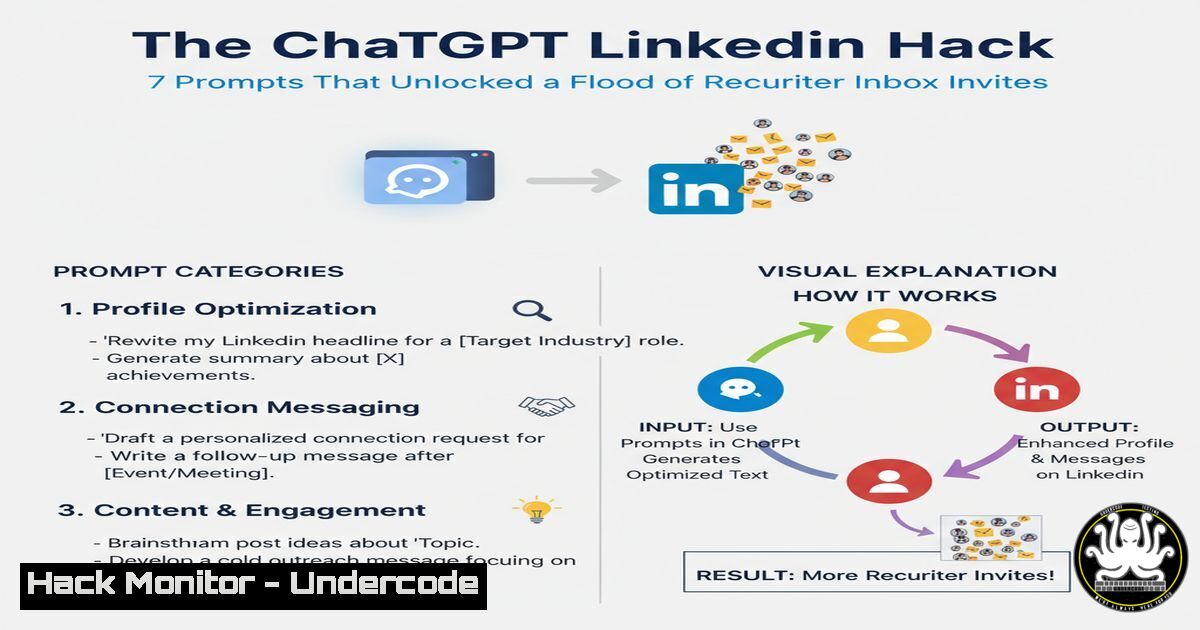
In the modern digital job market, your online profile is your first line of defense and your primary weapon of attack. A cybersecurity-minded professional understands that a LinkedIn profile is not merely a digital resume; it is a critical system in your personal infrastructure that requires hardening, constant monitoring, and strategic optimization to repel obscurity and attract high-value targets. By applying systematic, AI-powered prompts, you can effectively patch vulnerabilities in your professional narrative and deploy a robust, keyword-fortified presence that recruiters are programmed to find.
Learning Objectives:
- Understand how to use structured AI prompts to conduct a security-style audit and rebuild of your LinkedIn profile.
- Learn to embed high-value, industry-specific keywords to improve your visibility in recruiter search algorithms.
- Develop a sustainable 7-day engagement plan to maintain an active and authoritative presence in your professional network.
You Should Know:
1. Profile Reconnaissance & Vulnerability Assessment
Just as a penetration tester starts with reconnaissance, you must first identify weaknesses in your profile.
Prompt to Use: “Act like a hiring manager in [bash]. Review this LinkedIn profile summary and tell me exactly what’s weak, vague, or missing.”
This prompt initiates a threat assessment on your professional narrative. It forces the AI to adopt the perspective of an adversary (the hiring manager) whose goal is to filter you out. The output will highlight vague statements like “results-oriented professional,” which are the equivalent of default passwords, and identify missing skill credentials that act as security gaps in your profile’s armor.
2. Headline Keyword Injection
Your headline is the beacon broadcast to the recruiting scanner; it must contain the correct cryptographic keys (keywords).
Prompt to Use: “Based on my experience in [industry/skills], write a LinkedIn headline that’s keyword-rich, clear, and makes me stand out — without sounding generic.”
This process is akin to configuring a server banner to reveal only the necessary, secure, and enticing information. For a cybersecurity professional, instead of “Cybersecurity Expert,” a hardened headline would be: “Zero-Trust Architect | Cloud Security (AWS, Azure) | OSCP, CISSP | Penetration Testing & Incident Response.” This string contains multiple high-value keywords that recruiter Boolean search strings are designed to detect.
- Summary Exploit Code – The Reverse Shell of Personal Branding
A powerful summary is like a well-crafted reverse shell—it creates a compelling connection back to the reader.
Prompt to Use: “Write a compelling LinkedIn summary that highlights my biggest wins, unique value, and personality — in 3 short paragraphs.”
This constructs your narrative payload. The AI will help you encode your experience with measurable results (e.g., “Reduced corporate attack surface by 30% through implementation of a new SIEM tool”), which are the ‘proof-of-concepts’ of your capabilities. This moves your profile from being a static target to an active agent that demonstrates proven value.
4. Experience Section: Logging and Auditing Your Wins
Your experience section is the audit log of your career. Without specific, actionable entries, it is useless for forensic analysis (i.e., getting hired).
Prompt to Use: “Rewrite these 3 job descriptions using action verbs, measurable results, and keywords recruiters in [bash] actually search for.”
This command refactors your log entries. It transforms “Responsible for network security” into “Orchestrated the deployment of a campus-wide NAC solution, enforcing 802.1X authentication for 5,000+ endpoints and mitigating rogue device threats.” The latter is a specific, auditable event with a measurable impact, making your value tangible and verifiable.
5. Skills Portfolio: Building Your Defense Arsenal
Your skills are your toolset. Listing them is not enough; you must demonstrate a curated, relevant arsenal.
Prompt to Use: “List the top 10 LinkedIn skills I should add for someone trying to get hired as a [target role] — based on what hiring managers look for.”
This performs an intelligence gathering operation on the job market. For a target role like “Cloud Security Engineer,” the AI might return: 1. AWS, 2. Azure, 3. Terraform (Infrastructure as Code), 4. Docker, 5. Kubernetes, 6. Python, 7. SIEM (e.g., Splunk), 8. Threat Modeling, 9. CIS Benchmarks, 10. OWASP Top 10. This list becomes your verified command list for profile configuration.
- Active Engagement: The Persistent Threat Campaign for Visibility
In cybersecurity, persistence is key. The same applies to your job search.
Prompt to Use: “Give me a 7-day plan to comment on posts in my industry that raises my visibility, attracts profile visits, and builds credibility.”
This script generates your engagement campaign. A sample 7-day plan might include:
– Day 1: Find a post about a recent CVE. Comment with a brief analysis of the exploit mechanism.
– Day 2: Engage with a thought leader’s post on Zero-Trust, adding a practical implementation tip.
– Day 3: Share a link to a relevant OWASP cheat sheet with a sentence on its utility.
This consistent, value-driven activity keeps your profile in the “active processes” list of your network’s feed.
7. Thought Leadership: Deploying Your Own Intelligence Feed
Establishing authority means generating your own intelligence, not just consuming it.
Prompt to Use: “Write 5 post ideas that share insights, lessons, or tips from my career — so I can show up as credible without sounding like I’m bragging.”
This is the final stage of operational control. The AI will help you craft content that demonstrates expertise, such as:
– “A breakdown of how I used Wireshark to diagnose a lateral movement attempt.”
– “3 common misconfigurations in AWS S3 buckets I see during audits (and how to fix them).”
This transforms your profile from a target into a command-and-control center for your personal brand.
What Undercode Say:
- Your LinkedIn profile is a system that can be hacked for positive outcomes using the right, systematic commands.
- The synergy between AI-powered optimization and genuine human engagement creates an unstoppable personal marketing machine.
The methodology outlined in the source post is a masterclass in leveraging AI for career advancement. It transcends simple profile editing and enters the realm of strategic personal infrastructure management. By treating the profile as a system—with inputs (prompts), processes (AI analysis), and outputs (an optimized profile)—the user applies an engineer’s mindset to a marketing problem. The provided prompts are not mere suggestions; they are functional scripts that, when executed correctly, reconfigure a user’s digital presence to be discoverable, credible, and compelling. The inclusion of free, high-value course links (like the Google Cybersecurity Professional Certificate) further arms the individual with the substantive skills needed to back up the newly polished profile, creating a full-spectrum career development attack plan.
Prediction:
The strategic use of AI for personal brand optimization will soon become a non-negotiable standard, much like a well-formatted CV was a decade ago. As AI tools become more sophisticated and integrated into recruitment platforms, profiles that are not engineered for machine parsing and human appeal will be systematically filtered into obscurity. This will create a new digital divide: those who can effectively co-pilot with AI to manage their career trajectory will see unprecedented opportunity, while those who rely on traditional, static methods will find their inbound opportunities rapidly diminish. The future of job seeking is proactive, AI-augmented, and operates with the precision of a targeted cyber campaign.
🎯Let’s Practice For Free:
IT/Security Reporter URL:
Reported By: Ashutoshkumar1161 Naked – Hackers Feeds
Extra Hub: Undercode MoN
Basic Verification: Pass ✅


