Listen to this Post
Introduction:
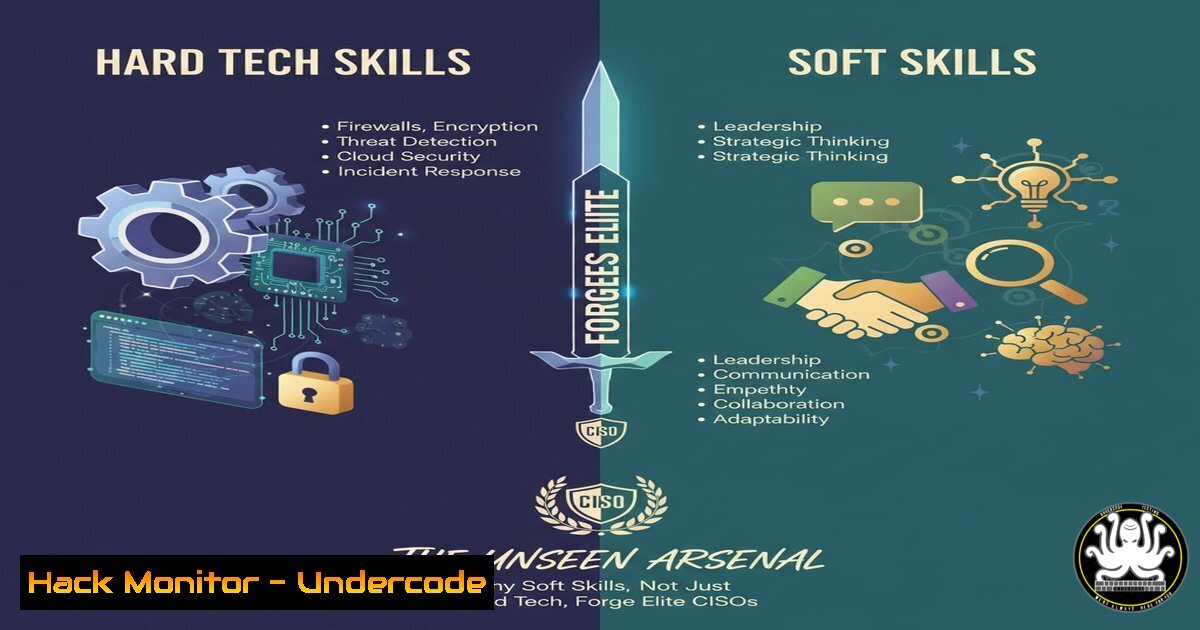
The traditional path to the CISO or RSSI role was often paved with deep technical expertise, but the modern threat landscape demands a more nuanced leader. As cybersecurity becomes a core business enabler, the ability to communicate risk, influence culture, and align security with business objectives is paramount. This article deconstructs the essential blend of non-technical competencies and foundational technical knowledge required to excel in a top-tier security leadership position.
Learning Objectives:
- Understand the critical soft skills for effective security leadership and stakeholder management.
- Identify the foundational technical commands and concepts a CISO must comprehend to maintain credibility.
- Learn how to translate technical vulnerabilities into business-impact risk for executive audiences.
You Should Know:
- The Art of the Brief: Translating Nmap Scans for the Board
A CISO doesn’t run scans, but they must understand and explain their implications. Knowing the output allows you to tell a compelling story.
Verified Command:
nmap -sV -sC --script vuln target-company.com
Step-by-step guide:
This Nmap command performs a service version detection (-sV), runs default scripts (-sC), and executes vulnerability scripts (--script vuln). A CISO should interpret the results not as a list of ports, but as a map of unauthorized entry points. For example, an exposed SSH service on port 22 becomes a narrative: “An unsecured remote access point could allow an attacker to bypass our perimeter defenses, directly threatening our intellectual property. The financial impact of a breach via this vector is estimated at X.”
2. Cloud Security Posture: Interpreting Misconfiguration Alerts
Cloud security is a primary business risk. A CISO must grasp the gravity of common misconfigurations reported by tools like AWS Security Hub or Azure Security Center.
Verified Command (AWS CLI):
aws s3api get-bucket-policy-status --bucket my-bucket-name
Step-by-step guide:
This command checks if an S3 bucket policy is public. The output will show `”IsPublic”: true` or false. A technically-astute CISO uses this not as an operational task, but as a key risk indicator. They can authoritatively state to the board: “Our marketing data bucket is configured for public access, violating our data governance policy and creating a direct compliance failure under GDPR, with potential fines of up to 4% of global revenue.”
- The Password Policy Paradox: Technical Enforcement vs. User Behavior
Mandating complex passwords is a technical control, but a CISO understands its limitations and the need for complementary solutions like MFA.
Verified Command (Windows PowerShell):
Get-ADDefaultDomainPasswordPolicy
Step-by-step guide:
This PowerShell cmdlet retrieves the active directory domain password policy. The output includes complexity requirements, minimum length, and lockout duration. A leader uses this data to steer policy discussions, arguing, “While our technical policy enforces 12-character passwords, this alone is insufficient. We must invest in user-friendly MFA to mitigate the risk of credential phishing, which technical complexity does not address.”
- Vulnerability Management: Prioritization with CVSS and Business Context
A CISO must guide their team beyond CVSS scores to risk-based prioritization using context.
Verified Command (Using curl with Vuln API):
curl -s "https://services.nvd.nist.gov/rest/json/cves/2.0?cveId=CVE-2021-44228" | jq '.vulnerabilities[bash].cve.metrics.cvssMetricV31[bash].cvssData.baseScore'
Step-by-step guide:
This command fetches the CVSS base score for Log4Shell (CVE-2021-44228) from the NVD API. A score of 10.0 is critical, but a CISO’s job is to add context: “This score is a 10, but its criticality for us is a 9 because our critical payment processing servers do not use the vulnerable Java component. Our priority is the score 8.5 vulnerability in our public-facing web servers, as they handle customer data.”
5. Incident Response Readiness: Validating Your Playbooks
A leader ensures the IR process is not just a document but a practiced capability.
Verified Command (Linux Forensic Triage):
ps aux --sort=-%mem | head -10
Step-by-step guide:
During a suspected incident, this command lists the top 10 processes by memory usage. A CISO doesn’t run this command live, but they understand its purpose. They can challenge their team: “Our IR playbook says we run memory analysis on compromised hosts. Show me the procedure and the tools we use. How quickly can we determine the scope of an attack based on process lineage?”
- API Security: The Silent Threat in Business Integrations
APIs are the backbone of modern business applications, and their security is a key board-level concern.
Verified Command (Using jq to parse API logs):
cat api_access.log | jq '. | select(.status_code == 500) | .request_uri' | sort | uniq -c | sort -nr
Step-by-step guide:
This command parses a JSON-formatted API log to find endpoints frequently returning 500 Internal Server errors, which can indicate unhandled exceptions and potential vulnerabilities. A CISO translates this for the CTO: “A high rate of errors on our customer data API endpoint could signal an attacker probing for injection flaws. This poses a direct risk to our core product’s integrity and customer trust.”
7. Logging and Accountability: The Foundation of Governance
A CISO ensures that logging answers the critical question: “Who did what, and when?”
Verified Command (Linux Audit Log Search):
ausearch -k "privileged-access" | aureport -f -i
Step-by-step guide:
This command searches the Linux audit logs for events tagged with the key “privileged-access” and generates a report. This is a control verification. The CISO’s role is to ask, “Can our current logging prove which administrator accessed the financial server at the time of the irregularity? Our compliance framework requires this level of accountability.”
What Undercode Say:
- Leadership is Translation: The primary role of a modern CISO is to act as a universal translator, converting the binary language of technology into the financial language of the boardroom and the operational language of engineering teams.
- Credibility is Grounded in Fundamentals: While you don’t need to be the top technical expert, a complete absence of hands-on knowledge destroys credibility with the very teams you rely on to execute your strategy. Understanding the “how” is crucial for defining the “why.”
The debate ignited by Ana Griman highlights a pivotal shift in cybersecurity leadership. The analysis confirms that the era of the purely technical CISO is fading. The most effective leaders are those who can architect a security-aware culture, a task that is fundamentally human-centric. They use their technical foundation not to configure firewalls, but to ask the right questions, challenge assumptions, and build bridges between the SOC and the C-suite. This hybrid model—a strategist who speaks tech and business fluently—is becoming the new gold standard. The future of organizational resilience depends less on a single tool and more on a leader’s ability to weave security into the very fabric of the business.
Prediction:
The CISO role will continue its evolution from a technical manager to a strategic business executive, often reporting directly to the CEO. Future hiring trends will prioritize demonstrated leadership, communication skills, and financial acumen over deep, hands-on technical certifications. We will see the rise of the “Chief Risk Storyteller,” a leader whose value is measured by their ability to articulate cyber risk in terms of brand reputation, market share, and shareholder value, fundamentally integrating security into corporate governance and long-term business strategy.
🎯Let’s Practice For Free:
IT/Security Reporter URL:
Reported By: Ana Griman – Hackers Feeds
Extra Hub: Undercode MoN
Basic Verification: Pass ✅


