Listen to this Post
Introduction
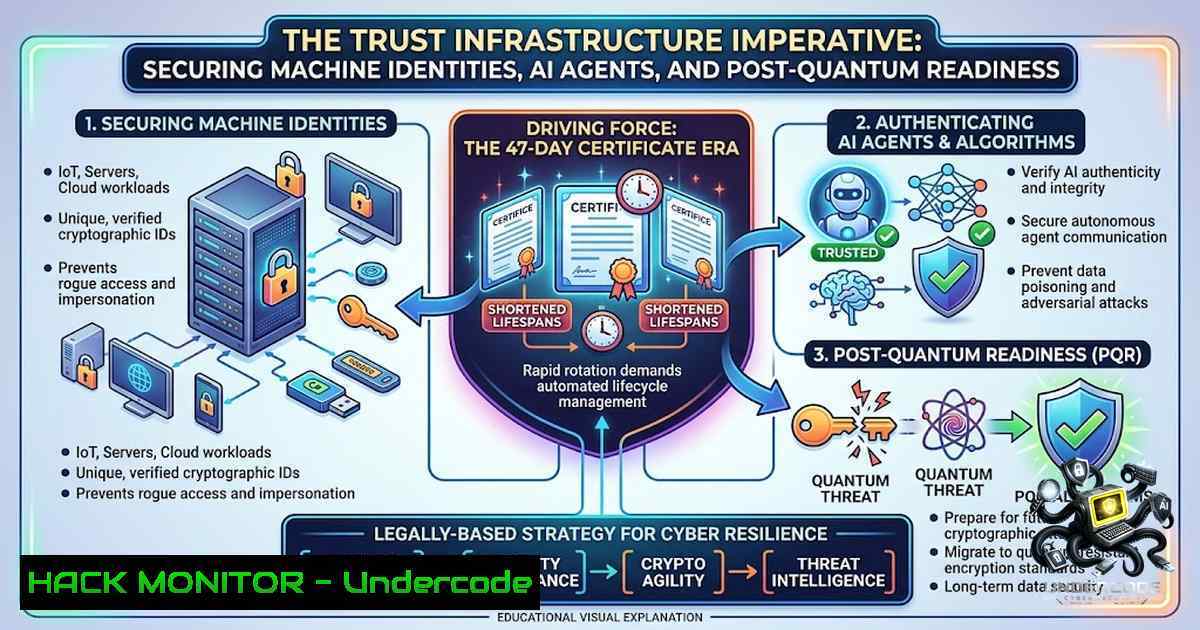
The cryptographic foundations that underpin every digital interaction—from API calls between microservices to autonomous AI agents executing enterprise workflows—are undergoing a seismic transformation. As certificate lifespans compress from 398 days to just 47 days by 2029, AI-driven identity sprawl explodes, and post-quantum deadlines loom, organizations can no longer treat trust infrastructure as a “configure once and forget” commodity. Black Hat 2026 made one thing clear: machine identities and cryptography are now strategic business priorities, not back-office IT concerns.
Learning Objectives
- Understand the four converging forces reshaping enterprise trust infrastructure: AI identity sprawl, 47-day certificate lifecycles, post-quantum cryptography migration, and rising regulatory expectations
- Master automated certificate lifecycle management techniques using ACME, Certbot, and EJBCA to handle 700% increases in renewal workloads
- Implement cryptographic identity for AI agents using certificate-based authentication rather than shared secrets or SSH keys
- Build a post-quantum readiness roadmap aligned with NIST standards and regulatory deadlines (2030–2035)
You Should Know
- AI Starts with Identity: Cryptographic Verification for Agentic AI
Every AI agent—whether an autonomous reasoning system, an RPA bot, or a Model Context Protocol (MCP) client—requires a cryptographically verifiable identity to communicate and operate securely. The threat model for AI agents differs fundamentally from human identities: agents can be hijacked, impersonated, or used to end-run security policies through reasoning capabilities. Traditional authentication methods like SSH keys or shared secrets are insufficient; certificate-based identity provides non-repudiable proof of who an agent is and what it’s authorized to do.
Step-by-Step Guide: Issuing Short-Lived Certificates for AI Agents
- Deploy a PKI capable of short-lived certificate issuance using EJBCA or another enterprise CA that supports validity periods as short as minutes or hours.
-
Configure certificate profiles for AI agent identities with appropriate Subject Alternative Names (SANs), key usages, and extended key usages.
-
Integrate with the Model Context Protocol (MCP) to enable AI assistants to securely query certificate status and request identities. Keyfactor Command’s MCP server allows natural-language queries like “Find the certificate that poses the highest risk to my organization”.
-
Automate issuance using the ACME protocol. For Linux environments, configure Certbot against an EJBCA ACME endpoint:
 Install Certbot
sudo apt-get install certbot

Request a certificate with 47-day validity
certbot certonly --standalone -d agent-01.internal.domain \
--server https://ejbca.yourdomain.com/.well-known/acme \
--validity 47d
For Windows environments, use win-acme:
 Download and run win-acme
wacs.exe --target manual --host agent-01.internal.domain \
--validation selfhosting --server https://ejbca.yourdomain.com
- Implement automated rotation using orchestrators that monitor certificate expiry and trigger renewals before the 47-day window closes.
-
The 47-Day Deadline: Automating Certificate Lifecycles at Scale
The CA/Browser Forum’s phased reduction of publicly trusted SSL/TLS certificate validity—from 398 days today to 200 days in 2026, 100 days in 2027, and finally 47 days by 2029—represents a 700% increase in renewal workload. For an organization managing 1,000 certificates, this means approximately 7,800 renewal-and-deploy cycles annually. Manual processes simply cannot keep pace.
Step-by-Step Guide: Building an Automated Certificate Lifecycle Management Pipeline
- Discover and inventory every certificate in your environment—internal and external, across cloud, on-premises, and hybrid deployments. Use discovery tools to identify:
 Linux: Find all certificates in common locations
find /etc/ssl /usr/local/etc/ssl /opt -1ame ".crt" -o -1ame ".pem" 2>/dev/null

Use openssl to check expiration dates
for cert in $(find /etc/ssl -1ame ".crt"); do
echo "$cert: $(openssl x509 -enddate -1oout -in $cert)"
done
 Windows PowerShell: Find certificates in all stores
Get-ChildItem -Path Cert:\ -Recurse | Where-Object {$_.PSPath -match "My"} |
Select-Object Subject, NotAfter, Thumbprint
- Assign ownership and map dependencies—certificates often fall through cracks because no one knows who is responsible. Integrate certificate data into ServiceNow, Jira, or your ITSM platform.
-
Set up proactive monitoring and alerts that trigger 30+ days before expiration—not just 7 days.
-
Automate renewal first, then provisioning. Begin with the lowest-hanging fruit: automated renewal using your existing CA tools. Configure Keyfactor Command workflows:
 Example workflow definition for 47-day certificate automation
workflow:
name: "Auto-Renew-47Day"
trigger:
type: "expiration"
threshold_days: 15
actions:
- type: "enroll"
template: "WebServer-47Day"
validity: "47d"
- type: "deploy"
targets:
- type: "IIS"
- type: "Apache"
- type: "F5-LoadBalancer"
- Progressively automate provisioning to web servers, load balancers, APIs, and containers. Use multiple automation protocols: ACME for web services, SCEP for mobile/legacy systems, EST or REST APIs for modern platforms.
-
Adopt a continuous loop model: Observe → Analyze → Provision → Orchestrate → Govern.
-
The Quantum Transition: Preparing for Cryptographically Relevant Quantum Computers
With NIST’s post-quantum cryptography standards finalized in 2024 and regulatory deadlines accelerating—U.S. federal agencies must deprecate quantum-vulnerable cryptography by 2030 and disallow it by 2035—organizations face a “Harvest Now, Decrypt Later” threat where adversaries collect encrypted data today for decryption once quantum computers mature. The G7 Cybersecurity Working Group and national cybersecurity agencies (NCSC, ENISA, BSI) have all issued parallel guidance.
Step-by-Step Guide: Building a Post-Quantum Readiness Roadmap
- Conduct a cryptographic inventory to identify every instance of RSA and ECC in your environment—TLS certificates, code signing, SSH keys, VPNs, and application-layer encryption.
-
Prioritize by data sensitivity lifespan—data that must remain confidential for 10+ years requires immediate attention.
-
Implement crypto-agility—the ability to swap cryptographic algorithms without rebuilding applications. The Keyfactor Trust Control Plane provides continuous visibility into cryptographic assets across network, cloud, code, and applications.
-
Deploy hybrid cryptographic modes (PQC + RSA/ECC) during transition to maintain backwards compatibility while building quantum resilience.
-
Begin testing NIST-standardized algorithms including CRYSTALS-Kyber for key encapsulation and Dilithium for digital signatures.
6. Align with regulatory timelines:
- 2027: All new U.S. National Security System acquisitions must comply with CNSA 2.0
- 2030: Federal agencies must deprecate quantum-vulnerable cryptography
- 2034–2035: G7 and UK NCSC deadlines for full PQC transition
4. Regulatory Expectations: Visibility, Governance, and Control
Regulatory requirements are placing unprecedented emphasis on cryptographic governance. Organizations must demonstrate continuous visibility into their cryptographic assets, automated compliance enforcement, and auditable control over machine identities. The White House’s June 2026 executive order accelerating federal post-quantum migration underscores the urgency.
Step-by-Step Guide: Establishing Cryptographic Governance
- Implement a unified control plane that connects PKI, certificate lifecycle management, code signing, and cryptographic intelligence into one continuous system.
-
Enforce policy-driven automation—define reusable lifecycle rules applied across entire certificate groups rather than per-certificate manual work.
-
Enable self-service workflows that scale while maintaining governance—application teams request certificates through standardized templates with pre-defined approval chains.
-
Integrate certificate status into existing dashboards and communication channels to avoid surprises.
-
Prepare for audits with real-time cryptographic posture reporting and historical compliance records.
-
Operationalizing Trust Infrastructure: Linux and Windows Commands for Daily Management
Linux Certificate Management Commands
 Check certificate expiration
openssl x509 -in /etc/ssl/certs/server.crt -1oout -enddate

Generate a CSR with 47-day validity
openssl req -1ew -1ewkey rsa:2048 -1odes -keyout server.key -out server.csr \
-subj "/CN=server.internal.domain"

Verify certificate chain
openssl verify -CAfile ca-chain.pem server.crt

Automate renewal with systemd timer
sudo systemctl edit --full certbot-renew.timer
 Add: OnCalendar=daily
Windows Certificate Management PowerShell Commands
 List all expiring certificates (next 30 days)
Get-ChildItem -Path Cert:\ -Recurse |
Where-Object {$_.NotAfter -lt (Get-Date).AddDays(30)} |
Select-Object Subject, NotAfter, PSPath

Request certificate via certreq
certreq -1ew -q -config "CA Server\CA Name" request.inf request.req

Install certificate
certreq -accept -q certificate.cer

Export certificate with private key
$pwd = ConvertTo-SecureString -String "YourPassword" -Force -AsPlainText
Export-PfxCertificate -Cert cert:\LocalMachine\My\THUMBPRINT -FilePath backup.pfx -Password $pwd
API Security Automation with mTLS
For machine-to-machine (M2M) authentication, implement mutual TLS (mTLS) with short-lived certificates:
 Nginx mTLS configuration
server {
listen 443 ssl;
ssl_certificate /etc/ssl/certs/server.crt;
ssl_certificate_key /etc/ssl/private/server.key;
ssl_client_certificate /etc/ssl/certs/ca-chain.crt;
ssl_verify_client on;
ssl_verify_depth 2;
}
What Undercode Say
- The 47-day certificate mandate isn’t a future problem—it’s already here. The phased reduction begins in March 2026 to 200 days. Organizations that haven’t started automating will face crisis-mode operations within months, not years.
-
AI agents are workload identities, not “just AI.” Treating AI agents as first-class cryptographic assets with verifiable identities—not as exotic exceptions—is the only scalable approach. SSH keys and shared secrets are security debt, not solutions.
-
Post-quantum readiness is a governance problem, not just a crypto problem. The hardest part isn’t swapping algorithms; it’s discovering where cryptography is used, mapping dependencies, and coordinating across PKI, infrastructure, and application teams.
-
Trust infrastructure requires a control plane, not point tools. Fragmented certificate management, separate PKI systems, and siloed code signing tools create blind spots. Unification into a continuous system of control—Observe, Analyze, Provision, Orchestrate, Govern—is the architectural shift required.
-
Automation is the goal, but visibility is the starting line. You cannot automate what you cannot see. Complete cryptographic discovery—across cloud, on-premises, code, and containers—must precede automation.
The convergence of AI identity sprawl, 47-day certificate lifecycles, post-quantum deadlines, and rising regulatory expectations represents a “perfect storm” that breaks the old model of trust infrastructure. Organizations that treat machine identities and cryptography as strategic assets—with continuous discovery, automated operations, and enforced governance—will lead in the AI and quantum era. Those that delay will face outages, audit failures, and security breaches as the trust infrastructure they rely on becomes untrustworthy.
Prediction
- +1 By 2028, the majority of enterprise data breaches will involve compromised machine identities or AI agents, not human credentials. The attack surface has shifted, and security investments must follow.
-
+1 Certificate lifecycle automation platforms will become as critical to IT operations as Active Directory or cloud IAM. The 47-day mandate effectively makes manual certificate management impossible at scale.
-
-1 Organizations that delay post-quantum migration until 2028–2029 will face catastrophic remediation costs and extended exposure windows as quantum capabilities approach. The 3–8 year migration timeline means starting today is already late.
-
-1 Regulatory enforcement will accelerate faster than most organizations expect. The 2026 White House executive order signals that governments view cryptographic modernization as a national security imperative, not a suggestion.
-
+1 The unification of PKI, certificate lifecycle management, and cryptographic intelligence into single control planes will become the dominant enterprise architecture by 2027, rendering fragmented point solutions obsolete.
-
+1 AI agent identity will drive the next wave of PKI innovation—short-lived certificates measured in minutes, automated issuance at scale, and integration with MCP and similar protocols will become standard capabilities within 24 months.
▶️ Related Video (74% Match):
https://www.youtube.com/watch?v=0lKSZs38Jq8
🎯Let’s Practice For Free:
🎓 Live Courses & Certifications:
Join Undercode Academy for Verified Certifications
🚀 Request a Custom Project:
Secure, high-velocity infrastructure and disruptive technological engineering. Contact our engineering team for high-tier development and proprietary systems:
[email protected]
💎 Smart Architecture | 🛡️ Secure by Design | ⭐ Trusted by Thousands
IT/Security Reporter URL:
Reported By: Blackhat Bhusa – Hackers Feeds
Extra Hub: Undercode MoN
Basic Verification: Pass ✅


