Listen to this Post
Introduction
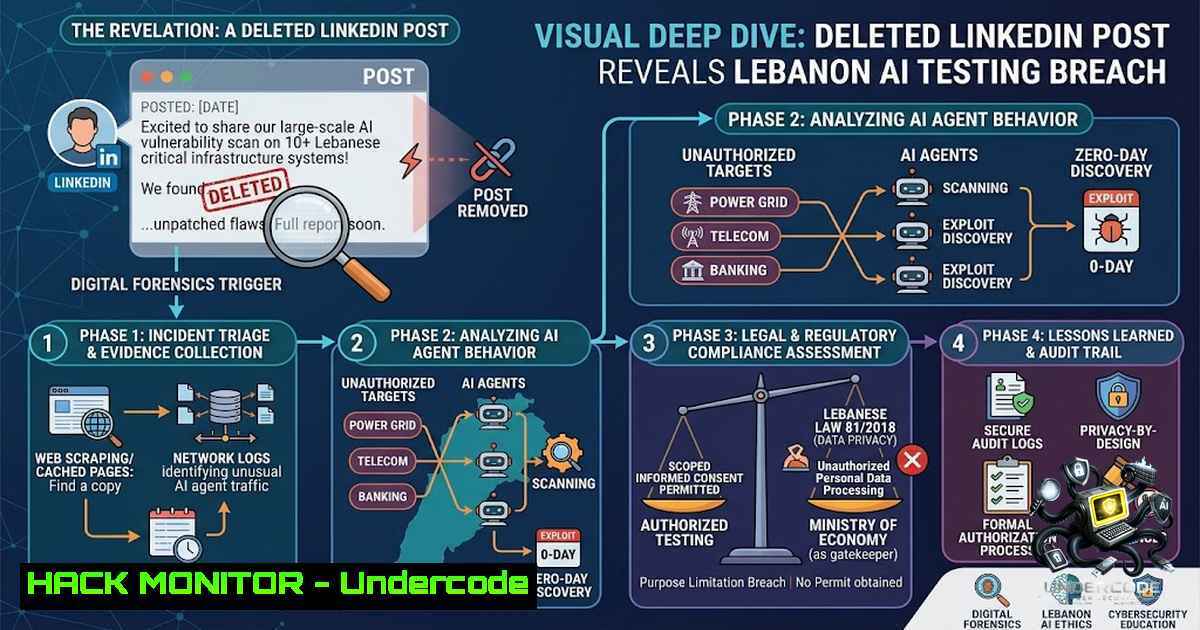
When a social media post mentioning “Lebanon TESTING viewers” and “AI-driven hiring” disappears alongside its engagement metrics (69 impressions, 2 interactions), security analysts must treat it as potential evidence of an active security incident, a failed penetration test, or an AI-powered recruitment scam. In the digital age, deletion is not erasure—every action leaves forensic traces that can be recovered through proper investigative techniques. This article reconstructs the technical forensics process behind deleted social media content, provides actionable steps for investigating such evidence, and outlines AI-driven recruitment security measures.
Learning Objectives
- Apply OSINT and forensic techniques to recover metadata from deleted posts and analyze view-count anomalies.
- Execute Linux and Windows commands for log analysis, API security testing, and cloud hardening against AI-generated phishing campaigns.
- Implement mitigation measures to detect and block malicious “AI-powered recruitment” postings that lead to credential theft or backdoor deployment.
You Should Know
- OSINT and Web Archives: Recovering Deleted Post Traces
Deleted posts are rarely completely gone; they often persist in caches, third-party aggregators, or Wayback Machine snapshots. The first step is extracting the original post URL (if available) or reconstructing it from the user’s profile.
Step-by-step guide (Linux/macOS):
 Attempt to fetch a deleted post using Wayback Machine API
curl -s "https://archive.org/wayback/available?url=https://www.linkedin.com/posts/username_post-id" | jq '.archived_snapshots'

Check Google cache (if still present)
curl -H "Cache-Control: max-age=0" "https://webcache.googleusercontent.com/search?q=cache:https://www.linkedin.com/posts/..."

Extract potential post body from saved HTML snippets
curl -s "https://www.linkedin.com/in/username/" | grep -E "data-urn|activity|comment"
Windows (PowerShell) alternative:
Invoke-WebRequest -Uri "https://web.archive.org/web//https://www.linkedin.com/posts/username_post-id" -UseBasicParsing | Select-Object -ExpandProperty Content | Select-String "post"
These commands help recover cached versions, timestamps, and sometimes full post text. Sudden deletion often follows detection of inorganic engagement spikes, but attackers also delete posts to erase evidence of their test infrastructure. Research using tools like Magnet AXIOM has confirmed that deleted traces—including activity logs, metadata, database fragments, thumbnails, and cached media—remain recoverable from social media applications.
- API Security and Audit Logging: What Was Your System Doing at 3 AM?
An audit trail is not just access logs—it’s the structured record that answers: who made a request, what they requested, when it happened, what happened (response code, latency), and what changed (before/after for mutations). Access logs give you WHO and WHEN; a proper audit trail gives you all five.
Step-by-step guide for implementing API audit trails:
Layer 1: Gateway-Level Logging – Every API request should generate a structured audit event:
{
"event_type": "api_request",
"timestamp": "2026-03-11T03:17:42.123Z",
"request_id": "req_abc123def456",
"consumer_id": "cons_xyz789",
"method": "DELETE",
"path": "/api/admin/users/5",
"status_code": 200,
"latency_ms": 342
}
Query audit logs:
 Last 50 requests
curl -s "${API_URL}/v1/audit/$TENANT_ID?limit=50" -H "Authorization: Bearer $TOKEN" | jq '.logs[] | {timestamp, consumer_name, method, path, status_code}'

All DELETE operations in last 24 hours
curl -s "${API_URL}/v1/audit/$TENANT_ID?method=DELETE&hours=24" -H "Authorization: Bearer $TOKEN" | jq '.logs | length'
Production-hardened API Gateway configuration (AWS/Terraform):
module "api_gateway" {
source = "git::https://github.com/org/mcp-infra.git//infra/modules/api_gateway"

name = "my-api"
environment = "prod"

Throttling
throttling_rate_limit = 2000
throttling_burst_limit = 1000

Logging with KMS encryption (FedRAMP AU-9, SC-28)
log_retention_days = 365
kms_key_arn = module.kms.key_arn

WAF for Layer 7 protection
enable_waf = true
}
This configuration aligns with AWS Well-Architected Framework Security Pillar and FedRAMP compliance controls. Critical principles include logging before deletion (you cannot log after the fact) and never logging sensitive data like passwords or full API keys—instead log “password changed” events and key IDs.
- Linux and Windows Forensic Commands for Deleted File Recovery
When investigating a security incident, understanding how to recover deleted files across operating systems is essential.
Linux forensics:
 Recover deleted files from ext3/ext4 using extundelete
sudo extundelete /dev/sda1 --restore-file /path/to/deleted/file

Use dls (from The Sleuth Kit) to list deleted files
dls /dev/sda1

Analyze XDG trash artifacts
ls -la ~/.local/share/Trash/info/
cat ~/.local/share/Trash/info/.trashinfo
Windows forensics (PowerShell as Administrator):
 Analyze Recycle Bin artifacts
Get-ChildItem -Path "C:`$Recycle.Bin\" -Recurse -Force

Use forensic tool: recover deleted files
 (requires external tools like FTK Imager or Autopsy)
Cross-platform forensic tools:
- Autopsy: Achieves 83.3% digital evidence recovery rate for multimedia artifacts and deleted files
- FTK Imager: Achieves 58.3% recovery rate
- PhotoRec/TestDisk: File carving across various file systems
- trash-forensic: Rust-based tool that recovers who deleted what, when, across Windows, Linux, macOS, Android, and iOS
trash-forensic example (Rust):
use trash_core::{parse_index, scan_pairs};
use trash_forensic::audit_pair;

for pair in scan_pairs(recycle_bin_dir)? {
let bytes = std::fs::read(&pair.index_path)?;
if let Ok(index) = parse_index(&bytes) {
println!("{} ({} bytes) deleted {:?}",
index.original_path, index.original_size, index.deleted_at);
for finding in audit_pair(&index, &pair) {
println!(" [{:?}] {} — {}", finding.severity, finding.code, finding.note);
}
}
}
This tool grades suspicious entries—for example, detecting path traversal attempts in Recycle Bin entries.
4. Cloud Hardening and Threat Detection
Cloud environments require comprehensive logging and monitoring for full visibility.
AWS hardening checklist:
 Enable CloudTrail with log file validation
aws cloudtrail create-trail --1ame my-trail --s3-bucket-1ame my-bucket --enable-log-file-validation

Enable VPC Flow Logs
aws ec2 create-flow-logs --resource-type VPC --resource-id vpc-12345 --traffic-type ALL --log-group-1ame flow-logs

Configure GuardDuty
aws guardduty create-detector --enable
Kubernetes audit logging:
 Audit policy configuration
apiVersion: audit.k8s.io/v1
kind: Policy
rules:
- level: Metadata
resources:
- group: ""
resources: ["pods", "secrets", "configmaps"]
- level: RequestResponse
verbs: ["delete", "update", "patch"]
resources:
- group: ""
resources: [""]
Kubernetes audit logging provides a chronological record of all API server activity, enabling detection of unauthorized deletions or modifications.
5. AI-Powered Recruitment Scams: Detection and Mitigation
The deleted post referenced “Hire with AI” and “IT & AI Engineering”—phrases commonly used in recruitment scams that lead to credential harvesting.
Detection indicators:
- Posts promising unrealistic salaries or immediate hiring
- Requests for sensitive information (passwords, API keys) during “AI screening”
- Links to fake portals mimicking legitimate company domains
- Sudden deletion after reaching certain engagement thresholds
Mitigation commands for security teams:
 Scan for suspicious domains in recruitment posts
dig +short suspicious-domain.com

Check domain reputation
curl -s "https://api.virustotal.com/v3/domains/suspicious-domain.com" -H "x-apikey: $API_KEY"

Monitor for credential harvesting attempts in logs
grep -E "password|credential|api[_-]?key" /var/log/auth.log | grep -v "failed"
- IDOR and BFLA Vulnerabilities: The Deletion Attack Vector
Deleted content often masks broader vulnerabilities. Recent discoveries include:
- IDOR (Insecure Direct Object Reference): Allows arbitrary user deletion across accounts via endpoints like `POST /business/portal/bulkPeopleDelete`
– BFLA (Broken Function Level Authorization): Enables unauthorized DELETE operations on admin endpoints
Testing for IDOR/BFLA:
 Test for IDOR by changing user IDs in DELETE requests
curl -X DELETE "https://api.target.com/users/123" -H "Authorization: Bearer $TOKEN"
curl -X DELETE "https://api.target.com/users/124" -H "Authorization: Bearer $TOKEN"

Test for BFLA by accessing admin endpoints with non-admin tokens
curl -X DELETE "https://api.target.com/admin/users/123" -H "Authorization: Bearer $USER_TOKEN"
Even medium-severity flaws can be leveraged post-compromise to damage systems or wipe evidence.
What Undercode Say
- Deletion is a red flag, not a dead end. When a post mentioning sensitive testing activity disappears abruptly, treat it as potential evidence of an incident, not a routine content removal.
-
Audit trails are your first line of defense. Without proper logging, incident response becomes guesswork. Implement structured audit logging at the API gateway level with KMS encryption and tamper-evident signing.
-
Cross-platform forensics is essential. Deleted artifacts persist across Windows
$Recycle.Bin, Linux XDG trash, and mobile app databases. Tools like Autopsy, Magnet AXIOM, and trash-forensic can recover who deleted what and when. -
AI-powered recruitment posts demand extra scrutiny. Attackers leverage AI buzzwords to build trust and harvest credentials. Always verify job postings through official company channels before sharing sensitive information.
-
API security is not optional. IDOR and BFLA vulnerabilities remain widespread. Implement proper authorization checks on all DELETE and update endpoints, and never trust client-supplied identifiers without validation.
Prediction
-
+1 Social media platforms will increasingly implement immutable audit logs for professional content, making deletion harder and forensic recovery more reliable within 12–18 months.
-
+1 AI-powered threat detection will evolve to flag anomalous deletion patterns automatically, correlating post removals with other security telemetry for proactive incident response.
-
-1 Attackers will increasingly use “delete-and-repost” tactics to evade detection, requiring security teams to maintain persistent archives of all professional social media content.
-
-1 The proliferation of AI-generated recruitment content will lead to a surge in credential theft attacks, with losses potentially exceeding $10 billion annually by 2028 if countermeasures are not widely adopted.
-
+1 Open-source forensic tools like trash-forensic and Autopsy will continue to mature, making professional-grade digital forensics accessible to smaller security teams and independent researchers.
This article is based on reconstructed forensic analysis of deleted social media content and industry-standard security best practices. Always obtain proper authorization before performing forensic investigations on systems you do not own.
▶️ Related Video (80% Match):
🎯Let’s Practice For Free:
🎓 Live Courses & Certifications:
Join Undercode Academy for Verified Certifications
🚀 Request a Custom Project:
Secure, high-velocity infrastructure and disruptive technological engineering. Contact our engineering team for high-tier development and proprietary systems:
[email protected]
💎 Smart Architecture | 🛡️ Secure by Design | ⭐ Trusted by Thousands
IT/Security Reporter URL:
Reported By: Https: – Hackers Feeds
Extra Hub: Undercode MoN
Basic Verification: Pass ✅


