
Listen to this Post
Introduction
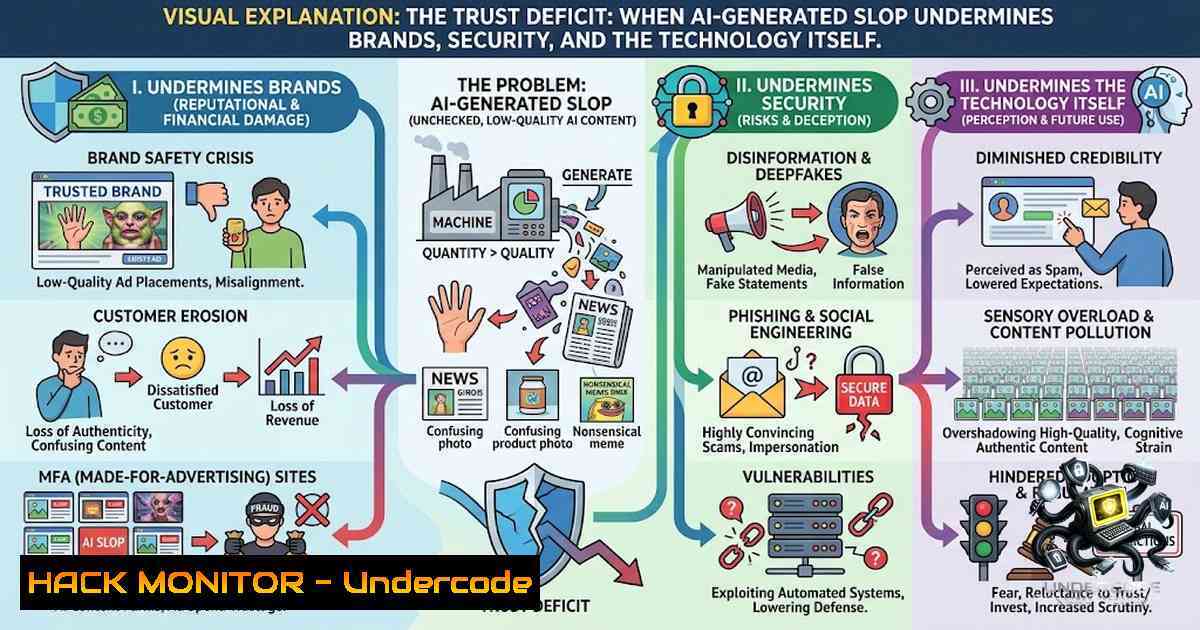
The proliferation of low-quality AI-generated content—widely termed “AI slop”—has evolved from a minor nuisance into a systemic challenge affecting brand trust, cybersecurity, and open-source sustainability. While artificial intelligence continues to offer transformative capabilities across industries, the careless deployment of generative AI without human oversight is creating a trust deficit that damages both the companies publishing the content and the perception of the technology itself. Recent events, from the 2026 Super Bowl advertising showdown to the shutdown of cURL’s bug bounty program, illustrate a critical inflection point: organizations must learn to use AI as a supportive tool rather than treating it as the entire solution.
Learning Objectives & Secrets
- Objective 1: Distinguish between AI-supported and AI-driven content strategies. Understand why Google Gemini’s “New Home” Super Bowl ad earned top marks while Svedka’s largely AI-generated spot received a failing grade—the difference lies in using AI to amplify human storytelling versus making AI the central idea.
-
Objective 2 Secret Tip: Implement AI usage policies for security reporting. The cURL project’s experience demonstrates that without clear guidelines, AI-generated vulnerability reports can overwhelm security teams. The project saw confirmed vulnerability rates drop from above 15% to below 5% as AI submissions surged. Organizations should establish explicit rules for AI-assisted security research and enforce consequences for low-quality submissions.
-
Objective 3 Secret Tip: Leverage community feedback mechanisms to filter AI slop. LinkedIn’s “Seems like AI slop” button, used by over one million users within weeks, reduced views on flagged content by 40%. This human-in-the-loop approach proves more effective than automated detection alone for maintaining content quality.
You Should Know
- The Super Bowl Case Study: AI as Support vs. AI as the Star
The 2026 Super Bowl provided a real-world laboratory for understanding how audiences perceive AI-generated content. Google Gemini’s “New Home” advertisement earned the top spot in the Kellogg School Super Bowl Advertising Review, receiving an “A” grade for its emotional storytelling that showcased how AI could support life transitions through creativity and human connection. The ad resonated because it told a clear, human story and demonstrated where AI fitted naturally into the narrative.
In stark contrast, Svedka’s largely AI-generated advertisement featuring dancing robots received a “D” grade from the same panel, described as “generally unpleasant, with no obvious benefit”. The ad was criticized for its cheap, sloppy, and uninspired quality, with viewers describing it as “nightmare fuel”.
Why This Matters for Your Organization:
When deploying AI in marketing or communications, ask yourself: Is AI supporting a human idea, or is AI the idea itself? The data confirms that consumers notice the difference. According to a December 2025 survey from Klaviyo and Datalily, when consumers notice AI-generated content in brand marketing, they are four times more likely to trust the brand less (31%) than more (just 7%).
Practical Implementation Steps:
- Audit existing AI-generated content across all channels—social media, blog posts, marketing materials, and customer communications.
- Establish a “human-first” review process where all AI-generated output is reviewed, edited, and approved by a human with domain expertise.
- Disclose AI usage transparently when it makes sense, but prioritize demonstrating genuine human value over the AI tool itself.
-
The cURL Crisis: When AI Slop Breaks Security Infrastructure
Perhaps the most alarming example of AI slop’s real-world consequences occurred in January 2026, when the cURL project—one of the most widely used open-source tools in the world—shut down its bug bounty program after six years of operation. The program had been genuinely successful, paying out over $100,000 across 87 confirmed vulnerabilities.
The tipping point came in 2025 when submission quality collapsed dramatically. The rate of confirmed vulnerabilities fell from above 15% to below 5%, meaning fewer than one in twenty submissions described a real problem. The rest was noise—much of it AI-generated or AI-influenced. Daniel Stenberg, cURL’s creator, described the situation as a DDoS attack on maintainer time, stating: “We now immediately ban every reporter we deem to have submitted an AI slob report”.
The project’s updated security.txt file now explicitly states: “We will ban you and ridicule you in public if you waste our time on crap reports”.
For Security Teams and Bug Bounty Programs:
This case study offers critical lessons for organizations running bug bounty programs or accepting external security reports:
Step-by-Step Guide to Protecting Your Security Program from AI Slop:
- Establish clear AI usage rules for security reporting. cURL now requires that anyone using AI to find vulnerabilities must follow specific guidelines—violations result in being banned from contributing.
-
Implement triage filters that can identify common AI-generated patterns: non-existent function references, imaginary patches, and vague claims that require disproportionate investigation time.
-
Set quality thresholds and enforce them consistently. Consider warning systems, temporary bans, or permanent exclusion for repeat offenders.
-
Remove financial incentives for low-quality submissions. cURL’s solution was to eliminate monetary rewards entirely, shifting to GitHub’s private vulnerability reporting with no compensation attached.
-
Protect maintainer mental health. The cURL team explicitly cited maintainer burnout and the need to protect project sustainability as reasons for the shutdown.
Relevant Commands for Security Teams:
 Example: Script to flag potential AI-generated vulnerability reports
 Look for patterns common in AI slop

Check for non-existent function references (common in AI slop)
grep -E "(function_that_does_not_exist|imaginary_api_call)" report.txt

Flag reports with overly generic language
grep -E "(potential vulnerability|may be vulnerable|could potentially)" report.txt

Count references to non-existent CVEs
grep -E "CVE-[0-9]{4}-[0-9]{4,}" report.txt | wc -l
Windows PowerShell Alternative:
 Search for AI slop indicators in security reports
Select-String -Path ".txt" -Pattern "(potential vulnerability|may be vulnerable|imaginary)"
3. Platform-Level Responses: LinkedIn’s “AI Slop” Button
LinkedIn’s response to the AI slop problem offers a scalable, community-driven solution. In July 2026, the platform launched a “Seems like AI slop” feedback option. Within weeks, over one million users had clicked the button on suspected posts and comments.
The results were significant: LinkedIn reported that members were “now experiencing 40% less views on what we classify as AI slop”. Chief Product Officer Hari Srinivasan emphasized that the platform focuses on users providing feedback to other users rather than relying solely on automated detection: “We want members to get feedback from real humans on what sounds authentic—not just have an AI detector review it and get it wrong”.
Implementation Lessons for Content Platforms and Communities:
- Empower users with simple feedback mechanisms. A single “seems like AI slop” button proved more effective than complex AI detection systems.
-
Combine human feedback with algorithmic adjustments. LinkedIn’s approach uses community feedback to inform content visibility algorithms.
-
Provide transparent feedback to content creators. LinkedIn now highlights when a post receives enough community feedback, helping creators understand how their content is perceived.
-
Build safeguards against abuse. LinkedIn implemented protections to prevent users from unfairly targeting legitimate content.
-
The Consumer Trust Crisis: Data You Cannot Ignore
The erosion of trust in AI-generated content extends far beyond social media. Multiple studies confirm a growing consumer backlash:
- 42% of consumers say they would feel negatively toward a brand that uses low-quality or “uncanny” AI-created advertising.
-
32% of US and UK consumers say AI is negatively disrupting the creator economy, up from 18% in 2023.
-
60% of US consumers report that brands using “artificial intelligence” in marketing feel off-putting.
-
86% of consumers cannot fully trust AI-generated content and will actively check original sources.
-
84% of Singaporeans believe AI-generated content should be clearly labelled, with nearly half saying their trust in a brand would decline if AI use was not disclosed.
5. Protecting Your Brand: A Strategic Framework
Based on the evidence from Super Bowl ads, cURL’s crisis, and consumer trust data, here is a strategic framework for organizations using AI:
Step-by-Step Brand Protection Guide:
- Conduct an AI content audit. Inventory all content that involves AI generation across marketing, customer support, product documentation, and social media.
-
Implement a “human-first” approval workflow. Require human review and editing for all AI-generated content before publication.
-
Develop clear AI usage policies. Document when and how AI can be used, and ensure all team members understand these guidelines.
-
Monitor consumer sentiment. Track how audiences respond to AI-generated content and be prepared to adjust strategies based on feedback.
-
Consider disclosure practices. While not always required, transparent disclosure of AI usage can build trust when done thoughtfully.
-
Invest in quality over quantity. One well-crafted piece of content with human insight is worth hundreds of AI-generated posts.
What Undercode Say
-
Key Takeaway 1: Poor AI content damages trust in the company first, but repeated exposure eventually affects trust in the technology itself. The distinction between Google’s successful “New Home” ad and Svedka’s failing AI-generated spot proves that audiences don’t reject AI outright—they reject lazy, thoughtless implementation.
-
Key Takeaway 2: The cURL bug bounty shutdown represents a warning for the entire cybersecurity ecosystem. When AI-generated noise overwhelms signal, critical security infrastructure becomes unworkable. Organizations must proactively establish safeguards before they face similar crises.
Prediction
-
+1 Organizations that treat AI as a supportive tool—enhancing human creativity, expertise, and judgment—will build stronger brand trust and achieve better outcomes than those that treat AI as a replacement for human effort. The data clearly shows that audiences reward thoughtful AI implementation.
-
-1 The volume of AI-generated low-quality content will continue to increase, potentially overwhelming more open-source projects, bug bounty programs, and content moderation systems. Without industry-wide standards and enforcement mechanisms, we may see more critical infrastructure projects shutting down or restricting access.
-
-1 Consumer trust in AI-generated content will likely continue to decline as exposure to low-quality AI content increases. Brands that fail to distinguish themselves through quality and human oversight risk being grouped with the “slop” that audiences increasingly reject.
-
+1 Community-driven solutions like LinkedIn’s “AI slop” button demonstrate that human feedback loops can effectively combat low-quality content at scale. As more platforms adopt similar mechanisms, the incentive to produce AI slop may decrease.
-
-1 The cybersecurity implications are particularly concerning: as AI tools become more sophisticated at generating convincing but虚假 reports, distinguishing genuine vulnerabilities from noise will become increasingly difficult. This could lead to more zero-day vulnerabilities going undiscovered as security teams allocate resources to triage rather than真正的 vulnerability discovery.
-
+1 Organizations that establish clear AI usage policies now—like cURL’s guidelines for AI-assisted security research—will be better positioned to maintain quality and trust as AI capabilities evolve.
▶️ Related Video (82% Match):
https://www.youtube.com/watch?v=-vLXiG2ev_s
🎯Let’s Practice For Free:
🎓 Live Courses & Certifications:
Join Undercode Academy for Verified Certifications
🚀 Request a Custom Project:
Secure, high-velocity infrastructure and disruptive technological engineering. Contact our engineering team for high-tier development and proprietary systems:
[email protected]
💎 Smart Architecture | 🛡️ Secure by Design | ⭐ Trusted by Thousands
IT/Security Reporter URL:
Reported By: https://lnkd.in/p/eju9fVH9 – Hackers Feeds
Extra Hub: Undercode MoN
Basic Verification: Pass ✅


