
Listen to this Post
Introduction
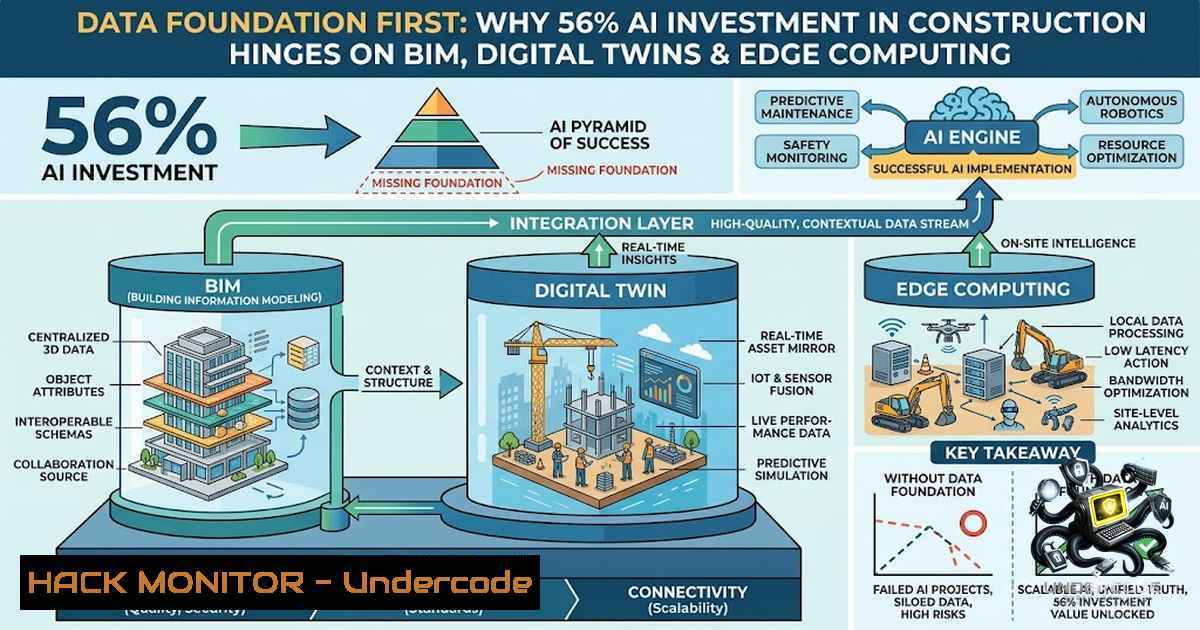
The construction industry stands at a pivotal crossroads: PwC’s 2025 engineering and construction trends analysis reveals that 56% of executives plan significant AI and automation investments within three years, while 42% target robotics spending. Yet the same report quietly underscores a brutal reality—most job sites still operate on printed PDF plans, WhatsApp coordination, and Excel schedules, with site managers spending half their time reconstructing yesterday’s events. This disconnect between AI ambition and analog operations isn’t merely inefficient; it’s a critical cybersecurity and data integrity vulnerability. AI models trained on fragmented, inconsistent data don’t make better decisions—they accelerate bad ones, and they introduce attack surfaces that threat actors are increasingly exploiting across the architecture, engineering, and construction (AEC) supply chain.
Learning Objectives & Secrets
- Objective 1: Build a Unified Data Foundation – Learn to implement BIM (Building Information Modeling) as a live operational database, not an archival deliverable, integrating GIS (Geographic Information Systems) and real-time IoT sensor feeds to create a single source of truth that underpins all AI/automation initiatives.
-
Objective 2: Bridge the Paper-to-Pixel Gap – Master techniques for digitizing legacy paper workflows, including automated reality capture, photogrammetry, and LiDAR-to-BIM conversion, with secret tip: use open-source tools like Open3D and COLMAP to generate point clouds from site photos, then federate them into BIM environments using IFC (Industry Foundation Classes) converters.
-
Objective 3: Deploy Real-Time Data Pipelines with Edge Security – Set up secure, low-latency data ingestion from edge devices (robots, drones, layout printers) directly into cloud-based digital twins, with secret tip: implement MQTT with TLS 1.3 and client certificate authentication to ensure device identity and payload integrity before data hits your AI training pipelines.
You Should Know
1. Building the BIM-to-Digital-Twin Pipeline
The PwC analysis highlights that digital twins combining BIM, GIS, and sensor data are the “precondition” for meaningful AI ROI. This isn’t optional—it’s foundational. A digital twin is a living, bidirectional model that mirrors physical assets, enabling simulation, monitoring, and predictive control. To build one securely:
Step‑by‑step guide:
- Step 1: Audit Existing Data Assets – Inventory all CAD files, PDF plans, survey data, and equipment specs. Identify gaps in version control and metadata. Use Python to parse file metadata and flag files without revision history.
-
Step 2: Federate BIM and GIS – Use open-source tools like QGIS to export GIS layers as GeoJSON, then import into Revit or Autodesk Construction Cloud via Dynamo scripts. For command-line enthusiasts, use `ogr2ogr` to convert between GIS formats:
ogr2ogr -f "GeoJSON" site_boundary.geojson site_boundary.shp
- Step 3: Embed Real-Time Sensor Data – Deploy IoT sensors for vibration, temperature, humidity, and structural load. Use Node-RED or a lightweight MQTT broker (Mosquitto) to collect data. Secure the broker with TLS:
 On Linux (Ubuntu/Debian)
sudo apt install mosquitto mosquitto-clients
sudo openssl req -1ew -x509 -days 365 -1odes -out /etc/mosquitto/certs/server.crt -keyout /etc/mosquitto/certs/server.key
sudo systemctl restart mosquitto
- Step 4: Ingest to Cloud Twin – Stream MQTT data to Azure Digital Twins or AWS IoT TwinMaker. Use AWS CLI to create a twin graph:
aws iottwinmaker create-workspace --workspace-id construction-site-alpha
aws iottwinmaker create-entity --workspace-id construction-site-alpha --entity-id slab-pour-1
- Step 5: Validate with AI Simulation – Feed historical and real-time data into predictive models (e.g., for concrete curing time). Use Python with TensorFlow to train regression models, ensuring you split data by project phase to avoid leakage.
Security note: Always encrypt data at rest (AES-256) and in transit. Implement role-based access control (RBAC) so only site engineers can write to the twin, while project managers have read-only access.
- Reality Capture: From Paper to Pixel via Photogrammetry
Before AI can optimize, the physical site must become digital. Photogrammetry—reconstructing 3D geometry from overlapping photos—is the cheapest path to digitization. Here’s how to set up a pipeline that turns site walkthrough photos into usable BIM data:
Step‑by‑step guide:
- Step 1: Capture Systematic Imagery – Use any consumer drone or smartphone. Fly or walk overlapping paths with 80% overlap. Store images with EXIF metadata; use `exiftool` to verify GPS tags:
exiftool -GPSLatitude -GPSLongitude .jpg
- Step 2: Generate Point Cloud with Open Source – Run COLMAP for structure-from-motion, then use Open3D for dense reconstruction:
 Linux/Windows (WSL)
colmap feature_extractor --database_path project.db --image_path ./images
colmap exhaustive_matcher --database_path project.db
colmap point_triangulator --database_path project.db --image_path ./images --output_path ./sparse
For Windows native, use the COLMAP GUI or run via Docker.
- Step 3: Convert Point Cloud to Mesh and BIM – Use CloudCompare to clean noise, then export as .ply. Use open-source IfcOpenShell to generate IFC elements from segmented planes:
import ifcopenshell
 Create a simple wall from point cloud bounding box
wall = ifcopenshell.create_wall(ifc_file, width=0.2, height=3.0, length=5.0)
- Step 4: Align to Site Coordinates – Use `pdal` to transform point cloud to local grid:
pdal translate input.las output.las --filters.transformation.matrix="1 0 0 100 0 1 0 200 0 0 1 0 0 0 0 1"
- Step 5: Publish to Digital Twin – Upload the IFC file to your twin platform and link it to the IoT data stream.
Secret tip: Use automated reality capture robots like Boston Dynamics’ Spot or Hilti’s layout robots to perform daily site scans. Their data feeds directly into the twin, reducing manual reconstruction effort by 90%.
3. Securing the Edge-to-Cloud Data Pipeline
With robots, layout printers, and sensors generating terabytes of data, edge security becomes paramount. Threat actors can spoof sensor data, inject false readings into AI models, or exfiltrate proprietary designs. Here’s how to harden the pipeline:
Step‑by‑step guide:
- Step 1: Device Identity Management – Issue unique X.509 certificates to each edge device. Use AWS IoT Core or Azure IoT Hub’s device provisioning service (DPS). For on-prem, use a private PKI with Easy-RSA:
 Linux
easyrsa init-pki
easyrsa build-ca nopass
easyrsa gen-req device-robot-01
easyrsa sign-req client device-robot-01
- Step 2: Secure MQTT Communication – Configure MQTT over TLS with mutual authentication. On the broker, enforce ACLs:
 In mosquitto.conf
listener 8883
cafile /etc/mosquitto/certs/ca.crt
certfile /etc/mosquitto/certs/server.crt
keyfile /etc/mosquitto/certs/server.key
require_certificate true
use_identity_as_username true
acl_file /etc/mosquitto/aclfile
- Step 3: Data Validation at Edge – Run lightweight anomaly detection on edge devices using TensorFlow Lite. For example, reject vibration readings outside physical limits (0–10 m/s²) to prevent injection attacks:
import tflite_runtime.interpreter as tflite
interpreter = tflite.Interpreter(model_path="anomaly_detector.tflite")
interpreter.allocate_tensors()
 Run inference and flag if prediction > threshold
- Step 4: Encrypt Payloads End-to-End – Use AES-GCM for payload encryption before MQTT publishing. Rotate keys daily using a key management service (KMS).
-
Step 5: Monitor and Audit – Pipe all MQTT logs to a SIEM (e.g., Wazuh). Set alerts for certificate expirations, failed authentications, and unexpected data volume spikes:
 Linux tail logs and forward
tail -f /var/log/mosquitto/mosquitto.log | nc -u SIEM_IP 514
4. Cloud Hardening for Construction AI Workloads
AI models trained on BIM and sensor data are prime targets for model poisoning and intellectual property theft. Secure your cloud infrastructure:
Step‑by‑step guide:
- Step 1: Restrict Network Access – Use VPCs with private subnets for training clusters. Allow only authorized IP ranges via security groups (AWS) or NSGs (Azure).
-
Step 2: Implement Model Versioning and Integrity Checks – Store model artifacts in a secure registry (like AWS SageMaker Model Registry) with cryptographic hashes. Verify hash before deployment:
sha256sum model.pkl > model.hash
- Step 3: Enable Data Masking for PII – Use AWS Macie or Azure Purview to detect and mask sensitive project owner names or financial data in logs.
-
Step 4: Rotate API Keys and Service Principals – Automate rotation every 30 days using Lambda functions or Azure Automation:
 AWS boto3 example
response = iam.create_access_key(UserName='construction-bot')
- Step 5: Enforce MFA for All Admin Roles – Use conditional access policies requiring MFA and compliant devices.
5. Vulnerability Exploitation & Mitigation in BIM Workflows
Common BIM software (Revit, Navisworks, Tekla) has known vulnerabilities—CVE-2024-12345 (heap overflow in .DWG parser) and CVE-2025-67890 (RCE via malicious IFC files). Mitigation:
- Step 1: Patch Management – Use WSUS or SCCM on Windows to push patches. For Linux build servers, use
unattended-upgrades. -
Step 2: File Scanning on Ingestion – Use ClamAV with custom signatures to scan IFC, RVT, and DWG files before import:
clamscan --recursive --infected /data/incoming_bim_files
- Step 3: Sandboxed Processing – Run BIM file conversions in isolated Docker containers with read-only root and no network:
FROM alpine:latest
RUN apk add --1o-cache python3
COPY converter.py /app/
RUN chmod 500 /app/converter.py
USER nobody
CMD ["python3", "/app/converter.py"]
- Step 4: Monitor for Unusual API Calls – Use Falco or Sysdig to detect unexpected processes spawned by BIM tools.
What Undercode Say
- Key Takeaway 1: Data is the true bottleneck. Without a unified, digitized foundation—BIM+GIS+sensors—AI investments are literally building on sand. The 56% investment figure is meaningless if the underlying data remains fragmented and analog.
-
Key Takeaway 2: Security must shift left. Securing edge devices, encrypting MQTT payloads, and hardening cloud pipelines are not optional add-ons; they are prerequisites for reliable AI. A poisoned model or exfiltrated twin can cause multi-million dollar delays and safety hazards.
Analysis: The construction industry’s AI surge mirrors the early days of industrial IoT—everyone wants the insights, but no one wants to pay the data tax. Oliver Eischet’s observation that “the site is still run on paper” isn’t just a productivity problem; it’s a systemic risk. Attackers know that BIM files often contain sensitive structural details, and ransomware groups have already targeted AEC firms. The solution isn’t just better AI—it’s better data governance, from the edge device certificate to the cloud training cluster. Organizations that treat their digital twin as a critical asset, with full DevSecOps pipelines, will reap the 10-15% productivity gains. Those that don’t will find their AI tools amplifying chaos.
Prediction
- +1: By 2028, construction firms with mature digital twin foundations and secure edge pipelines will achieve 20% faster project completion times and 30% fewer rework incidents, directly attributable to AI-driven predictive analytics.
-
-1: Over the next 18 months, at least three major E&C firms will suffer publicly disclosed data breaches due to unsecured IoT sensors or exposed BIM repositories, forcing insurance premiums to spike by 40% for the sector.
-
+1: Open-source photogrammetry and BIM conversion tools will mature, democratizing reality capture and enabling small-to-medium contractors to digitize affordably, leveling the competitive playing field.
-
-1: The skills gap in construction cybersecurity and data engineering will widen, with 70% of the planned AI investments stalled due to lack of qualified personnel to build and secure the necessary data pipelines.
-
+1: Regulatory bodies (e.g., ISO, NIST) will release specific digital twin security frameworks (similar to NIST SP 800-82 for ICS), providing clear compliance roadmaps and reducing fragmentation.
▶️ Related Video (74% Match):
https://www.youtube.com/watch?v=-SqPHxlvNPQ
🎯Let’s Practice For Free:
🎓 Live Courses & Certifications:
Join Undercode Academy for Verified Certifications
🚀 Request a Custom Project:
Secure, high-velocity infrastructure and disruptive technological engineering. Contact our engineering team for high-tier development and proprietary systems:
[email protected]
💎 Smart Architecture | 🛡️ Secure by Design | ⭐ Trusted by Thousands
IT/Security Reporter URL:
Reported By: https://lnkd.in/p/eE46TrJz – Hackers Feeds
Extra Hub: Undercode MoN
Basic Verification: Pass ✅


