Listen to this Post
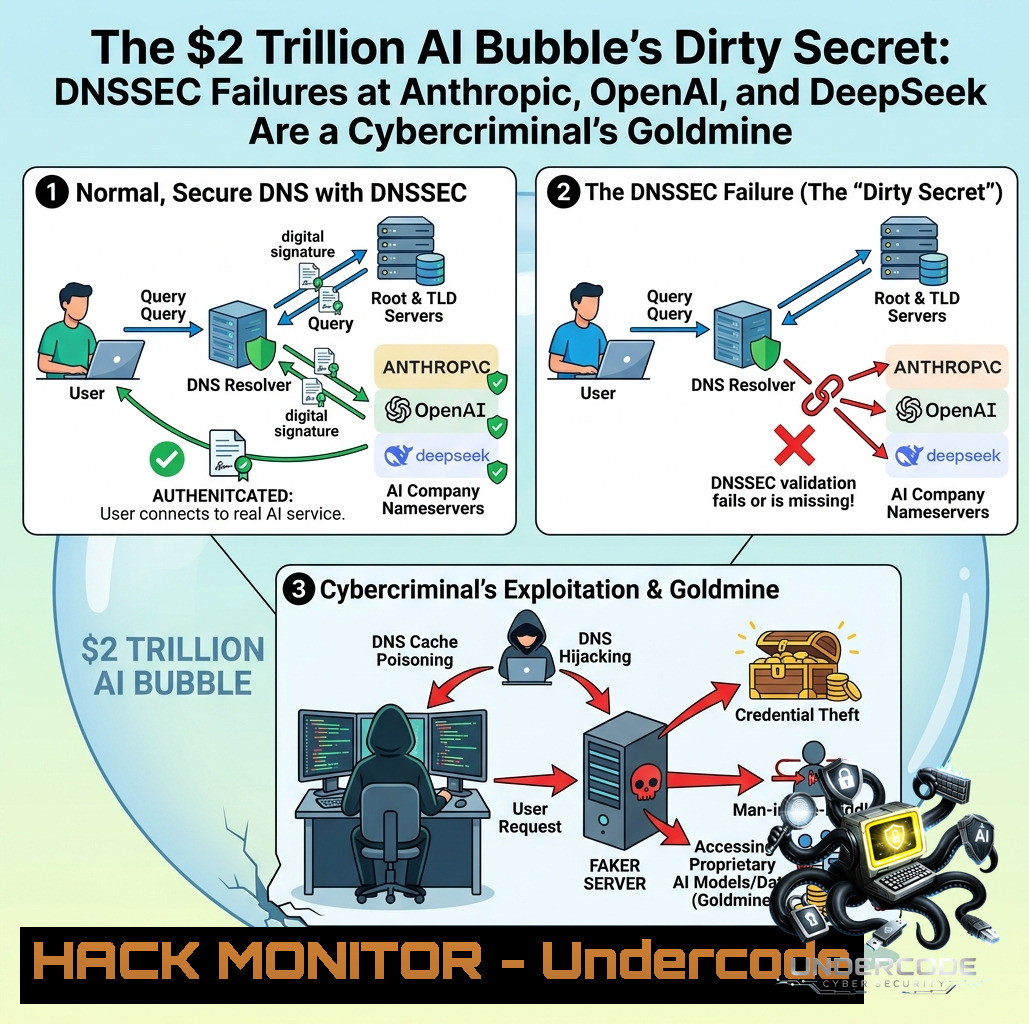
Introduction:
The AI industry is racing toward a $2 trillion breakeven target by 2030, but with realistic revenues projected at only $1.2 trillion, an $800 billion shortfall looms. Meanwhile, major providers like Anthropic, OpenAI, DeepSeek, and Grok have demonstrated critical DNSSEC failures—not due to technical impossibility, but organisational neglect—leaving their infrastructure wide open to DNS spoofing, cache poisoning, and reconnaissance attacks.
Learning Objectives:
– Validate DNSSEC configuration and identify insecure RRsets on any domain.
– Mitigate DNS-based attack vectors using command-line tools and cloud hardening techniques.
– Understand how AI’s systemic insecurity and financial desperation create a perfect storm for cybercrime.
You Should Know:
1. Diagnosing DNSSEC Failures: Commands to Audit Any Domain
DNSSEC (Domain Name System Security Extensions) prevents attackers from forging or poisoning DNS responses. When an organisation like Anthropic regresses from full security to “six insecure RRsets and broken delegations,” it becomes trivial for adversaries to redirect traffic, intercept API calls, or harvest credentials.
Step‑by‑step guide to check DNSSEC posture:
Linux / macOS (using `dig`):
 Check if DNSSEC is enabled for a domain
dig +dnssec anthropic.com ANY

 Verify specific record types with DNSSEC flags
dig +dnssec +multi anthropic.com A

 Trace delegation chain and detect broken delegations
dig +trace +dnssec anthropic.com

 Look for RRSIG, NSEC, or DNSKEY records (absence indicates insecurity)
dig anthropic.com DNSKEY +short
Windows (using `Resolve-DnsName` in PowerShell):
 Check DNSSEC validation status
Resolve-DnsName -1ame anthropic.com -Type A -DnsOnly -DnssecOK

 Query DNSKEY records
Resolve-DnsName -1ame anthropic.com -Type DNSKEY
Online validation (quick sanity check):
 Using Google’s public DNS resolver with DNSSEC requirement
nslookup -setopt=dnssec anthropic.com 8.8.8.8
Interpretation:
– If `dig` returns `flags: qr rd ra ad` (AD = Authenticated Data), DNSSEC is validated.
– Missing `RRSIG` or `DNSKEY` records → insecure RRsets.
– “Broken delegation” means the chain of trust from root to parent zone is severed.
2. Exploiting DNSSEC Absence: How Attackers Redirect AI Model Traffic
Without DNSSEC, an attacker on the same network or via BGP hijacking can spoof DNS responses. For AI providers hosting proprietary models or training data, a well-placed DNS spoof can redirect API calls to a malicious server, exfiltrating prompts, responses, or authentication tokens.
Step‑by‑step lab simulation (ethical use only):
Set up a rogue DNS server using `dnschef` (Linux):
 Install DNSchef
pip install dnschef

 Run fake DNS for target domain (e.g., api.openai.com)
dnschef --fakeip=192.168.1.100 --fakedomain=api.openai.com --interface=0.0.0.0
Test by querying your rogue server:
dig @192.168.1.100 api.openai.com
Mitigation:
– Enforce DNSSEC validation on all recursive resolvers.
– Use `unbound` with `val-override` to reject insecure answers.
– Monitor for missing RRSIGs via `dnspython` script.
3. Systemic Insecurity in AI APIs: Hardening Authentication & Request Chains
The post notes “AI can identify organisational weaknesses and simply exploit them.” Attackers now use AI to craft spear‑phishing, find misconfigured API endpoints, and automate credential stuffing. For AI providers, API security is paramount.
Step‑by‑step API hardening checklist (cloud + code):
Enforce mTLS and restrict DNS dependencies:
 nginx configuration for mTLS
server {
listen 443 ssl;
ssl_verify_client on;
ssl_client_certificate /etc/ssl/certs/ca.crt;
proxy_pass https://backend;
}
Use short-lived tokens and pin DNS records (Linux):
 Generate a service account key with fixed IP (Google Cloud)
gcloud iam service-accounts keys create key.json [email protected]

 Pin DNS A record in /etc/hosts as emergency fallback
echo "203.0.113.10 api.anthropic.com" >> /etc/hosts
Windows (PowerShell) – restrict outbound DNS:
 Block all DNS queries except to trusted resolvers
New-1etFirewallRule -DisplayName "Block DNS" -Direction Outbound -Protocol UDP -RemotePort 53 -Action Block
New-1etFirewallRule -DisplayName "Allow Trusted DNS" -Direction Outbound -Protocol UDP -RemoteAddress 1.1.1.1,8.8.8.8 -RemotePort 53 -Action Allow
4. Auditing the $800 Billion Shortfall: How Financial Desperation Amplifies Risk
When AI providers face a massive revenue gap, security budgets are slashed, and “organisational choices” like disabling DNSSEC emerge. Attackers exploit this by monitoring CVE disclosures (e.g., DNS-related CVEs affirmed by NCSC/NIST) and targeting the most financially fragile players.
Command to enumerate known DNS CVEs affecting your resolver:
 Using searchsploit (Kali Linux)
searchsploit dns cache poisoning

 Query NVD API for recent DNS CVEs
curl "https://services.ncep.nist.gov/rest/cves/1.0/cves?keyword=dns&pubStartDate=2025-01-01"
Hardening against exploitation:
– Automate DNSSEC monitoring with `Zonemaster` (open-source).
– Set up alerts for RRSIG expiration using `ldns-signzone -c`.
– Conduct monthly “red team” DNS audits – the post confirms not one major AI provider passed as of June 2026.
5. Mandated Audits & Transparency: Implementing Continuous DNSSEC Validation
The post demands “reform is not optional.” For your own organisation or clients, build a compliance pipeline that checks DNSSEC daily and reports on insecure RRsets and broken delegations.
Step‑by‑step automated DNSSEC health check (Linux cron job):
!/bin/bash
 dnssec_check.sh
DOMAINS=("openai.com" "anthropic.com" "deepseek.com" "grok.com")
for domain in "${DOMAINS[@]}"; do
if ! dig +dnssec $domain A | grep -q "ad"; then
echo "ALERT: $domain has no DNSSEC validation" >> /var/log/dnssec_failures.log
fi
if dig +trace +dnssec $domain | grep -q "Broken delegation"; then
echo "CRITICAL: $domain delegation broken" >> /var/log/dnssec_failures.log
fi
done
Schedule with crontab:
0 6 /usr/local/bin/dnssec_check.sh
Windows Task Scheduler (PowerShell script):
$domains = @("openai.com","anthropic.com")
foreach ($d in $domains) {
$result = Resolve-DnsName -1ame $d -Type A -DnssecOK -ErrorAction SilentlyContinue
if ($result.DnssecStatus -1e "Secure") {
Write-Warning "$d is insecure" | Out-File -Append C:\Logs\dnssec_alerts.txt
}
}
What Undercode Say:
– Key Takeaway 1: DNSSEC failures at Anthropic, OpenAI, DeepSeek, and Grok are not technical problems – they are deliberate organisational choices that signal a systemic disregard for infrastructure security.
– Key Takeaway 2: The $800 billion AI revenue shortfall creates a dangerous incentive to cut security corners, turning desperate providers into prime targets for DNS spoofing and cache‑poisoning attacks.
Analysis (10 lines):
The revelation that Anthropic was fully DNSSEC-secure in November 2022 but regressed to six insecure RRsets by August 2025 – a state still present in May 2026 – proves that security decay is an active management decision. Without mandated audits and public transparency, the AI industry will continue to normalise insecurity. The NCSC and NIST have affirmed DNS’s criticality, yet no major provider passed a basic posture check as of June 2026. This is not a skills gap; it is a governance failure. When financial desperation meets woeful systemic security, the bubble’s burst will be accelerated by cybercriminals who weaponise these weaknesses. Reform must include quarterly DNSSEC audits, mandatory disclosure of insecure RRsets, and liability for broken delegations. Until then, every API call to an AI provider is a gamble.
Prediction:
– -1 The AI bubble will burst before 2030, triggered by a major DNS-based breach at a top-tier provider (likely exploiting unvalidated responses to redirect model training data).
– -1 Cybercrime groups will automate DNSSEC failure scanning and target the most financially desperate AI providers for ransom or data exfiltration within 12 months.
– +1 Mandated DNSSEC audits (similar to PCI DSS for DNS) will emerge from joint NCSC/NIST pressure by late 2027, but adoption will be too late for early victims.
– -1 The $800 billion shortfall will force at least two major AI providers into fire sales or bankruptcy, and attackers will leverage their insecure infrastructure to compromise downstream customers.
▶️ Related Video (72% Match):
🎯Let’s Practice For Free:
🎓 Live Courses & Certifications:
[Join Undercode Academy for Verified Certifications](https://undercode.co.uk/certifications/)
🚀 Request a Custom Project:
Secure, high-velocity infrastructure and disruptive technological engineering. Contact our engineering team for high-tier development and proprietary systems:
[[email protected]](mailto:[email protected])
💎 Smart Architecture | 🛡️ Secure by Design | ⭐ Trusted by Thousands
IT/Security Reporter URL:
Reported By: [Andy Jenkinson](https://www.linkedin.com/posts/andy-jenkinson-whitethorn-shield-96210727_the-ai-bubble-has-another-problem-insecurity-share-7467230789898903554-PuJD/) – Hackers Feeds
Extra Hub: Undercode MoN
Basic Verification: Pass ✅
🔐JOIN OUR CYBER WORLD [ CVE News • HackMonitor • UndercodeNews ]
[💬 Whatsapp](https://undercode.help/whatsapp) | [💬 Telegram](https://t.me/UndercodeCommunity)
📢 Follow UndercodeTesting & Stay Tuned:
[𝕏 formerly Twitter 🐦](https://x.com/undercodeupdate) | [@ Threads](https://www.threads.net/@undercodetesting) | [🔗 Linkedin](https://www.linkedin.com/company/undercodetesting/) | [🦋BlueSky](https://bsky.app/profile/undercode.bsky.social)


