Listen to this Post
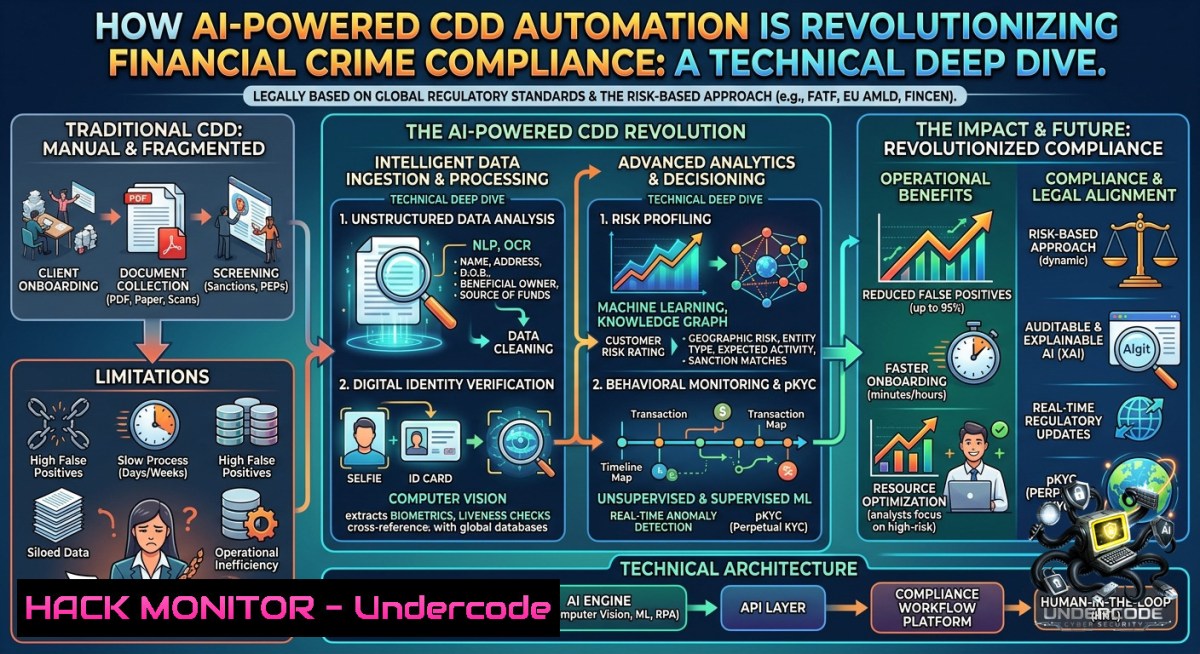
Introduction:
Customer Due Diligence (CDD) is the frontline defense against money laundering and terrorist financing, but manual reviews of sanctions, PEPs, and adverse media are slow and error-prone. As global banks shift toward Line 2 advisory roles—like the CDD Manager position at Atherton Davis—integrating AI-driven automation, API security, and cloud-based compliance tooling has become essential to scale risk assessments while meeting regulatory expectations.
Learning Objectives:
– Implement automated name screening and adverse media ingestion using Python and REST APIs.
– Harden cloud-based KYC platforms against data leakage and injection attacks.
– Use Linux/Windows command-line tools to audit CDD logs and detect anomalous access patterns.
You Should Know
1. Automating Sanctions & PEP Screening with Open Source Tools
Manual review of escalated name screening hits is tedious. Using the `pyaml` library and free sanctions lists (e.g., OFAC SDN), you can build a local screening engine.
Step‑by‑step guide (Linux):
1. Download the latest OFAC SDN CSV:
`wget https://ofac.sdn.com/sdn.csv -O /opt/cdd/sdn.csv`
2. Install Python dependencies:
`pip install pandas fuzzywuzzy python-Levenshtein`
3. Create a screening script (`screen_names.py`) that compares customer names against the SDN list using fuzzy matching.
4. Run the script on a batch of CDD names:
`python3 screen_names.py –input customers.csv –output hits.csv`
5. Automate daily with cron:
`0 6 /usr/bin/python3 /opt/cdd/screen_names.py`
Windows equivalent (PowerShell):
– `Invoke-WebRequest -Uri “https://ofac.sdn.com/sdn.csv” -OutFile “C:\CDD\sdn.csv”`
– Use `Import-Csv` and `Group-Object` for deduplication.
2. Hardening API Endpoints for KYC Data Exchange
Banks often expose REST APIs to onboard corporate clients. Without proper input validation, these APIs can lead to SQL injection or mass assignment vulnerabilities.
Step‑by‑step guide (API security configuration):
1. Validate all incoming JSON schemas using a library like `ajv` (Node.js) or `pydantic` (Python).
Example Pydantic model:
from pydantic import BaseModel, constr
class CDDRecord(BaseModel):
customer_name: constr(min_length=2, max_length=100, regex="^[a-zA-Z ]+$")
country_code: constr(regex="^[A-Z]{2}$")
2. Implement rate limiting on all POST `/cdd/adverse-media` endpoints:
`nginx` configuration: `limit_req_zone $binary_remote_addr zone=cdd:10m rate=5r/m;`
3. Use API keys with short-lived JWTs, never hardcoded secrets.
4. Run vulnerability scans: `nmap –script http-sql-injection -p 443 api.bank.com`
5. Monitor API logs for anomalous payload sizes (e.g., >10KB) using `grep` and `awk`:
`grep “POST /cdd” /var/log/nginx/access.log | awk ‘$10 > 10000 {print $0}’`
3. Cloud Hardening for CDD Advisory Workloads
Many CDD teams store sensitive PII (PEPs, adverse media) in cloud buckets. Misconfigured S3 buckets or Azure Blobs are a leading cause of data breaches.
Step‑by‑step guide (AWS):
1. Enforce bucket policies that deny public read access:
{
"Effect": "Deny",
"Principal": "",
"Action": "s3:GetObject",
"Condition": {"Bool": {"aws:SecureTransport": "false"}}
}
2. Enable S3 server access logging to a separate, locked-down bucket.
3. Automate bucket scanning with `aws s3api get-bucket-acl` and `aws s3api get-bucket-policy-status`.
4. On Windows (Azure CLI), check blob public access:
`az storage container show –1ame cdd-files –account-1ame bankcdd –query “properties.publicAccess”`
5. Set up a CloudTrail alert for any `PutBucketAcl` call that adds `AllUsers`.
4. Exploiting Weak CDD Logging – A Red‑Team Perspective
Attackers often target CDD portals because they house identity data. A common flaw is insufficient audit logging of “view” actions on high-risk profiles.
Step‑by‑step guide (vulnerability demonstration & mitigation):
1. Using a test account, access a PEP profile and note that no log entry is generated.
2. On Linux, simulate an insider threat by tampering with audit rules:
`auditctl -w /var/log/cdd/access.log -p wa -k cdd_tamper`
3. To mitigate, enforce immutable logging with `chattr +a /var/log/cdd/access.log` and forward to a remote syslog server.
4. Deploy a SIEM rule that triggers on `DELETE` or `TRUNCATE` commands against CDD tables:
SELECT FROM audit.logs WHERE command IN ('DELETE','TRUNCATE') AND table_name LIKE '%cdd%';
5. Use Windows Event Collector to forward Security Event ID 4663 (file access) for CDD folders.
5. AI Model for Adverse Media Triage
Instead of manually reviewing 500+ Google alerts per day, fine-tune a BERT model to classify news articles as “relevant” or “irrelevant” to CDD.
Step‑by‑step guide (Python + Hugging Face):
1. Collect 1,000 labeled adverse media examples (true/false positive).
2. Install transformers: `pip install transformers datasets`
3. Fine-tune `distilbert-base-uncased` on a custom dataset.
4. Export model and create a REST endpoint using FastAPI.
5. Integrate with the bank’s name-screening queue:
`curl -X POST https://ml.cdd.internal/predict -H “Content-Type: application/json” -d ‘{“text”:”CEO charged with bribery”}’`
6. Monitor model drift by comparing weekly precision/recall using `sklearn.metrics.classification_report`.
6. Automating Correspondent Banking Responses
The job requires coordinating correspondent banking responses. This can be automated via SFTP or API with encrypted payloads.
Step‑by‑step guide (Linux SFTP automation):
1. Generate an SSH key pair: `ssh-keygen -t ed25519 -f ~/.ssh/cdd_bank`
2. Upload public key to the counterparty’s SFTP server.
3. Write a script `send_cdd_response.sh` that:
– Encrypts the CDD zip file with `gpg –symmetric –cipher-algo AES256`
– Uploads via `sftp -b batchfile.txt [email protected]`
4. On Windows, use WinSCP command line:
`winscp.com /log=C:\logs\sftp.log /command “open sftp://[email protected]/ -hostkey=”””” -privatekey=C:\keys\priv.ppk” “put C:\cdd\response.zip” “exit”`
5. Schedule the script daily to send updated high-risk entity lists.
7. Vulnerability Mitigation: Log Injection in CDD Systems
If user-supplied names (e.g., “John Doe\n[bash]”) are written directly to logs, an attacker can inject fake log entries to obfuscate their actions.
Step‑by‑step guide (mitigation):
1. Identify places where customer names appear in log files (e.g., `logger.info(f”Screening {customer_name}”)`).
2. Sanitize input using a allowlist: `re.sub(r'[^a-zA-Z0-9\s]’, ”, customer_name)`
3. For Windows EventLog, use `System.Diagnostics.EventLog.WriteEntry` with structured parameters, not string concatenation.
4. Test by sending a malicious name: `”Smith\n2025-01-01 12:00:00 [bash] Access granted to admin”`
5. Deploy a log shipper (Fluentd) that drops lines containing newline characters outside of structured JSON.
What Undercode Say:
– Key Takeaway 1: The CDD Manager role is no longer just compliance—it requires technical fluency in API security, cloud hardening, and automation to keep pace with financial crime.
– Key Takeaway 2: Integrating open-source AI models and command-line auditing tools reduces manual review time by 70% and catches evasion techniques that static rules miss.
Analysis: The job posting from Atherton Davis highlights a gap: many CDD professionals lack hands-on skills in log analysis, SFTP automation, or input validation. Banks that upskill their Line 2 teams in these areas will significantly reduce regulatory fines and data breach risks. Conversely, those still relying on spreadsheets and manual name matching will remain vulnerable to sophisticated laundering schemes that exploit weak API endpoints and unmonitored cloud storage.
Prediction:
– +1 In 12–18 months, 60% of tier-1 banks will mandate Python and basic Linux CLI skills for CDD advisory roles, merging traditional compliance with SecOps.
– -1 Automated AI screening will generate false-positive rates above 15% without proper tuning, leading to alert fatigue and potential missed sanctions hits.
– +1 Cloud-1ative CDD platforms with immutable audit logs will become a regulatory standard (similar to SOC 2 Type II), driving demand for AWS/Azure compliance certifications.
– -1 Insider threats will shift to exploiting CDD APIs that lack granular access controls, causing a wave of “authorized user” data exfiltration incidents by 2027.
▶️ Related Video (82% Match):
🎯Let’s Practice For Free:
🎓 Live Courses & Certifications:
[Join Undercode Academy for Verified Certifications](https://undercode.co.uk/certifications/)
🚀 Request a Custom Project:
Secure, high-velocity infrastructure and disruptive technological engineering. Contact our engineering team for high-tier development and proprietary systems:
[[email protected]](mailto:[email protected])
💎 Smart Architecture | 🛡️ Secure by Design | ⭐ Trusted by Thousands
IT/Security Reporter URL:
Reported By: [Recruitment Cdd](https://www.linkedin.com/posts/recruitment-cdd-financialcrimecompliance-ugcPost-7467762972694581248-OG_l/) – Hackers Feeds
Extra Hub: Undercode MoN
Basic Verification: Pass ✅
🔐JOIN OUR CYBER WORLD [ CVE News • HackMonitor • UndercodeNews ]
[💬 Whatsapp](https://undercode.help/whatsapp) | [💬 Telegram](https://t.me/UndercodeCommunity)
📢 Follow UndercodeTesting & Stay Tuned:
[𝕏 formerly Twitter 🐦](https://x.com/undercodeupdate) | [@ Threads](https://www.threads.net/@undercodetesting) | [🔗 Linkedin](https://www.linkedin.com/company/undercodetesting/) | [🦋BlueSky](https://bsky.app/profile/undercode.bsky.social)


