
Listen to this Post
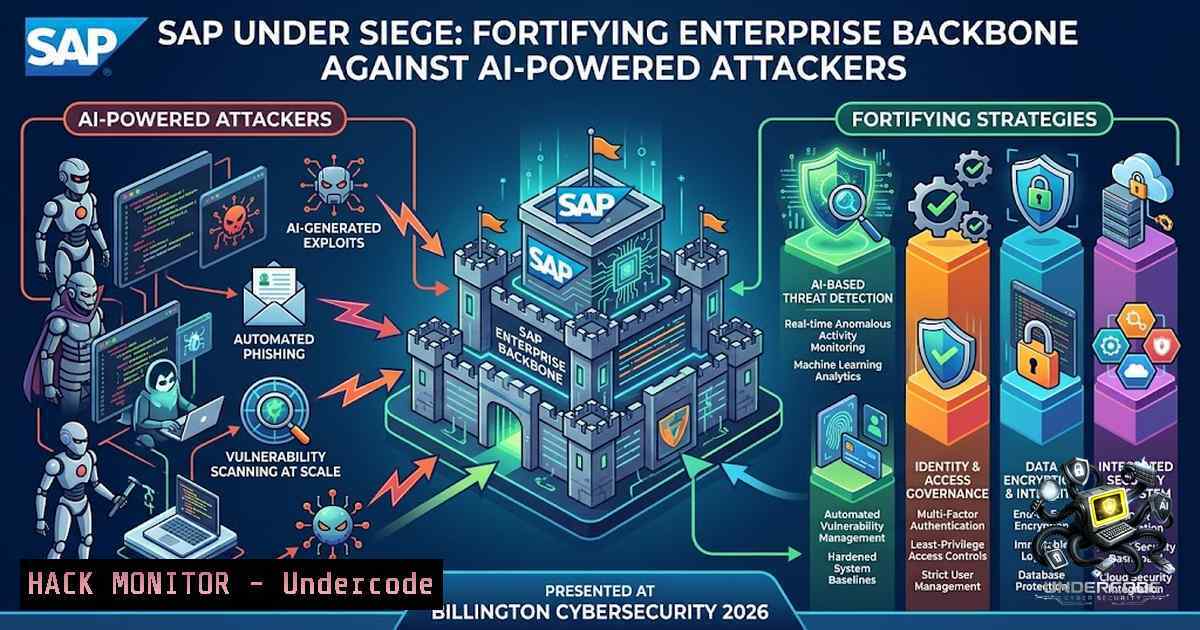
Introduction:
As AI democratizes cybercrime, threat actors are leveraging large language models to decode complex SAP architectures and execute targeted exploits without prior SAP training. The 17th Annual Billington CyberSecurity Summit, themed “Reducing Risk in an Age of AI-Enabled Threats,” convenes September 8–10, 2026, in Washington, D.C., to address this paradigm shift. With SAP systems accounting for 84% of global commerce—approximately $46 trillion—the security of these platforms is no longer just an IT concern but a national and economic security imperative.
Learning Objectives:
- Understand how AI-powered offensive tools are automating SAP vulnerability discovery and exploitation
- Master the implementation of SAP-1ative security controls, including risk-based authentication and real-time threat monitoring
- Learn to integrate SAP security telemetry with enterprise SIEM/SOAR platforms for unified threat detection and response
- Gain hands-on knowledge of attack path mapping tools like SAPMAP to proactively identify and remediate systemic weaknesses
You Should Know:
- The AI Threat Landscape: How LLMs Are Weaponized Against SAP
The convergence of generative AI and cybercrime has eliminated the traditional barrier of requiring deep, proprietary SAP knowledge. Attackers now use plain English prompts to instruct AI agents to discover misconfigurations, pivot across databases, and execute critical exploits at machine speed. This democratization of hacking capabilities means that even unsophisticated adversaries can now target mission-critical SAP environments.
The threat vectors are multifaceted. Workflow hijacking—compromising RPA bots or machine learning models to alter procurement orders or redirect payments—represents a growing risk. Deepfake-based authorizations exploit synthetic voice or video to bypass AI-driven approval processes. Shadow AI—unauthorized AI services interfacing with SAP systems via APIs outside established governance frameworks—creates blind spots that traditional security tools cannot detect.
Step‑by‑step guide to assessing your AI threat exposure:
- Inventory all AI services interacting with your SAP landscape, including RPA bots, machine learning models, and third-party API integrations.
- Audit API endpoints using tools like `curl` to enumerate exposed services:
curl -X GET "https://your-sap-system:443/sap/public/api" -H "Accept: application/json"
For Windows environments, use PowerShell:
Invoke-RestMethod -Uri "https://your-sap-system:443/sap/public/api" -Method Get
3. Review SAP authorizations for AI-related service accounts using transaction `SUIM` (User Information System) to identify overly permissive profiles.
4. Implement API gateway policies that restrict AI service access to only necessary endpoints and enforce rate limiting.
- SecurityBridge AI Companion: Your 24/7 SAP Security Expert
The SecurityBridge AI Companion, unveiled in December 2025, represents a first-of-its-kind conversational security advisor embedded directly in the SecurityBridge Platform. Trained on more than a decade of SAP-1ative threat intelligence, this AI assistant answers natural-language questions about SAP security best practices, compliance requirements, and potential threats.
Unlike generic AI tools, the AI Companion is purpose-built for SAP. It explains vulnerabilities and misconfigurations in plain language, recommends concrete next steps for any finding, and supports SAP Basis teams, security analysts, and compliance roles alike. For SOC teams, the integration with Microsoft Sentinel enables investigation of SAP threats directly within Sentinel—bringing SAP context into the tool so analysts can triage SAP incidents without leaving their primary workflow.
Step‑by‑step guide to deploying AI-powered SAP security:
- Enable the AI Companion within your SecurityBridge Platform (included at no additional cost with standard subscription).
- Integrate with Microsoft Sentinel by configuring the SecurityBridge connector to forward enriched SAP security data as structured “Smart Data”:
PowerShell script to verify Sentinel integration
Get-AzSentinelAlertRule -ResourceGroupName "YourRG" -WorkspaceName "YourWorkspace"
- Train your SOC team on using natural-language queries with the AI Companion, such as: “Why is this vulnerability critical?” or “How do I mitigate this threat?”
- Establish automated playbooks that span SAP and Microsoft environments, enabling automated response to confirmed threats.
-
SAPMAP: Mapping Attack Paths Like BloodHound for SAP
SecurityBridge Director of Security Research Joris van de Vis has launched SAPMAP, an open-source AI tool designed to map attack paths across SAP environments. Released under the OWASP Core Business Application Security project, SAPMAP automatically plots attack routes tied to 16 business impact scenarios, including salary theft, vendor bank fraud, production sabotage, and customer data breaches.
The tool catalogs 72 CVEs and runs 1,817 automated tests, covering both on-premises SAP systems and SAP cloud environments on SAP BTP. It maps relationships between systems and identifies possible paths from an initial compromise to broader control of business processes. The release includes seven exploits, including CVE-2025-31324 (a flaw exploited in recent enterprise attacks) and CVE-2026-31431 (a root-level privilege escalation issue).
Step‑by‑step guide to using SAPMAP for proactive defense:
- Apply for access to SAPMAP through the OWASP Core Business Application Security project (invitation-only for vetted security teams).
2. Deploy SAPMAP to map your SAP environment:
 Clone the SAPMAP repository (access required)
git clone https://github.com/owasp/sapmap
cd sapmap
./sapmap --scan --target your-sap-system
3. Review attack path reports to identify high-risk pathways that could be exploited by adversaries.
4. Prioritize remediation based on the business impact scenarios flagged by SAPMAP, starting with the most critical business processes.
4. SAP Security Benchmark 2026: Where Organizations Stand
The Cybersecurity Resilience Index for SAP (CRIS) provides an aggregated, anonymized view of security posture across thousands of SAP production environments. The benchmark reveals that most areas of responsibility cluster in the 58–77% range, indicating a generally solid security program but notable variability.
Strengths include operating system hardening at 100%, development (code vulnerability) at 77%, and integration security at 77%. However, critical gaps persist in authorizations (68%), data protection (65%), and SAP Basis (58%)—the lowest score representing governance and configuration that underpins all other controls.
Step‑by‑step guide to improving your SAP security posture based on CRIS findings:
- Audit authorizations using transaction `PFCG` (Role Maintenance) to identify and prune risky or unused authorization profiles:
Linux command to export role data for analysis
sapcontrol -1r 00 -function GetProcessList
- Enforce data protection by implementing encryption at rest and in transit, and validating GDPR/privacy controls.
- Harden SAP Basis by tightening baseline configurations, fixing misconfigurations, ensuring audit logs are enabled and retained, and regularly reviewing transport security and parameter settings.
- Implement continuous monitoring with automated controls that track compliance across GDPR, SOX, NIS2, PCI DSS, and ISO 27001.
5. Risk-Based Authentication: Step-Up MFA for SAP
SecurityBridge enforces risk-based authentication inside SAP—step-up MFA triggers automatically for sensitive actions without adding login friction for normal use. This approach balances security with user experience, ensuring that high-risk transactions receive additional verification while routine operations proceed uninterrupted.
Step‑by‑step guide to implementing risk-based authentication:
- Define sensitive actions within your SAP environment (e.g., financial approvals, user privilege changes, system configuration modifications).
- Configure risk-based policies in the SecurityBridge Platform to trigger MFA for these actions.
- Integrate with your existing MFA provider (e.g., Microsoft Entra ID, Okta) to enforce step-up authentication.
- Monitor authentication events using transaction `SM19` (Security Audit Log Configuration) to verify proper enforcement.
-
Closing the SOC Gap: SIEM Integration for SAP
Standard SIEM/SOAR connectors bring SAP into enterprise security operations, enabling detection and response to SAP incidents like any other system. SecurityBridge connects SAP security events with existing SIEM and SOAR platforms, enabling detection, investigation, and response within existing workflows.
Step‑by‑step guide to integrating SAP with your SIEM:
- Deploy the SecurityBridge SIEM connector to forward SAP security events in real time.
- Configure your SIEM (e.g., Splunk, QRadar, Microsoft Sentinel) to ingest normalized SAP events:
Example Splunk forwarder configuration
[monitor:///var/log/sap/security]
index = sap_security
sourcetype = sap:security
- Create alerting rules for critical SAP events, such as failed privileged logins or unauthorized transaction executions.
- Develop incident response playbooks that include SAP-specific containment and remediation steps.
What Undercode Say:
- Key Takeaway 1: AI is not just a defensive tool—it’s actively being weaponized by adversaries to automate SAP attacks, making SAP-1ative security solutions no longer optional but mandatory.
- Key Takeaway 2: The Billington CyberSecurity Summit 2026 serves as the premier forum for U.S. government and industry collaboration on AI-enabled threats, with SecurityBridge demonstrating how native SAP cybersecurity can reduce risk without slowing digital transformation.
Analysis: The cybersecurity community is at an inflection point. The same AI capabilities that promise to enhance defense are being turned against enterprises with unprecedented speed and sophistication. For SAP environments—which underpin the global economy—the stakes could not be higher. The CRIS benchmark data reveals that while organizations have made progress in foundational security areas like OS hardening and integration security, critical gaps in authorizations, data protection, and SAP Basis remain dangerously exposed. These are precisely the vectors that AI-powered attackers will exploit first.
The launch of SAPMAP represents a significant step forward in defensive capabilities, giving security teams the same visibility into trust relationships that attackers might exploit. However, controlled access to the tool underscores the dual-use nature of such capabilities—a reminder that defensive innovation must keep pace with offensive AI advancement. Organizations attending the Billington Summit would be wise to prioritize engagements with SAP security vendors like SecurityBridge, whose AI Companion and SIEM integrations offer practical, immediate pathways to reducing risk in this new era of AI-enabled threats.
Prediction:
- -1: The proliferation of AI-powered attack tools will lead to a surge in SAP-specific breaches over the next 12-18 months, particularly targeting organizations that have not implemented continuous monitoring and risk-based authentication.
- -1: Regulatory bodies will increasingly mandate SAP-specific security controls, with frameworks like NIS2, DORA, and CMMC incorporating explicit requirements for ERP security monitoring and incident response.
- +1: Open-source initiatives like SAPMAP under OWASP will foster a community-driven approach to SAP security, accelerating the discovery and remediation of vulnerabilities across the ecosystem.
- +1: AI-powered security assistants will become standard features in enterprise security platforms, dramatically reducing the expertise barrier for SAP security and enabling faster, more accurate threat response.
- -1: The skills gap in SAP security will widen as AI attackers lower the barrier to entry, increasing demand for specialized talent and driving up costs for organizations struggling to secure their SAP landscapes.
▶️ Related Video (82% Match):
🎯Let’s Practice For Free:
🎓 Live Courses & Certifications:
Join Undercode Academy for Verified Certifications
🚀 Request a Custom Project:
Secure, high-velocity infrastructure and disruptive technological engineering. Contact our engineering team for high-tier development and proprietary systems:
[email protected]
💎 Smart Architecture | 🛡️ Secure by Design | ⭐ Trusted by Thousands
IT/Security Reporter URL:
Reported By: Cary White – Hackers Feeds
Extra Hub: Undercode MoN
Basic Verification: Pass ✅


