
Listen to this Post
Introduction:
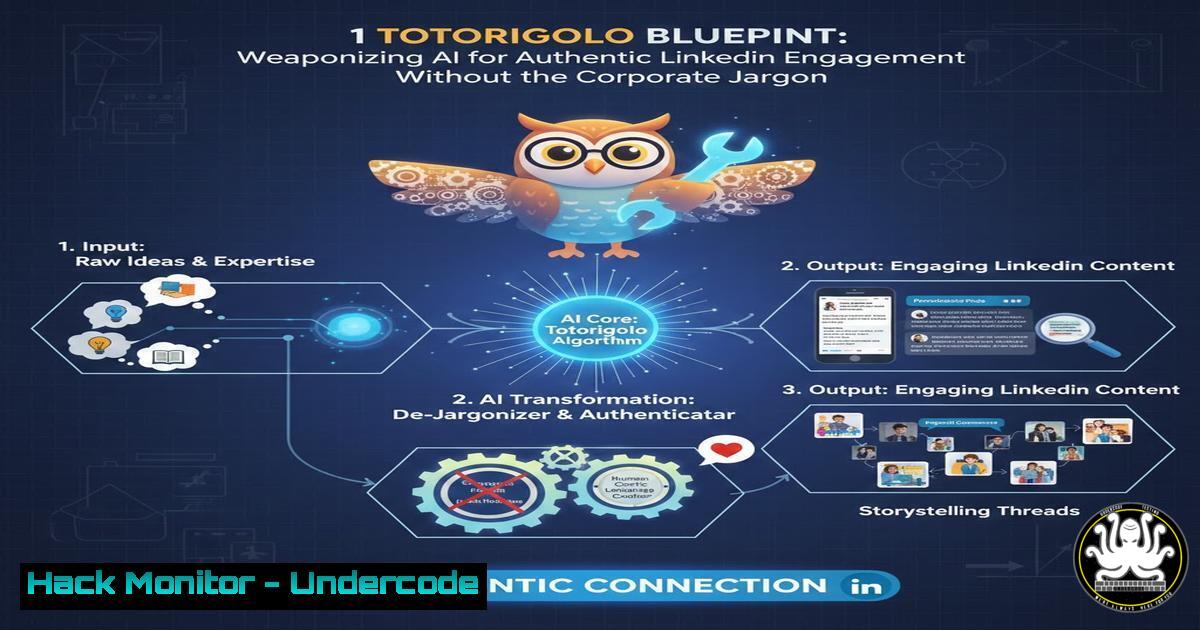
In the crowded landscape of professional social media, authentic voice is the new cybersecurity perimeter for your personal brand. Just as enterprises guard their digital assets, professionals must protect their online presence from the homogenizing threat of generic, AI-generated content. The “Totorigolo” setup, shared by DevSecOps architect Alexandre ODA, represents a sophisticated prompt engineering attack on this very problem—crafting an AI assistant specifically engineered to bypass LinkedIn’s algorithmic defenses and human disengagement detectors by enforcing a strict, conversational tone.
Learning Objectives:
- Deconstruct the architecture of a purpose-built AI writing assistant for platform-specific content creation.
- Implement a dual-component AI system separating foundational knowledge from executable personality instructions.
- Apply technical document handling and prompt validation techniques to deploy and test your own configured agent.
You Should Know:
1. Architecting the AI Brain: Knowledge Base Injection
The core of any effective AI agent is its curated knowledge base. This isn’t about raw data; it’s about strategic doctrine. The first step involves extracting and formatting the strategic document to create the AI’s operational context.
Step-by-step guide:
Extract the Intelligence: The provided document’s first segment contains the “Stratégie Éditoriale & Mécanismes LinkedIn 2025.” This is your proprietary intelligence.
Create the Knowledge File: Using a command-line or script, isolate this section. On Linux/macOS, you might use `sed` or `awk` to split the file at the `PERSONA` marker.
 Example: If 'original_doc.txt' contains the full paste
sed -n '/^1️⃣ La Connaissance/,/^2️⃣ La Personnalité/p' original_doc.txt > Knowledge_Totorigolo.txt
On Windows PowerShell, you can use:
$content = Get-Content -Raw original_doc.txt
$knowledgePart = ($content -split '2️⃣ La Personnalité')[bash]
$knowledgePart | Out-File -FilePath "Knowledge_Totorigolo.docx" -Encoding UTF8
Note: The actual command depends on the exact structure of the source document.
Upload to the AI Platform: In your chosen AI platform’s (e.g., Gemini Advanced’s “Connaissances” section, Claude’s file upload, or a custom GPT builder) knowledge base feature, upload this `.docx` or `.txt` file. This grounds the AI’s responses in the specific 2025 LinkedIn algorithm rules, dwell time tactics, and mobile formatting requirements.
2. Programming the Personality: The XML Instruction Set
The personality is the executable code that governs style. It is delivered via a strict XML schema that defines tone, format, and forbidden jargon, acting as a runtime configuration.
Step-by-step guide:
Isolate the XML Payload: Locate the section beginning with the `PERSONA` tag. This XML block is the configuration file for the AI’s behavior.
Validate and Copy: Ensure the XML is well-formed. It should contain tags like <persona>, <tone>, <format_rules>, and <forbidden_terms>. Copy the entire block, from the opening to the closing root tag.
Deploy to Instruction Field: Paste this exact XML code into the primary “Instructions” or “System Prompt” field of your AI agent builder. This overrides the AI’s default corporate voice with the specified “conversation machine à café” style.
3. Operational Security: Validating the Agent’s Output
After deployment, you must test the agent against known inputs to ensure it adheres to its programming and doesn’t revert to generic patterns—a form of AI model drift.
Step-by-step guide:
Create a Test Suite: Prepare a list of raw ideas or bullet points (e.g., “Just finished a cloud security audit, found common IAM misconfigurations”).
Run Initial Queries: Feed these inputs to your configured Totorigolo agent.
Analyze for Compliance: Use simple `grep` or text search commands to check for violations.
 Check for forbidden corporate jargon in the output file
grep -i -E "leverage|synergy|disrupt|paradigm|corporate" totorigolo_output.txt
 If this returns matches, the personality instructions need tightening.
Iterate on Instructions: Based on failures, refine the XML instruction set, making prohibitions more explicit and style directives clearer.
4. Automating the Workflow: Basic Scripting for Consistency
To move from a manual tool to a semi-automated system, wrap the process in a simple script that ensures consistent file handling and prompt formatting.
Step-by-step guide:
Create a Wrapper Script (Example – Linux Bash):
!/bin/bash
 totorigolo_runner.sh
 1. Define paths
KNOWLEDGE_FILE="./knowledge_base.txt"
PROMPT_TEMPLATE="./prompt_template.xml"
RAW_IDEA="$1"
 2. Construct the final prompt by injecting the raw idea into the XML
FINAL_PROMPT=$(sed "s/{{RAW_IDEA}}/$RAW_IDEA/g" $PROMPT_TEMPLATE)
 3. Call the AI API (placeholder for Gemini, OpenAI, etc.)
 This is a conceptual example using a fictional CLI tool
 ai-cli --knowledge "$KNOWLEDGE_FILE" --instructions "$FINAL_PROMPT" > linkedin_post.md
echo "Process initiated for: $RAW_IDEA"
This script standardizes how the knowledge and personality are applied to each new idea.
- Mitigating Platform Risk: Exporting and Backing Up Your Agent
Your configured agent is a valuable digital asset. Relying solely on a cloud platform’s GUI is a single point of failure. Regularly export its configuration.
Step-by-step guide:
Document the Build: Keep a master `README.md` file in a project directory.
Version Control: Store your `Knowledge_Totorigolo.txt` and `Persona_Instructions.xml` files in a Git repository.
mkdir totorigolo-agent
cd totorigolo-agent
git init
cp /path/to/Knowledge_Totorigolo.txt .
cp /path/to/Persona_Instructions.xml .
echo " Totorigolo Agent Build v1.0" > README.md
git add .
git commit -m "Initial agent configuration files"
Screenshot the UI: Take screenshots of the AI platform’s configuration page as a backup of settings that may not be exportable via text.
What Undercode Say:
- The Human Firewall is Prompt-Deep: The most critical security layer for AI-assisted content is not the model itself, but the meticulously crafted instructions and knowledge that constrain it. This setup is a “jargon firewall.”
- Specificity Defeats Generality: A tool built to solve one problem—authentic LinkedIn posting—with extreme specificity will outperform any general-purpose ChatGPT session. This is the engineering principle of single responsibility applied to AI.
Analysis:
The Totorigolo blueprint is less about content creation and more about controlled augmentation. It acknowledges that pure manual creation doesn’t scale, while pure AI generation lacks defense-in-depth against algorithmic and social detection. By splitting the “brain” (knowledge) from the “voice” (personality), it creates a maintainable system. The knowledge can be updated quarterly with new platform algorithm insights, while the personality can be A/B tested. This mirrors IT security practice: separate policies (knowledge) from enforcement mechanisms (personality instructions). The real hack is recognizing that on modern platforms, authenticity is a technical parameter that can be defined, configured, and systematically applied through careful AI orchestration, turning personal branding into a repeatable, secure pipeline rather than an artisanal mystery.
Prediction:
This methodology will rapidly evolve into a standard practice for professional social selling and brand building. We will see the rise of a new niche in “AI Personality Engineering,” with professionals offering audits to detoxify corporate AI output. Platform algorithms will inevitably adapt to detect and potentially penalize content that is too generically AI, making these finely-tuned, rule-based agents not just an advantage but a necessity. Furthermore, the principles will be applied beyond LinkedIn to other engagement-critical platforms like GitHub, Dev.to, and even internal corporate communication systems, where authentic, human-seeming digital interaction is paramount.
🎯Let’s Practice For Free:
IT/Security Reporter URL:
Reported By: Oda Alexandre – Hackers Feeds
Extra Hub: Undercode MoN
Basic Verification: Pass ✅


