
Listen to this Post
Introduction:
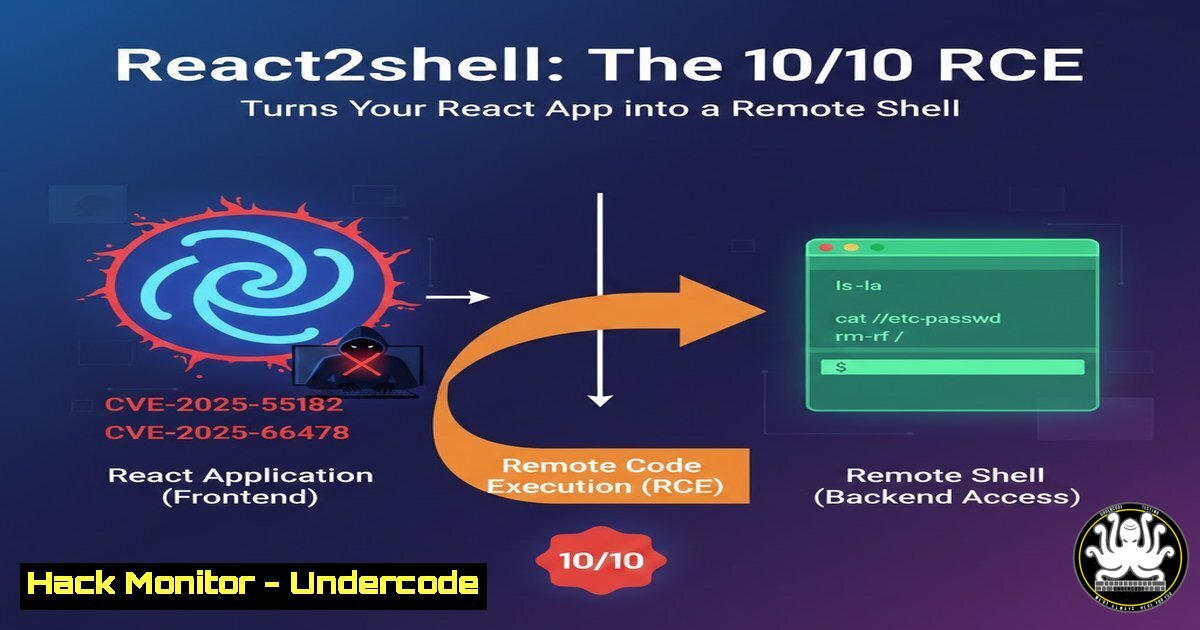
A pair of critical, maximum-severity (CVSS 10.0) Remote Code Execution vulnerabilities, dubbed “React2shell,” have been discovered in React Server Components and the Next.js App Router. These flaws reside in the deserialization of Server Actions, allowing unauthenticated attackers to execute arbitrary operating system commands on the server by smuggling malicious data:, node:, or `file:` protocol payloads. This represents a severe threat to the vast ecosystem of applications built with React 19.0.0-19.2.0 and Next.js 15.x/16.x prior to the immediate patches released.
Learning Objectives:
- Understand the root cause of the React2shell RCE vulnerability in the RSC deserializer.
- Learn how to immediately detect, patch, and mitigate affected React and Next.js applications.
- Explore defensive coding and configuration practices to harden against deserialization attacks.
You Should Know:
1. Root Cause: The Broken Deserialization Gate
The core flaw exists in how React Server Components (RSC) deserialize “Server Action” identifiers sent from the client. The deserializer incorrectly trusted and processed user-supplied action IDs without proper validation or sanitization. An attacker could craft a malicious action ID specifying a dangerous protocol like `node:child_process` or a local `file:` path, which the server would then import and execute. This bypasses all React’s security boundaries, treating the injected module as trusted server code.
Step‑by‑step guide explaining what this does and how to use it.
The Exploit Chain: 1) Attacker probes a Next.js/React app endpoint. 2) They intercept or forge a request containing a Server Action reference. 3) They replace the action ID with a payload like 'node:child_process'. 4) The server’s RSC deserializer receives this ID, dynamically imports the specified module, and executes it in the server context. 5) This leads to direct RCE, enabling shell command execution.
Example Malicious Payload Concept: The attack manipulates the serialized action reference. While the full PoC is on the researcher’s site, the structure involves substituting a legitimate action ID with something like `”node:child_process”` to spawn a system shell.
2. Immediate Detection and Patching
The first step is to determine your exposure and apply the official fixes without delay.
Step‑by‑step guide explaining what this does and how to use it.
1. Check Your Versions: Run `npm list react next` or check your package.json.
Vulnerable: React `^19.0.0` && < 19.2.1; Next.js `>=15.0.0` && `< 15.2.6` or `>=16.0.0` && < 16.2.4.
2. Apply Patches Immediately: Update to the patched versions.
 Linux/macOS npm example
npm update [email protected] next@latest
 Or with yarn
yarn upgrade [email protected] next@latest
 Windows PowerShell (run as admin if needed)
npm update [email protected] next@latest --force
3. Verify the Update: Re-run `npm list react next` to confirm versions. For React, you should see 19.2.1. For Next.js, `15.2.6` or `16.2.4` and above.
4. Audit for Indicators: Search your codebase for patterns of dynamic imports in Server Components or custom deserialization logic related to actions. Use `grep -r “serverAction”` or similar searches in your project directory.
3. Server-Side Hardening and Configuration
Patching is mandatory, but defense-in-depth measures are critical. Harden your server environment to limit the impact of potential future deserialization bugs.
Step‑by‑step guide explaining what this does and how to use it.
1. Principle of Least Privilege: Ensure the Node.js process runs under a dedicated, non-root user with minimal permissions.
 Create a limited user for your app (Linux)
sudo useradd -r -s /bin/false nextjsuser
 Change ownership of your app directory
sudo chown -R nextjsuser:nextjsuser /path/to/your/app
 Run your process with this user (e.g., using PM2)
pm2 start npm --name "myapp" --user nextjsuser -- start
2. Restrict Module Import Paths: Use runtime flags or security policies to restrict accessible modules. This is complex in Node.js but consider:
Docker Sandboxing: Run your app in a minimal container (e.g., node:alpine) with read-only filesystems where possible.
Process Sandboxing: For advanced setups, tools like `sandbox` or `seccomp` profiles can limit syscalls.
3. Implement Strict Content Security Policies (CSP): While this is a server-side bug, a strict CSP adds a layer of client-side protection against payload delivery vectors.
4. Hunting for Exploitation Attempts in Logs
You must monitor for attack attempts, both pre- and post-patch, to assess if you were targeted.
Step‑by‑step guide explaining what this does and how to use it.
1. Analyze HTTP Access Logs: Look for anomalous POST requests to RSC endpoints (typically `/_next/action` or similar) containing suspicious strings.
 Example using grep on Nginx/APache logs
grep -E "(/_next/action|rsc)" access.log | grep -i -E "(node:|data:|file:|\"actionId\")"
2. Monitor Node.js Process Activity: Use auditing tools to detect child process spawning from your Node application.
 On Linux, audit Node.js process spawns (may require auditd rules)
sudo ausearch -k node_child_spawn
3. Utilize Web Application Firewalls (WAF): Deploy or configure WAF rules to block requests containing patterns like `node:` or unusual protocol schemes in POST bodies. Create a custom rule to match the serialized action payload signature.
5. Long-Term Mitigation: Secure Deserialization Practices
This vulnerability is a classic case of insecure deserialization. Developers must enforce strict validation.
Step‑by‑step guide explaining what this does and how to use it.
1. Never Trust Client-Supplied Module Identifiers: Implement an allow-list (allowlist) mechanism. The server should map action IDs to a known, finite set of server-side functions, not dynamically import arbitrary strings.
// Example of an allow-list approach (pseudocode)
const allowedActions = {
'safeAction1': import('./actions/safe1'),
'safeAction2': import('./actions/safe2')
};
function deserializeAction(id) {
const action = allowedActions[bash];
if (!action) {
throw new Error('Invalid action ID'); // Critical: Fail closed
}
return action;
}
2. Adopt Security-First Code Reviews: Any code handling serialization/deserialization, especially of client data, must undergo rigorous security review focusing on validation and trust boundaries.
3. Integrate Security Testing: Use SAST (Static Application Security Testing) tools that can detect patterns of insecure deserialization and include this vulnerability class in your penetration testing scope.
What Undercode Say:
- Patch Immediately, Verify Absolutely: A CVSS 10.0 rating is not an exaggeration. The exploitation barrier is low, and the impact is total server compromise. Updating is the only complete remedy; verify the patch is live across all deployments.
- The Trust Boundary is Sacred: This breach occurred because a client-controlled value crossed a trust boundary (network) and was executed with server privileges without validation. This fundamental security principle must be enforced at the architectural level in meta-frameworks.
Analysis: The React2shell vulnerability is a watershed moment for the Next.js and React ecosystem. It exposes the inherent risks in the trend towards complex, opaque abstractions like Server Components and automatic serialization/deserialization. While these features boost developer experience, they can obscure critical security boundaries. This incident will likely force a long-overdue security audit of the RSC and Server Actions architecture, leading to more restrictive defaults, mandatory validation layers, and potentially the adoption of formal security models for data crossing the client-server boundary. The community’s response in patching was swift, but the trust in “magic” frameworks has been dented. Future development must prioritize “secure by default” configurations, where deserialization paths are explicitly defined and validated, not implicitly trusted.
Prediction:
This vulnerability will accelerate several trends in web security: First, a surge in automated scanning targeting `/_next/action` endpoints across the internet. Second, increased scrutiny on deserialization mechanisms in all full-stack JavaScript frameworks (e.g., Nuxt, SvelteKit). Third, a potential shift in enterprise policy, slowing the adoption of cutting-edge server-component features until they undergo more rigorous security maturation. Frameworks will likely respond by introducing compile-time validation of action IDs and mandatory allow-listing, moving away from the dynamic patterns that enabled this critical flaw.
🎯Let’s Practice For Free:
IT/Security Reporter URL:
Reported By: Qi Deng – Hackers Feeds
Extra Hub: Undercode MoN
Basic Verification: Pass ✅


