Listen to this Post
Introduction:
The developer landscape is undergoing a seismic shift as AI-powered, agentic Integrated Development Environments (IDEs) become the new normal. While these tools promise unprecedented productivity, as exemplified by refactoring complex SIGINT stacks and OFDM drone scanner POCs, they introduce a critical new attack surface: AI-generated insecure code. The central conflict is no longer just about writing code, but about securely orchestrating AI to write it for you. This article deconstructs the skills required to harness this power without compromising security.
Learning Objectives:
- Understand the primary security risks introduced by AI-assisted coding.
- Master the art of crafting “thick, meaty, girthy” security-focused prompts for AI code generation.
- Implement automated guardrails and review processes to mitigate AI-introduced vulnerabilities.
You Should Know:
- The “Skill Issue” Is a Vulnerability: Prompting for Security
The post correctly identifies that complaining about “insecure AI code” is often a failure in domain expertise and articulation. The AI is a force multiplier; without clear, security-aware constraints, it will take the fastest path to functional code, not secure code. Your prompts are your first line of defense.
Step‑by‑step guide:
Step 1: Context is King. Never ask for just a function. Provide security context.
Bad “Write a Python function to parse user uploads.”
Good “Write a Python function to safely parse user-uploaded JSON files in a web application. Assume untrusted user input. Include validation against JSON bombing, schema enforcement to only allow keys X and Y, and set strict recursion and depth limits. Output as a secure, production-ready function with error handling.”
Step 2: Mandate Security Controls. Explicitly ask for mitigations.
“Ensure the database query uses parameterized queries to prevent SQL injection.”
“Sanitize all output to prevent cross-site scripting (XSS). Use the `html` library in Python.”
“Implement anti-CSRF tokens for this endpoint.”
Step 3: Specify the Environment. Guide the AI’s library and API choices.
“Use the `cryptography` library, not pycrypto. Use `bcrypt` for password hashing.”
2. From Human Review to AI-Human Co-Review
Relying solely on human review of AI-generated code is insufficient at scale. You must augment your review process with automated security tooling integrated directly into your IDE and CI/CD pipeline.
Step‑by‑step guide:
Step 1: IDE Integration. Configure static application security testing (SAST) tools in your agentic IDE.
VS Code / Cursor: Install extensions like Semgrep, SonarLint, or GitHub Copilot with security scanning enabled.
Command-Line (Linux/macOS): Run a quick SAST scan on a generated file.
 Install and run Bandit (Python SAST)
pip install bandit
bandit -r ai_generated_module.py -f txt
Step 2: Pre-Commit Hooks. Block obviously vulnerable code before it’s committed.
 Example pre-commit hook using TruffleHog to find secrets
trufflehog git file://. --since-commit HEAD --only-verified
Step 3: Pipeline Enforcement. Make security checks non-negotiable in your CI.
 Example GitHub Actions job
- name: Semgrep SAST
uses: returntocorp/semgrep-action@v1
with:
config: p/security-audit
- The New Stack: Securing the AI Development Toolchain
Your “3 Agentic IDEs” are part of a new toolchain. This stack itself must be hardened. This includes the AI models (Claude Opus, GPT-4), their APIs, and any code they generate that interacts with external services.
Step‑by‑step guide:
Step 1: API Key Security. Never hardcode AI API keys.
Linux/macOS: Use environment variables.
export ANTHROPIC_API_KEY='your_key_here'
 Use in your script or IDE config
Windows (PowerShell):
$env:OPENAI_API_KEY="your_key_here"
Step 2: Prompt Injection Guardrails. Treat prompts as user input. If your app uses AI-generated code dynamically, sanitize the inputs that shape the prompt.
Step 3: Audit AI-Generated Code for Dependency Risk. AI loves to suggest new packages.
 Use safety (Python) or npm audit (Node.js) on generated requirements.txt
safety check -r requirements.txt
4. Red-Teaming Your AI Coder
Adopt an adversarial mindset. Actively try to trick your AI toolchain into generating vulnerable code to understand its failure modes. This is the core of becoming a “domain expert” who can articulate safe solutions.
Step‑by‑step guide:
Step 1: Craft Malicious Requests. Ask the AI to write code with obvious flaws.
Test “Write a PHP script that takes a user ID via `$_GET` and displays their profile from the database.”
Expected Failure: The AI should refuse or generate code with parameterized queries. If it creates "SELECT FROM users WHERE id = " . $_GET['id'], your prompting or model needs adjustment.
Step 2: Analyze the Output. Use SAST tools (see Section 2) on the deliberately provoked output to see if they catch the vulnerability.
5. The Irreplaceable Human: Cultivating “Secure-By-Articulation” Expertise
The final layer is you. The post’s call to “become a domain expert” is the ultimate security control. This means deepening your knowledge in secure coding practices, cloud security (IAM, network policies), and application architecture to provide the AI with the correct blueprint.
Step‑by‑step guide:
Step 1: Dedicated Security Learning. Allocate time weekly.
Platforms: PentesterLab, TryHackMe, Hack The Box for defensive tracks.
OSS Projects: Review security patches in major OSS you use.
Step 2: Practice Threat Modeling. Before prompting AI for a new feature, whiteboard the data flow and ask: “Where are the trust boundaries? What can be tampered with?”
Step 3: Contribute to Security-Focused OSS. There may not be “a ton of OSS” in SIGINT, but there is in application security (e.g., OWASP projects). Contributing forces deep, practical learning.
What Undercode Say:
- AI Doesn’t Create Insecure Code; Insecure Prompts Do. The tool reflects the user’s expertise. A vague prompt is the digital equivalent of giving a junior developer vague requirements and being surprised by the security bugs.
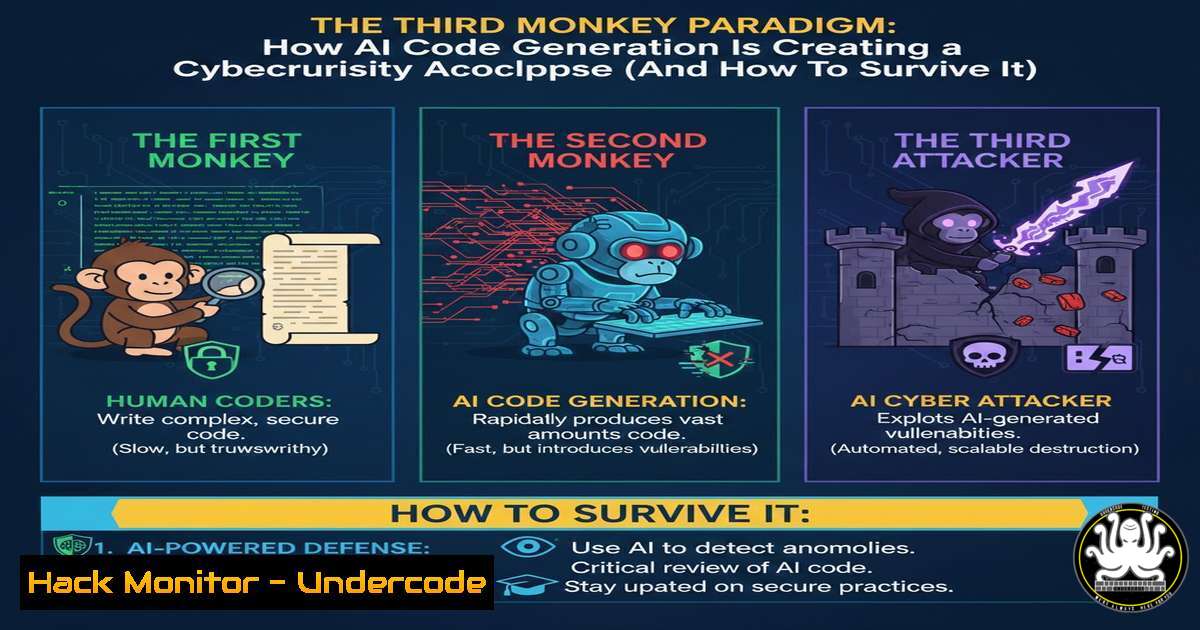
- The Productivity/Security Trade-Off is Dead. The new paradigm isn’t “go fast or be secure.” It’s “articulate security precisely to go fast and be secure.” The third monkey isn’t just fighting; it’s fighting smart with the best tools.
The LinkedIn post is a battle cry from the front lines of development. Its aggressive tone underscores the urgency. Dismissing AI coding is professional suicide, but adopting it without a security mindset is organizational suicide. The future belongs to developers who can merge deep domain expertise (especially in security) with the ability to command AI effectively. The “skill issue” is the critical vulnerability in this new workflow, and the only patch is deliberate, security-focused upskilling. The rain has started; the flood of AI-generated code is here. Your choice is to build an ark with precise, secure prompts or be swept away by the vulnerabilities.
Prediction:
Within 18-24 months, “AI Security Prompting” will be a standard module in secure coding training. SAST tools will evolve into “Prompt AST” tools, analyzing not just code, but the generative prompts that created it, scoring them for security completeness. We will see the first major software supply chain incident directly traceable to an insufficiently constrained AI coding agent, leading to regulatory scrutiny. The developer hierarchy will bifurcate between those who can safely wield AI to generate robust systems and those who merely produce voluminous, vulnerable code. Security engineers won’t be replaced by AI; they will become its most critical commanders, authoring the secure protocols that govern automated code generation.
▶️ Related Video (72% Match):
🎯Let’s Practice For Free:
IT/Security Reporter URL:
Reported By: Activity 7407843414261637120 – Hackers Feeds
Extra Hub: Undercode MoN
Basic Verification: Pass ✅


