Listen to this Post
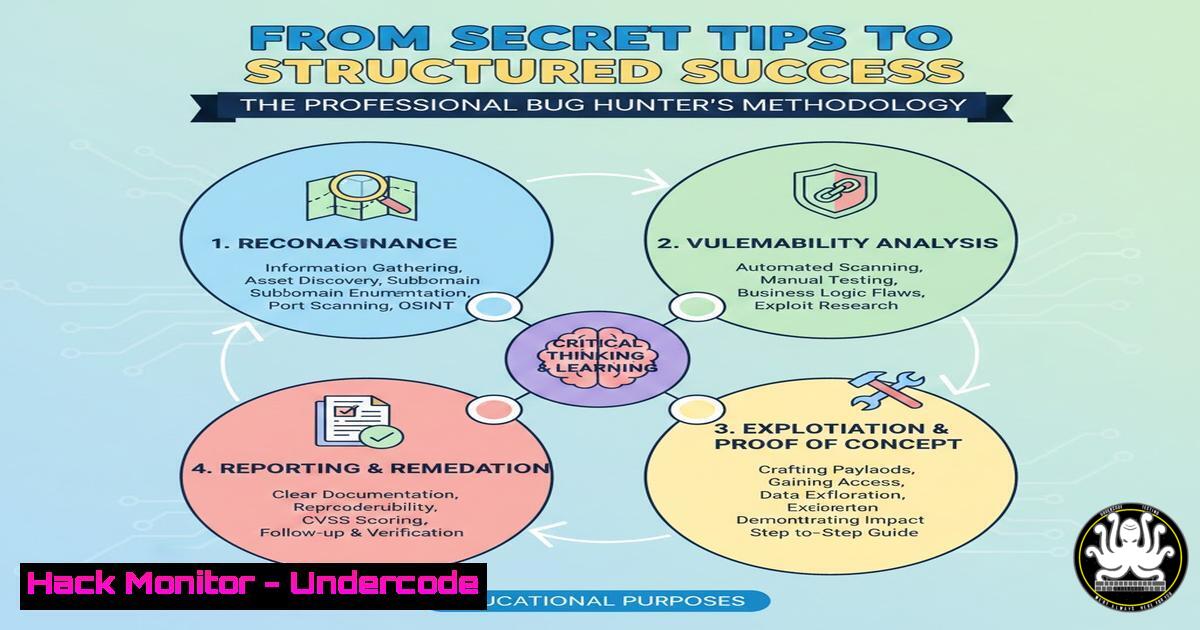
Introduction:
The allure of bug bounty hunting is often wrapped in stories of secret techniques and massive payouts. However, sustainable success isn’t built on scattered tips; it’s founded on a structured, professional methodology that transforms curiosity into consistent results. This guide demystifies the process by applying a formal penetration testing framework—the same used by security professionals—to bug bounty hunting, providing a clear path from reconnaissance to report .
Learning Objectives:
- Understand and apply the standard penetration testing lifecycle to bug bounty programs.
- Identify “low-hanging fruit” vulnerabilities within each phase of security assessment.
- Build a personal, repeatable playbook for efficient and effective bug hunting.
1. Foundation First: The Professional Pentest Lifecycle
Step‑by‑step guide explaining what this does and how to use it.
Forget jumping straight into exploitation. Professional security assessments follow a defined lifecycle. Adopting this structure is your first major advantage over hunters who rely on random probing .
- Pre-engagement Interaction: This is your program reconnaissance. Before touching a target, meticulously review the bug bounty platform’s brief (like HackerOne or Bugcrowd). Document the scope (which domains/subdomains are in/out-of-bounds), rules of engagement (testing limitations, banned techniques), and reward structure. This formalizes your agreement with the company.
- Intelligence Gathering (Reconnaissance): This is the most critical phase for finding unique bugs. Systematically collect information about your target using passive and active methods.
- Threat Modeling & Vulnerability Analysis: Analyze the gathered data to hypothesize where vulnerabilities might exist (e.g., an old subdomain might run outdated software).
- Exploitation & Post-Exploitation: Responsibly test your hypotheses to confirm vulnerabilities, understand their impact, and document the steps.
- Reporting: Clearly communicate the flaw, its impact, and steps to reproduce. Quality reports are as important as the find itself.
2. Weaponizing Reconnaissance: Beyond Simple Enumeration
Step‑by‑step guide explaining what this does and how to use it.
Reconnaissance is not just running automated tools; it’s a guided hunt for misconfigurations. Add purpose to each scan by hunting for specific vulnerabilities during this phase .
Command (DNS Recon):
 Check for DNS Zone Transfer misconfiguration (a potential info leak)
dig axfr @ns1.target-domain.com target-domain.com
 Check for missing SPF/DMARC records (can lead to email spoofing)
dig txt target-domain.com
Procedure:
- During subdomain enumeration (using tools like
amass,subfinder), don’t just collect names. Immediately probe each new subdomain for common misconfigurations. - For every subdomain, check if it’s pointing to a third-party service (like GitHub Pages, AWS S3, Azure App Services). Use a tool like `subjack` or `tko-subs` to check for Subdomain Takeover vulnerabilities, where the DNS record points to a service you can claim.
- This mindset turns a passive list into an active vulnerability hunt.
-
The Hunter’s Goldmine: Identifying Exposed Dev & Backup Files
Step‑by‑step guide explaining what this does and how to use it.
A common real-world finding, as demonstrated by hunters, is exposed sensitive directories and backup files . These are classic “low-hanging fruit.”
Command (Brute-forcing Paths):
 Using ffuf to find sensitive files and directories
ffuf -w /usr/share/wordlists/seclists/Discovery/Web-Content/common.txt -u https://target-domain.com/FUZZ -fs 4242
 A more targeted wordlist for backups/archives
ffuf -w /usr/share/wordlists/seclists/Discovery/Web-Content/CommonBackdoors.txt -u https://target-domain.com/FUZZ
Procedure & Case Study:
- After identifying a target (e.g.,
app.target.com), use a tool likeffuf,gobuster, or `dirb` with wordlists containing backup extensions (.zip,.tar,.bak,.sql) and common paths (/backup,/wp-admin,/git,/metrics). - Real Example: A hunter found `https://example.com/wp.zip`. This file was a complete WordPress backup containing `wp-config.php` with database credentials, source code, and potentially other secrets . Always check for:
`/.git/` (may lead to source code disclosure)
`/.env` (environment files with API keys)
`/api/` or `/swagger/` (exposed API documentation)
`/metrics/` (exposed system performance data)
- From Observation to Exploitation: Testing Common Web Flaws
Step‑by‑step guide explaining what this does and how to use it.
Once you’ve mapped the application, test for common vulnerabilities based on the technology you see.
For Potential SQL Injection:
 Basic manual test in a parameter
https://target.com/profile?id=1'
https://target.com/profile?id=1' OR '1'='1
 Using sqlmap (ONLY on authorized targets within scope)
sqlmap -u "https://target.com/profile?id=1" --batch --level=2
For Cross-Site Request Forgery (CSRF):
- Use a checklist to audit forms and state-changing actions .
- Look for the absence of anti-CSRF tokens, or tokens that are predictable or reused.
- Craft a simple HTML proof-of-concept (PoC) file that submits a form to the target site when opened by a victim.
<html><body></li>
</ol>

<form action="https://target.com/change-email" method="POST">
<input type="hidden" name="email" value="[email protected]" />
</form>

<script>document.forms[bash].submit();</script></body></html>
- Building Your Personal Playbook: The Key to Consistency
Step‑by‑step guide explaining what this does and how to use it.
The final step is to systematize your learning. Your playbook ensures you never miss a step and continuously improves .
- Document Your Process: Create a checklist for each phase. For example, your Reconnaissance Phase playbook entry might state: “1. Enumerate subdomains. 2. For each subdomain, check for takeover. 3. Run a `nikto` scan on main ports. 4. Brute-force for
/wp-admin,/backup,.git.” - Record Tools & Commands: Keep a curated list of your most effective tools and their specific command-line arguments for different situations.
- Analyze & Adapt: After each hunt—win or lose—review your playbook. Did you miss something? Add it. Was a step unnecessary? Refine it. This turns experience into a repeatable system.
What Undercode Say:
- Methodology Over Magic: The “secret” of top performers is not a hidden tool, but a disciplined, repeatable process derived from professional standards .
- Context is King: Automated tools generate data; the hunter’s skill lies in analyzing that data within the context of the target’s technology stack to hypothesize where vulnerabilities will be .
The narrative that bug bounty success relies on undisclosed “secrets” from elite hunters is a myth that obscures the real pathway. True proficiency stems from adopting and internalizing a structured security methodology. This approach replaces randomness with rigor, allowing hunters to efficiently filter noise and focus on logic-driven vulnerability discovery. The future of bug hunting will be dominated not by those with a larger arsenal of one-off tricks, but by those who can most effectively systematize their approach and leverage AI as a research and analysis force multiplier, while retaining the critical human judgment for context and exploitation .
Prediction:
The democratization of hacking knowledge and tools will make the foundational reconnaissance phase increasingly competitive. Future differentiation will come from advanced threat modeling and AI-assisted vulnerability correlation. Hunters will use AI to synthesize data from reconnaissance (technologies, version histories, CVE databases) to predict attack surfaces with high precision. Furthermore, as programs harden against common bugs, success will shift towards logical flaws and business logic vulnerabilities—areas that require deep understanding of application flow and are difficult to find with automation alone. The hunters who thrive will be those who master the structured methodology and augment it with strategic technology, evolving from script runners into true security analysts.
▶️ Related Video (86% Match):
🎯Let’s Practice For Free:
IT/Security Reporter URL:
Reported By: Deepak Saini – Hackers Feeds
Extra Hub: Undercode MoN
Basic Verification: Pass ✅🔐JOIN OUR CYBER WORLD [ CVE News • HackMonitor • UndercodeNews ]
📢 Follow UndercodeTesting & Stay Tuned:
- Building Your Personal Playbook: The Key to Consistency


