
Listen to this Post
Introduction:
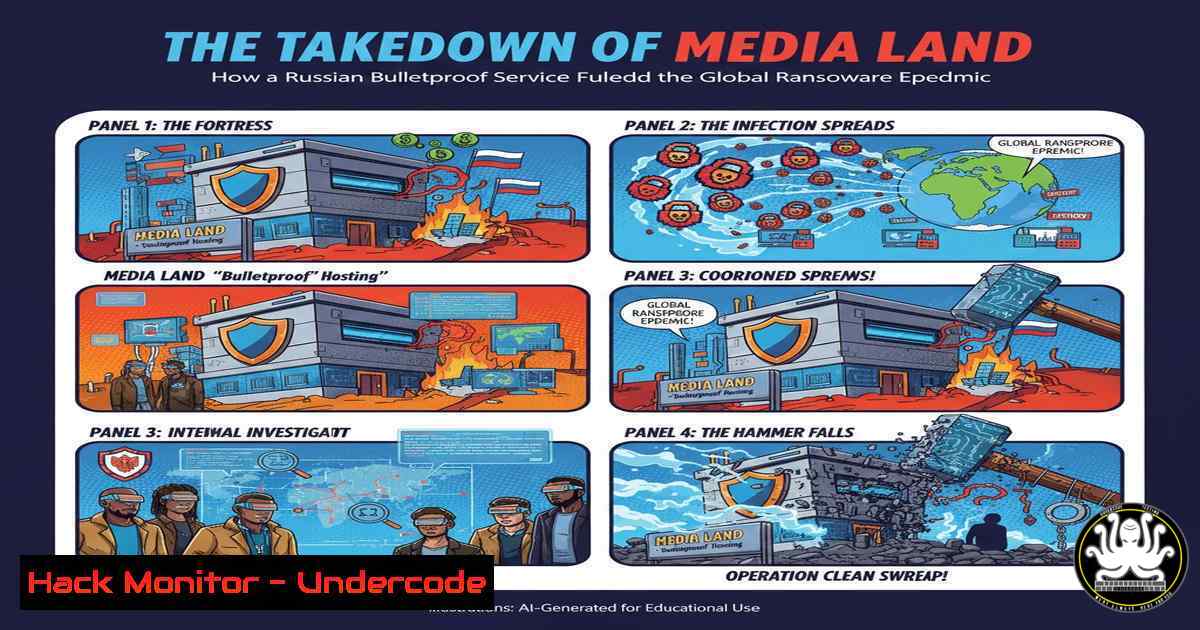
In a landmark international operation, U.S., U.K., and Australian authorities have disrupted a critical piece of the cybercrime ecosystem: a Russian bulletproof hosting service known as Media Land LLC. This infrastructure, along with a massive global drug trafficking organization (DTO), was dismantled, revealing the sophisticated use of cryptocurrency in laundering illicit profits. This action signifies a strategic shift by law enforcement from targeting individual actors to dismantling the core infrastructure that enables cybercrime on a global scale.
Learning Objectives:
- Understand the role and operational mechanics of “bulletproof hosting” services in the cybercrime kill chain.
- Learn how to trace cryptocurrency transactions associated with illicit activities using blockchain analysis.
- Identify the technical indicators of compromise (IoCs) and methodologies for hardening networks against threats emanating from such infrastructures.
You Should Know:
1. Deconstructing Bulletproof Hosting: The Cybercriminal’s Foundation
Bulletproof hosting providers (BPH) are a class of internet service that explicitly caters to cybercriminals by ignoring abuse complaints and legal takedown requests. Unlike legitimate hosting services, BPHs operate with a willful negligence for the law, providing the foundational infrastructure for ransomware-as-a-service (RaaS), phishing campaigns, malware command-and-control (C2) servers, and illicit cryptocurrency nodes. Media Land LLC was a prime example, supporting the entire cybercrime kill chain, from initial access brokers to the ransomware deployment itself.
Step-by-Step Guide: Identifying and Blocking BPH IP Ranges
Security teams can proactively defend their networks by identifying and blocking known BPH IP ranges.
Step 1: Gather Threat Intelligence Feeds. Subscribe to or regularly download IP blocklists from reputable sources. For a case like Media Land, official designations from OFAC will include specific IP addresses and domains.
Step 2: Implement Blocking Rules on Your Firewall. Using the gathered intelligence, create and enforce firewall rules to deny all traffic to and from these malicious IP ranges.
Linux iptables example: To block a specific IP range associated with Media Land (e.g., 192.0.2.0/24), you would use:
sudo iptables -A INPUT -s 192.0.2.0/24 -j DROP
sudo iptables -A OUTPUT -d 192.0.2.0/24 -j DROP
Windows PowerShell with NetSecurity Module: You can use the `New-NetFirewallRule` cmdlet.
New-NetFirewallRule -DisplayName "Block Media Land IP Range" -Direction Inbound -RemoteAddress 192.0.2.0/24 -Action Block
New-NetFirewallRule -DisplayName "Block Media Land IP Range Outbound" -Direction Outbound -RemoteAddress 192.0.2.0/24 -Action Block
Step 3: Monitor for Beaconing. Even after blocking, monitor your network logs for attempted connections to these blocked IPs, which could indicate a pre-existing compromise within your environment.
- Tracing the Crypto: From Ransomware Payment to Cash-Out
The Chainalysis report highlights thousands of cryptocurrency addresses linked to the operator “Yalishanda.” Blockchain analysis tools allow investigators to follow the flow of funds from a ransomware payment through a complex web of services designed to obfuscate the trail, ultimately to an off-ramp where crypto is converted to fiat currency.
Step-by-Step Guide: Basic Principles of Blockchain Analysis
Step 1: Start with the Ransomware Address. When a victim pays a ransom, the transaction is recorded on the blockchain. This is the starting point.
Step 2: Cluster Addresses. Use heuristic analysis to cluster addresses likely controlled by the same entity. This includes identifying addresses that are inputs to the same transaction (common input ownership).
Step 3: Track Fund Flows to Services. Follow the transactions from the initial address to known cryptocurrency services like mixers (e.g., Wasabi Wallet, Blender.io), exchanges, or decentralized finance (DeFi) protocols. Mixers attempt to break the transaction trail by pooling and mixing funds from multiple users.
Step 4: Identify the Off-Ramp. The final step is identifying the exchange where the criminal cashes out. Law enforcement can then issue subpoenas to these regulated entities to uncover the real-world identities behind the accounts.
- The Convergence of Cyber and Physical Crime: The DTO Case
The simultaneous takedown of a global drug trafficking organization (DTO) run by former Olympian Ryan Wedding, which moved $263 million in crypto, demonstrates the convergence of cyber and physical crime. The DTO showed connections to Chinese chemical manufacturers, using crypto to pay for precursor chemicals and launder proceeds from global fentanyl and methamphetamine sales.
Step-by-Step Guide: Analyzing Darknet Market Listings
Step 1: Accessing Darknet Markets (For Research Purposes). Using the Tor browser, security researchers can access darknet markets to gather intelligence on threat actors and their products.
Step 2: Identifying Vendor Patterns. Analyze vendor profiles, product listings, and payment addresses. Look for PGP keys, Jabber contact info, and cryptocurrency addresses posted by vendors.
Step 3: Correlating Data. Correlate the cryptocurrency addresses found on darknet markets with those published in law enforcement reports or blockchain intelligence platforms. This can help map the entire ecosystem of a specific DTO or cybercriminal group.
4. Hardening Your Network Against BPH-Facilitated Attacks
Given that BPHs host the tools for initial access, it’s critical to harden defenses at the network perimeter and within endpoints.
Step-by-Step Guide: Implementing Strong EDR and Network Segmentation
Step 1: Deploy and Tune Endpoint Detection and Response (EDR). EDR tools go beyond traditional antivirus by monitoring for malicious behaviors and techniques.
Configure policies to alert on and block processes spawning from temporary directories, scripting hosts like `powershell.exe` or `cscript.exe` making outbound connections, and attempts to disable security software.
Step 2: Implement Strict Network Segmentation. Do not allow lateral movement across your network. Segment critical assets (e.g., domain controllers, file servers) from general user workstations.
Use firewall rules to enforce the principle of least privilege, allowing only necessary communication between subnets.
Step 3: Enforce Multi-Factor Authentication (MFA) Everywhere. This is the single most effective control to prevent credential-based attacks, which are often launched from BPH infrastructures.
5. Leveraging YARA for Threat Hunting
YARA is a powerful tool used to identify and classify malware based on textual or binary patterns. You can create rules to hunt for malware families known to be hosted on services like Media Land.
Step-by-Step Guide: Creating a Basic YARA Rule
Step 1: Identify a Unique Pattern. Analyze a malware sample (or its indicators from a threat report) to find a unique string, hex pattern, or sequence of operations.
Step 2: Write the Rule. A simple YARA rule to detect a hypothetical ransomware variant “CryptoLocker-2024” might look like:
rule CryptoLocker_2024 {
meta:
description = "Detects CryptoLocker 2024 Ransomware"
author = "Your-SOC-Team"
date = "2024-05-20"
strings:
$a = "CryptoLocker-2024" wide ascii
$b = { 48 8B 05 ?? ?? ?? ?? 48 89 44 24 28 }
$c = "/C vssadmin delete shadows /all /quiet"
condition:
any of them
}
Step 3: Deploy and Scan. Deploy this rule to your YARA-compatible EDR, sandbox, or endpoint scanner to proactively hunt for this threat across your environment.
What Undercode Say:
- The disruption of core infrastructure like Media Land is more impactful than arresting individual hackers. It creates cascading failures across multiple criminal operations that relied on that service.
- The convergence of cybercrime and traditional illicit trade, both relying on the same cryptocurrency-based money laundering ecosystems, demands a unified intelligence and enforcement approach from global authorities.
Analysis: This coordinated action represents a maturation of global cyber-policing. By targeting the “utilities” of the cyber-underground—hosting and money movement—authorities are attacking the business model of cybercrime itself. The technical details released, including thousands of cryptocurrency addresses, provide a treasure trove of data for security researchers and companies to update their threat intelligence feeds and defensive postures. This move from reactive indictments to proactive infrastructure dismantling will force cybercriminals to constantly rebuild, increasing their operational costs and reducing their effectiveness.
Prediction:
In the next 12-24 months, we predict a surge in the use of more decentralized infrastructure by high-tier cybercriminal groups, such as peer-to-peer botnets and anonymous cloud platforms, to reduce their reliance on centralized BPHs. Simultaneously, the use of privacy-focused cryptocurrencies and cross-chain bridges for money laundering will accelerate, pushing law enforcement and blockchain analytics firms to develop more sophisticated tracking capabilities for these emerging technologies. The line between cybercrime and other transnational crimes will continue to blur, with AI-powered fraud and procurement becoming a central pillar of these converged criminal enterprises.
🎯Let’s Practice For Free:
IT/Security Reporter URL:
Reported By: Chainalysis Us – Hackers Feeds
Extra Hub: Undercode MoN
Basic Verification: Pass ✅


