
Listen to this Post
Introduction:
SolarWinds represents a cornerstone of enterprise IT infrastructure management, providing unparalleled visibility into network operations, server performance, and application health. However, its pervasive access and deep integration within corporate networks also made it the perfect vehicle for one of the most sophisticated supply chain attacks in history. Understanding the SolarWinds platform is now as much about leveraging its management capabilities as it is about fortifying it against catastrophic compromise.
Learning Objectives:
- Understand the core features of SolarWinds that make it both an essential management tool and a high-value attack target.
- Learn the technical mechanics of the SUNBURST backdoor attack and how to detect its indicators of compromise (IOCs).
- Master the hardening and monitoring procedures essential for securing SolarWinds Orion deployments in a modern enterprise.
You Should Know:
- The SolarWinds Supply Chain Attack: A Technical Post-Mortem
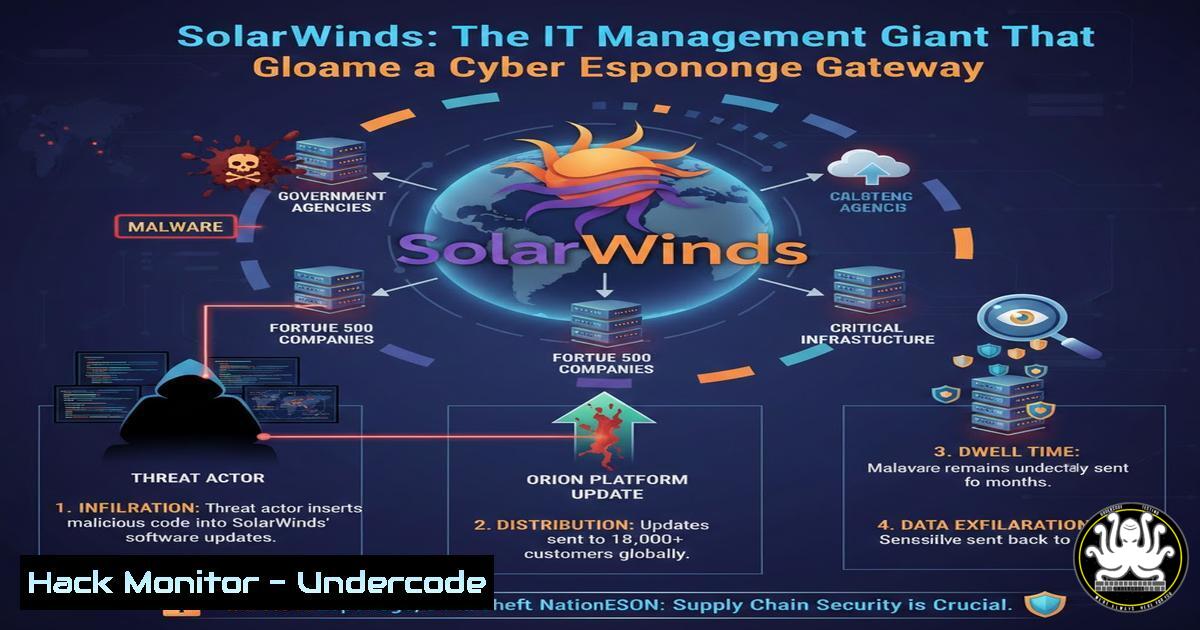
The 2020 SolarWinds attack was a masterclass in software supply chain compromise. Nation-state actors injected a malicious component, dubbed SUNBURST, into the legitimate SolarWinds.Orion.Core.BusinessLayer.dll library. This backdoor was digitally signed with SolarWinds’ own certificates, allowing it to bypass traditional security controls and propagate through automatic updates to over 18,000 organizations.
Step-by-Step Guide to Understanding the SUNBURST Kill Chain:
Step 1: Initial Compromise – Attackers gained access to SolarWinds’ build environment and inserted the SUNBURST code into the Orion platform’s source code.
Step 2: Weaponized Update – The trojanized DLL was compiled into the official Orion software updates between March and June 2020. This update was then distributed to customers through SolarWinds’ official update channels.
Step 3: Dormancy and Reconnaissance – Upon installation, the backdoor would lie dormant for up to two weeks. It then gathered system information (hostname, domain, IP address, running processes) and beaconed to a Command and Control (C2) server using a domain generation algorithm (DGA) to blend in with normal SolarWinds API traffic.
Step 4: Lateral Movement and Espionage – If the C2 server responded with active commands, the attackers could then deploy secondary payloads like TEARDROP or Cobalt Strike beacons to move laterally and exfiltrate data.
2. Detecting SUNBURST IOCs in Your Environment
Early detection is critical. The SUNBURST backdoor left specific forensic artifacts that can be hunted for in your logs and file systems.
Step-by-Step Guide to IOC Hunting:
Step 1: File Hash Verification – Check the hashes of your SolarWinds Orion DLLs. The malicious `SolarWinds.Orion.Core.BusinessLayer.dll` had specific SHA256 hashes (e.g., acd7c41c9f24c34a5c74c6577b71c1b4a28f7e04b81bae1c3c786a695a1a0c82). Use the following PowerShell command to generate hashes for comparison:
Get-FileHash -Path "C:\Program Files (x86)\SolarWinds\Orion\SolarWinds.Orion.Core.BusinessLayer.dll" -Algorithm SHA256
Step 2: Network Traffic Analysis – SUNBURST C2 domains often mimicked legitimate SolarWinds subdomains (e.g., avsvmcloud.com). Search your DNS and proxy logs for connections to known-bad C2 domains and any unusual outbound traffic on ports 443 or 8888.
Step 3: Process and Service Analysis – Look for the `SolarWinds.BusinessLayerHost.exe` process making unexpected network connections. On Linux, you can use:
lsof -i -P | grep -i solarwinds
netstat -tulnp | grep :17778
(Note: Adjust the port based on your SolarWinds configuration).
3. Hardening Your SolarWinds Orion Deployment
A proactive defense-in-depth strategy is non-negotiable for a system with the privileges of SolarWinds.
Step-by-Step Hardening Guide:
Step 1: Network Segmentation – Place your SolarWinds Orion server in a dedicated management VLAN. Strictly limit inbound and outbound traffic using firewall rules. The Orion server should not have unrestricted internet access.
Step 2: Principle of Least Privilege – The Orion service account should have only the minimum permissions required to function. Avoid using Domain Admin accounts. Regularly audit account permissions.
Step 3: Certificate Pinning and Validation – Implement certificate pinning for Orion’s communication with nodes to prevent man-in-the-middle attacks. Disable weak TLS protocols and cipher suites on the IIS server hosting the Orion web console.
Step 4: Disable Unused Features – Turn off any SolarWinds features and modules that are not actively in use within your environment to reduce the attack surface.
4. Advanced Monitoring for Anomalous Orion Activity
Beyond IOCs, behavioral analytics can catch novel attacks.
Step-by-Step Monitoring Configuration:
Step 1: SIEM Logging – Ensure all Orion logs (Windows Event Logs, IIS logs, Orion application logs) are forwarded to your SIEM. Create correlation rules to alert on:
Multiple failed login attempts to the Orion web console.
Changes to critical configuration files or user accounts.
Orion processes spawning unexpected child processes (e.g., cmd.exe, powershell.exe).
Step 2: File Integrity Monitoring (FIM) – Use tools like Windows Defender ATP, AuditD on Linux, or third-party FIM solutions to monitor critical Orion directories (C:\Program Files (x86)\SolarWinds\) for unauthorized file creation, modification, or deletion.
Step 3: Network Detection – Employ a Network Detection and Response (NDR) system to baseline normal Orion API traffic and alert on deviations in volume, frequency, or destination.
5. Incident Response Plan for a SolarWinds Compromise
Having a plan ensures a swift, effective response.
Step-by-Step IR Plan Outline:
Step 1: Preparation – Document contact lists, communication plans, and ensure your IR toolkit is available.
Step 2: Identification – Upon a positive detection, immediately isolate the Orion server from the network. Do not turn it off, as this destroys volatile evidence.
Step 3: Containment – Block all identified IOCs at the firewall. Reset credentials for all service accounts used by Orion and any accounts that may have been queried by the Orion server.
Step 4: Eradication & Recovery – Follow official guidance from SolarWinds, CISA, and your incident response provider. This typically involves a complete wipe and rebuild of the Orion server from a known-clean backup, followed by patching to the latest secure version.
Step 5: Post-Incident Analysis – Conduct a full root cause analysis to understand how the breach occurred and what controls failed, then update your security policies accordingly.
What Undercode Say:
- Trust, But Verify Your Supply Chain. The SolarWinds hack shattered the implicit trust placed in software vendors. Organizations must now implement rigorous software bill of materials (SBOM) analysis and assume that any third-party code could be compromised.
- Visibility is a Double-Edged Sword. The very tool granting you total visibility into your IT estate can, if compromised, grant that same visibility to an adversary. The security of your monitoring systems must be paramount, treated with the same rigor as your most critical domain controllers.
The SolarWinds incident was a paradigm shift, moving the threat from the network perimeter to the very heart of IT operations. It demonstrated that sophisticated actors are willing to invest immense time and resources to compromise a single, high-value target for maximum downstream access. The lesson is clear: in today’s landscape, defending your own network is not enough; you must also actively manage the risk introduced by every piece of software and hardware in your supply chain. Proactive hunting, stringent segmentation, and a well-rehearsed incident response plan are no longer optional for any organization relying on complex IT management platforms.
Prediction:
The SolarWinds attack will have a long-tail impact, catalyzing a global push for stringent software supply chain security regulations and standards. We will see a rapid adoption of Zero Trust architectures, where implicit trust in any asset—including internal management systems—is eliminated. Future attacks will likely mimic this model, targeting other widely used but less-secured IT operations tools (e.g., backup software, configuration management databases) and open-source libraries. The arms race will shift further “left” in the software development lifecycle, with a heavy focus on securing build pipelines and code-signing infrastructure against nation-state-level intrusion.
🎯Let’s Practice For Free:
IT/Security Reporter URL:
Reported By: Ahmed Bawkar – Hackers Feeds
Extra Hub: Undercode MoN
Basic Verification: Pass ✅


