Listen to this Post
Introduction:
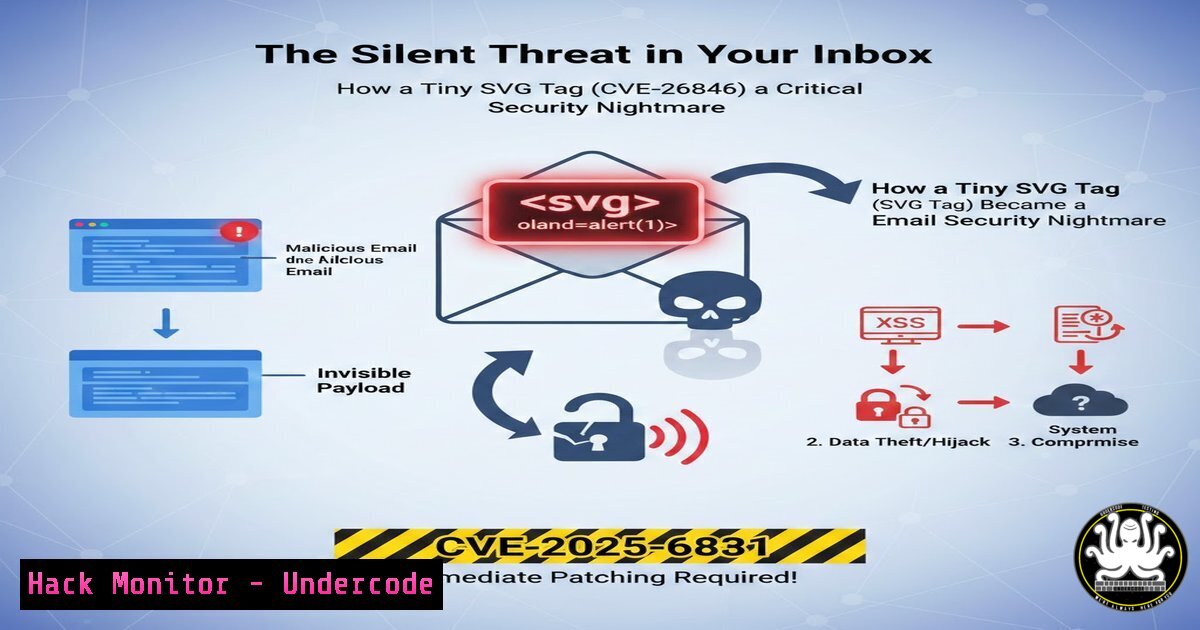
A high-severity Cross-Site Scripting (XSS) vulnerability, tracked as CVE-2025-68461, has been uncovered in Roundcube Webmail, exposing widely used email systems to client-side attacks. With a CVSS score of 7.2, this flaw allows attackers to inject malicious scripts via a specially crafted SVG `animate` tag, potentially leading to session hijacking and data theft within the webmail interface. This incident underscores the evolving threat landscape where trusted file formats like SVG become weapons for bypassing security controls.
Learning Objectives:
- Understand the technical mechanics of the SVG `animate` tag XSS vulnerability in Roundcube.
- Learn how to detect vulnerable installations and apply the official security patches.
- Implement proactive security measures, including Content Security Policies (CSP) and input sanitization, to mitigate similar client-side threats.
You Should Know:
- The Anatomy of the Attack: Exploiting the SVG Animate Tag
The core of CVE-2025-68461 lies in Roundcube’s improper neutralization of input within SVG documents. Specifically, the `animate` tag’s `values` attribute, which controls animation sequences, was not adequately sanitized. Attackers can smuggle malicious JavaScript payloads into this attribute.
Step-by-step guide explaining what this does and how to use it:
An SVG `animate` tag can interpolate between multiple values defined in a semicolon-separated list within the `values` attribute. Research shows that a common attack vector involves placing a `javascript:` URL as one value among others to bypass Web Application Firewalls (WAFs). For example:
<svg>
<a id="xss"><text x="20" y="20">Click</text></a>
<animate xlink:href="xss" attributeName="href" dur="5s"
values="https://safe.example.com/;javascript:alert(document.cookie);0"
keyTimes="0;0;1" />
</svg>
In this payload, the `keyTimes=”0;0;1″` attribute ensures the animation jumps to the second value (javascript:alert(document.cookie)) immediately and holds it indefinitely. When a victim views a malicious email containing this SVG, the script executes in their browser session, compromising their Roundcube account.
2. Detection and Verification: Is Your Instance Vulnerable?
Immediate detection is critical. The vulnerability affects Roundcube Webmail versions before 1.5.12 and 1.6.x versions before 1.6.12.
Step-by-step guide explaining what this does and how to use it:
First, identify your Roundcube version. You can typically find this in the bottom corner of the login page or within the application’s “About” section. If the version number is lower than the patched ones, your system is vulnerable.
For technical verification, security researchers can examine the HTML sanitization logic. The flaw was in the handling of the SVG `animate` tag. A simple test can involve checking if a benign SVG animation is properly stripped or neutralized. You can also search server logs for patterns of SVG file uploads or accesses, which might indicate probing activity.
3. Immediate Remediation: Applying the Official Patch
The only complete solution is to apply the official security update released by the Roundcube development team.
Step-by-step guide explaining what this does and how to use it:
1. Backup: Always start by creating a full backup of your Roundcube installation directory and its database.
2. Download: Obtain the patched release from the official GitHub repository. For the stable branch, use version 1.6.12, and for the Long-Term Support (LTS) branch, use version 1.5.12.
3. Update: Replace your current Roundcube files with the new ones. The project provides `update.sh` or `installto.sh` scripts to assist with migration.
4. Verify: After updating, confirm the version number in the web interface has changed to the patched version. Test core email functionalities to ensure the update did not break any features.
4. Hardening Defenses: Implementing Content Security Policy (CSP)
Patching fixes this specific flaw, but a defense-in-depth strategy is essential. Implementing a strict Content Security Policy (CSP) header can effectively neuter many client-side XSS attacks, including those via SVG.
Step-by-step guide explaining what this does and how to use it:
A CSP instructs the browser which sources of content are trusted. To block inline scripts commonly used in XSS, you can use the following directive in your web server configuration (e.g., Apache `.htaccess` or Nginx config file):
Content-Security-Policy: default-src 'self'; script-src 'self';
This policy only allows scripts to be loaded from the same origin as the page itself. For Roundcube, which may use inline scripts, a more tailored policy is needed. You can start with a report-only mode to avoid breaking functionality:
Content-Security-Policy-Report-Only: default-src 'self'; report-uri /csp-report-endpoint;
Analyze the reports to fine-tune the policy before enforcing it. This will prevent any unauthorized script, whether from an SVG `animate` tag or other injected elements, from executing.
5. Proactive Sanitization: Securing File Uploads and Rasterization
Since SVG files can contain executable code, treating them as active content, not just images, is vital.
Step-by-step guide explaining what this does and how to use it:
Implement server-side sanitization for all user-uploaded SVG files. Use a dedicated library like `svg-sanitizer` (for PHP) to parse uploaded SVGs and remove all potentially dangerous elements and attributes, such as <script>, `event handlers` (e.g., onbegin), and `javascript:` URLs.
A more radical but effective approach is server-side rasterization. Convert all uploaded SVGs to a safe raster format like PNG before display. This completely eliminates any script-based threat. A tool like ImageMagick can automate this:
 Linux command using ImageMagick to convert SVG to PNG
convert input.svg output.png
Integrate this conversion into your file upload workflow. While this changes the file format, it guarantees safety for all users viewing the content.
What Undercode Say:
- The Evolution of Stealth: This vulnerability signifies a shift towards exploiting complex features within “safe” standards like SVG. Attackers are increasingly targeting the gap between a format’s specification and its implementation in sanitizers, making them potent for bypassing security filters.
- Email as a Critical Attack Surface: Roundcube’s widespread use makes it a high-value target. Compromising a webmail client doesn’t just steal one account’s data; it provides a foothold for lateral movement, credential phishing via trusted contacts, and monitoring of sensitive communications. The integrity of email systems is foundational to organizational security.
The exploitation of CVE-2025-68461 is not just about an alert pop-up. It’s a gateway for session hijacking, where an attacker could silently read a user’s emails, send messages from their account, or steal contact lists. The CVSS vector (AV:N/AC:L/PR:N/UI:N/S:C) highlights its danger: it’s network-based, requires low attack complexity, no privileges, no user interaction, and has a scope change, meaning it can affect other components. Patching is non-negotiable, but it’s merely the first step. Security teams must now scrutinize their entire stack for similar lax sanitization of SVG and other XML-based formats.
Prediction:
SVG-based XSS attacks will see a marked increase in both frequency and sophistication over the next 12-18 months. As demonstrated by CVE-2025-68461 and related research, the flexibility of SVG provides a rich toolkit for evading signature-based WAFs and blacklist sanitizers. We predict a rise in chained attacks where an SVG XSS vulnerability, like this one, is used as a precursor to more severe breaches. For instance, stealing a session cookie via XSS could grant access to internal plugins or settings, potentially leading to server-side request forgery (SSRF) or further exploitation of other vulnerabilities, as has been seen in previous Roundcube attack chains. The security community’s response will need to move beyond tag blacklists and towards context-aware parsing, stricter CSP adoption, and treating all user-supplied vector graphics as untrusted code by default.
🎯Let’s Practice For Free:
IT/Security Reporter URL:
Reported By: Deepak Saini – Hackers Feeds
Extra Hub: Undercode MoN
Basic Verification: Pass ✅


