
Listen to this Post
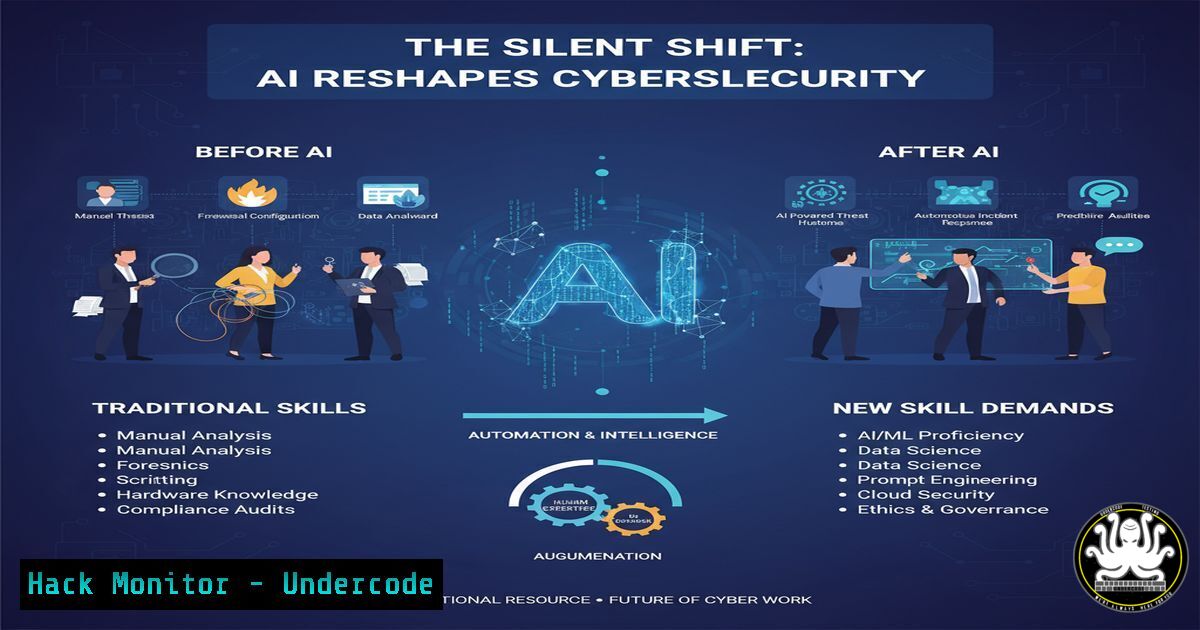
Introduction:
The integration of Artificial Intelligence into the business landscape is not triggering mass layoffs but is instead orchestrating a fundamental transformation of IT and cybersecurity roles. As highlighted by Yale’s Budget Lab analysis, the disruption is subtle, emphasizing a shift in required skills over outright job replacement. This evolution demands a proactive approach to upskilling, particularly in leveraging AI for both defensive and offensive security operations.
Learning Objectives:
- Understand the key AI tools and commands reshaping cybersecurity workflows.
- Learn to implement AI-augmented security protocols for cloud, network, and application defense.
- Develop a skill set that pivots from manual task execution to AI-powered security orchestration.
You Should Know:
1. AI-Enhanced Threat Intelligence Aggregation
Manually sifting through threat feeds is inefficient. AI can automate this, correlating data from disparate sources to identify emerging threats.
Command & Guide:
 Using `curl` and `jq` to query a threat intelligence API and parse IOCs (Indicators of Compromise)
curl -s -H "Authorization: Bearer $API_KEY" https://api.threatintelplatform.com/v1/indicators | jq '.data[] | select(.malicious_confidence > 80) | .ip_address'
Step 1: Store your API key from your threat intel provider in an environment variable (export API_KEY=your_key_here).
Step 2: The `curl` command silently (-s) fetches the latest indicator data from the API.
Step 3: The `jq` utility parses the JSON output, filtering for entries with a malicious confidence score above 80 and extracting only the IP addresses. This creates a focused, actionable blocklist.
2. Automating Vulnerability Scans with AI-Powered Prioritization
Traditional vulnerability scanners produce overwhelming lists. AI-driven tools can contextualize risks, prioritizing based on exploitability and asset criticality.
Command & Guide:
 Using a hypothetical AI-powered scanner 'clairvoyant-scanner'
clairvoyant-scanner --target 10.0.1.0/24 --output json | clairvoyant-prioritize --criticality-tags web,external
Step 1: Run the scanner against your target network range, outputting the results in JSON format.
Step 2: Pipe the results into the `prioritize` module. The AI model analyzes each vulnerability, considering factors like proximity to the network edge and service type.
Step 3: The output is a shortlist of critical vulnerabilities that demand immediate attention, drastically reducing triage time.
3. AI-Driven Security Log Analysis with PowerShell
Windows environments generate vast logs. AI scripts can identify anomalous patterns indicative of a breach.
Command & Guide:
 PowerShell script to detect anomalous login times
Get-WinEvent -FilterHashtable @{LogName='Security'; ID=4624} | Where-Object {
$<em>.TimeCreated.Hour -lt 7 -or $</em>.TimeCreated.Hour -gt 19
} | Select-Object TimeCreated, @{Name='TargetUser';Expression={$<em>.Properties[bash].Value}}, @{Name='SourceIP';Expression={$</em>.Properties[bash].Value}}
Step 1: The `Get-WinEvent` cmdlet retrieves all successful login events (Event ID 4624) from the Security log.
Step 2: The `Where-Object` cmdlet filters these events to those occurring outside of typical business hours (before 7 AM or after 7 PM).
Step 3: The `Select-Object` cmdlet formats the output to show the timestamp, user account, and source IP, flagging potential compromised credentials or insider threats.
- Hardening Cloud Configurations with AI Policy as Code
Misconfigured cloud storage (S3 buckets, Blob containers) is a leading cause of data breaches. AI can continuously audit configurations against best practices.
Command & Guide:
 Using `terraform` with an AI security analysis tool like `checkov`
terraform plan -out=tfplan
checkov -f tfplan --soft-fail
Step 1: Generate a Terraform execution plan for your cloud infrastructure.
Step 2: Run `checkov` against the plan file. Its AI-driven engine analyzes the configuration for security missteps before deployment.
Step 3: Review the output, which will list security violations (e.g., “Ensure S3 bucket is not publicly readable”) with a severity rating, allowing for pre-emptive hardening.
- Implementing Behavioral AI for Endpoint Detection and Response (EDR)
Signature-based detection is obsolete. Modern EDR uses AI to model process behavior, detecting never-before-seen malware.
Command & Guide:
 Querying a EDR's API for AI-detected anomalies
curl -X GET "https://your-edr-api.com/v1/alerts" -H "X-Api-Key: $EDR_API_KEY" --data-urlencode "alert_type=behavioral"
Step 1: Obtain your EDR solution’s API key and set it as an environment variable.
Step 2: Use `curl` to query the alerts endpoint, specifically filtering for `behavioral` alerts.
Step 3: These alerts represent processes that acted suspiciously (e.g., mass file encryption, unusual network connections) based on the AI’s behavioral model, enabling rapid investigation of potential zero-day attacks.
6. AI-Powered Phishing Detection with Python and NLP
AI can analyze email headers and body content with far greater accuracy than traditional rule-based filters.
Code Snippet & Guide:
 A simplified example using a pre-trained model (conceptual)
from phishing_detector import AIPhishingModel

model = AIPhishingModel.load('trusted_model.h5')
email_text = "Urgent! Click here to verify your account: http://malicious-link.bad"

prediction = model.predict([bash])
if prediction[bash] > 0.8:  Confidence threshold
print("ALERT: High-confidence phishing email detected.")
 Quarantine email, alert SOC
Step 1: Import a pre-trained AI model designed for Natural Language Processing (NLP) of phishing emails.
Step 2: Feed the email’s text content into the model’s `predict` function.
Step 3: The model returns a confidence score. If it exceeds a defined threshold (e.g., 0.8 or 80%), automated actions can be triggered to isolate the threat.
7. Automating API Security Testing with AI Fuzzers
APIs are prime targets. AI fuzzers can intelligently generate malicious input to find vulnerabilities traditional scanners miss.
Command & Guide:
 Running an AI-based API fuzzer like 'ffuf' with advanced wordlists
ffuf -w /usr/share/wordlists/ai-generated-payloads.txt -u https://api.target.com/v1/users/FUZZ -H "Authorization: Bearer <token>" -mc all -fr "error"
Step 1: The tool `ffuf` is used with a specialized, AI-generated wordlist containing nuanced and complex attack payloads.
Step 2: It tests every endpoint (replacing FUZZ) on the target API.
Step 3: The flags `-mc all` (match all status codes) and `-fr “error”` (filter out common error messages) help identify subtle, abnormal responses that could indicate a hidden vulnerability like IDOR or SQLi.
What Undercode Say:
- The cybersecurity labor market is not shrinking but is bifurcating. Demand is plummeting for professionals who only perform manual, repetitive tasks (e.g., basic log review, simple vuln scanning) and skyrocketing for those who can architect, manage, and interpret AI-driven security systems.
- The core function of a security professional is shifting from “doing” the analysis to “orchestrating” the AI that does the analysis. The human role becomes one of strategic oversight, tool configuration, and handling the complex edge cases that AI cannot.
The Yale analysis correctly identifies that the tremors, not the earthquake, are here. In cybersecurity, we see this as the automation of Tier 1 SOC analyst functions. The professional who merely follows a static playbook is being augmented—and will soon be replaced—by AI that can execute that playbook infinitely faster. However, this creates a massive opportunity for those who can build the playbooks, train the AI models on domain-specific data, and conduct the deep-dive forensic investigations that the AI flags. The key is to pivot from being a manual operator to an AI-augmented strategist. The tools listed above are not just utilities; they are the new fundamentals of the trade.
Prediction:
The future impact will be an acceleration of the cyber arms race. Defensive AI will become standard, forcing threat actors to increasingly adopt offensive AI to find vulnerabilities, craft polymorphic malware, and launch hyper-personalized phishing campaigns at scale. This will not eliminate the need for human cybersecurity experts but will concentrate their value on high-level tasks: threat hunting, AI model poisoning detection, security architecture design, and crisis management. Organizations that invest in reskilling their IT teams to work symbiotically with AI will develop an unassailable defensive advantage, while those that resist will face an exponentially growing capability gap.
🎯Let’s Practice For Free:
IT/Security Reporter URL:
Reported By: Akshilthumar Ai – Hackers Feeds
Extra Hub: Undercode MoN
Basic Verification: Pass ✅


