
Listen to this Post
Introduction:
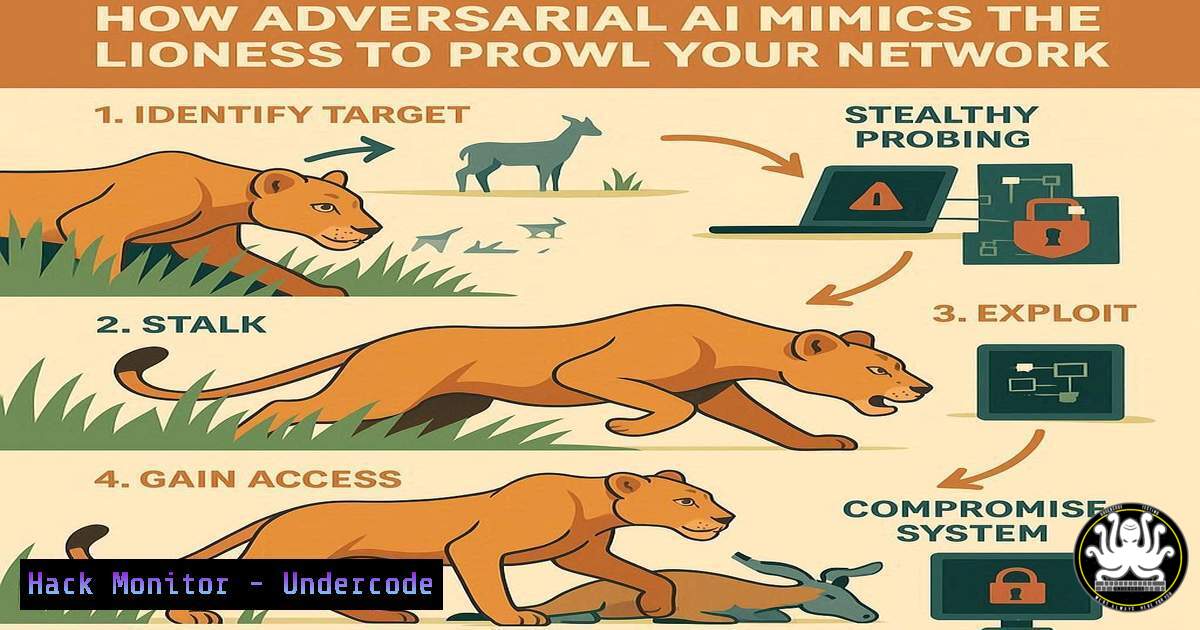
The recent discourse on leadership, drawing parallels to a lioness guiding her cubs, offers a profound metaphor for a new breed of cyber threats. Adversarial AI operates with the same patient, observant, and relentless precision, learning from your environment to strike with devastating effectiveness. This article decodes how these “silent hunter” algorithms work and provides the essential commands to fortify your defenses.
Learning Objectives:
- Understand the core principles of Adversarial AI and Machine Learning (ML) security.
- Learn to detect data poisoning and model evasion techniques in your ML pipelines.
- Implement defensive commands and configurations to harden your AI systems and traditional network perimeters.
You Should Know:
1. Detecting Data Poisoning at the Source
Data poisoning is the first step in corrupting your AI “cubs,” where an attacker injects malicious data into your training sets.
Verified Command/Tutorial:
 Using 'jq' to analyze training dataset metadata for anomalies (e.g., unexpected sources)
curl -s https://your-ml-repo/datasets/training_log.json | jq '.[] | select(.data_source | test("suspicious-domain.org")) | {file, source, hash}'

Calculate SHA-256 hashes to verify dataset integrity
sha256sum training_dataset_v1.csv
Step-by-step guide:
This process helps audit your ML training data. The first command fetches your training log (in JSON format) and parses it with `jq` to filter for entries from a potentially malicious source. The second command generates a cryptographic hash of your dataset file. By comparing this hash against a known good value, you can verify the dataset has not been tampered with since its creation.
2. Hardening Model Endpoints Against Evasion Attacks
Adversarial examples are subtly modified inputs designed to fool your ML models during inference.
Verified Command/Code Snippet:
 Python snippet using TensorFlow to add adversarial robustness with Gaussian noise
import tensorflow as tf

def preprocess_input(image):
 Add a small amount of noise to blur adversarial perturbations
noise = tf.random.normal(shape=tf.shape(image), mean=0.0, stddev=0.01)
return image + noise

Example for securing a TensorFlow Serving endpoint
Step-by-step guide:
This simple preprocessing step can mitigate many basic evasion attacks. By adding a small amount of random Gaussian noise to the input data (e.g., an image, text embedding), you disrupt the delicate perturbations crafted by an adversary to fool the model. Integrate this function into your prediction pipeline before the data is fed into the main model for classification.
- Auditing Cloud IAM Roles for Over-Permissive ML Services
An ML service with excessive permissions is a prime target for compromise.
Verified Command/Tutorial:
 AWS CLI command to list IAM policies attached to an ML role
aws iam list-attached-role-policies --role-name SageMakerExecutionRole

Check for specific, dangerous permissions like 's3:' or 'iam:PassRole'
aws iam get-policy-version --policy-arn arn:aws:iam::aws:policy/AmazonSageMakerFullAccess --version-id v1
Step-by-step guide:
Run the first command to list all policies attached to your Amazon SageMaker execution role. The second command retrieves the details of a specific policy version. Scrutinize the output for overly broad actions like `s3:` (full S3 access) or iam:PassRole, which could allow an attacker to escalate privileges and move laterally from a compromised ML workload.
4. Monitoring API Calls for Reconnaissance Activity
Adversaries probe ML endpoints to map their behavior and craft attacks.
Verified Command/Code Snippet:
 Using 'journalctl' to monitor system logs for suspicious API call patterns on a Linux-based ML server
journalctl -u your-ml-api-service --since "1 hour ago" | grep -E "(401|403|422)" | head -20
Step-by-step guide:
This command checks the systemd journal for logs from your ML API service unit over the past hour, filtering for HTTP status codes indicating unauthorized (401), forbidden (403), or unprocessable entity (422) errors. A sudden spike in these errors can indicate an automated tool is probing your endpoint, testing for weaknesses and input validation flaws.
5. Implementing Network Segmentation for AI Workloads
Isolate your ML environments to contain a potential breach.
Verified Command/Tutorial:
 Linux iptables rule to restrict traffic from an ML pod/container to a specific subnet
iptables -A OUTPUT -p tcp -d 10.0.1.0/24 --dport 443 -m state --state NEW,ESTABLISHED -j ACCEPT
iptables -A OUTPUT -p tcp --dport 443 -j DROP

Windows PowerShell command to create a firewall rule
New-NetFirewallRule -DisplayName "Block-ML-App-Outbound" -Direction Outbound -Program "C:\ML\app.exe" -Action Block
Step-by-step guide:
The Linux command uses `iptables` to create a rule that only allows the ML application to establish new HTTPS connections to the designated subnet (10.0.1.0/24), then drops all other outbound HTTPS traffic. The Windows PowerShell command creates a rule to block all outbound traffic from a specific ML application executable. This limits an attacker’s ability to exfiltrate data or communicate with a command-and-control server.
6. Scanning Container Images for ML-Specific Vulnerabilities
ML containers often contain outdated, vulnerable packages.
Verified Command/Tutorial:
 Using Trivy to scan a Docker image for vulnerabilities in common ML libraries
trivy image --severity HIGH,CRITICAL your-registry/your-ml-model:latest

Filtering for specific packages
trivy image your-registry/your-ml-model:latest | grep -E "(tensorflow|pytorch|numpy)"
Step-by-step guide:
This command uses the open-source tool Trivy to scan a container image for operating system and language-specific vulnerabilities, reporting only those with HIGH or CRITICAL severity. The second command greps the output for specific ML libraries known to have security issues. Integrate this into your CI/CD pipeline to prevent vulnerable images from being deployed.
- Validating Input with Web Application Firewall (WAF) Rules
Block malicious payloads targeting your model’s API before they reach the application.
Verified Command/Code Snippet:
 Example ModSecurity (WAF) rule to block potential adversarial input patterns
SecRule ARGS "@rx \x90{10,}" "phase:2,deny,msg:'Potential shellcode in input',id:100001"
Step-by-step guide:
This is a simplified example of a WAF rule for the ModSecurity engine. It inspects all request arguments (ARGS) during the request body processing phase (phase:2) for a sequence of 10 or more `0x90` bytes (a common NOP sled used in buffer overflow attacks). If detected, it denies the request and logs the message. Customize such rules to block patterns indicative of attacks against your specific model input format.
What Undercode Say:
- The Threat is Asymmetric: Defending a model requires securing every potential input vector, while an attacker only needs to find one weakness. The lioness only needs one successful hunt; the prey must be vigilant always.
- The Skills Gap is the Real Vulnerability: The most sophisticated commands are useless without teams that understand both cybersecurity and data science. The “walking classroom” must include cross-training for these disciplines.
The analogy of the lioness is chillingly accurate for modern cyber threats. Adversarial AI doesn’t brute-force its way in; it learns, adapts, and waits for the perfect moment, much like a predator studying its prey’s patterns. Our defensive posture must evolve from building static walls to fostering resilient, adaptive ecosystems. This means continuous monitoring, robust model testing (red teaming your AI), and, most critically, a cultural shift where security is integrated into the entire ML lifecycle, from data collection to deployment. The cubs—our AI systems—must be taught resilience from the very first step.
Prediction:
The convergence of AI and cybersecurity will lead to fully autonomous “hunter-killer” malware within five years. These programs will use reinforcement learning to navigate networks, identify critical assets, and execute disruptive payloads with minimal human intervention, making traditional, signature-based defense systems nearly obsolete. The era of the patient, digital lioness is dawning.
🎯Let’s Practice For Free:
IT/Security Reporter URL:
Reported By: Soren Muller – Hackers Feeds
Extra Hub: Undercode MoN
Basic Verification: Pass ✅


