Listen to this Post
Introduction:
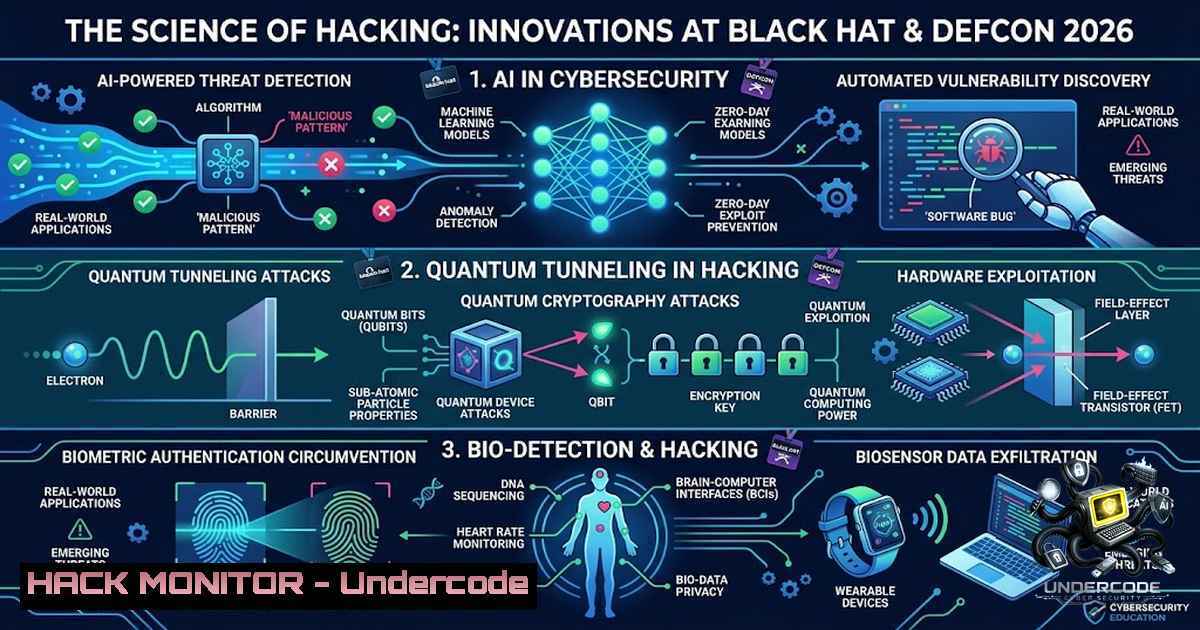
The convergence of artificial intelligence, quantum physics, and biological threat detection at Black Hat and Defcon 2026 has signaled a new era in cybersecurity where the boundaries between science fiction and reality have effectively dissolved. As hackers demonstrated exploits targeting everything from quantum computers to IoT refrigerators, the security community witnessed a paradigm shift where AI vendors now compete alongside traditional security firms to address an expanding attack surface that includes melting permafrost pathogens and quantum-resistant cryptography failures. This article extracts the technical essence from these briefings, providing actionable intelligence on the emerging threat vectors and defensive strategies that security professionals must master to survive this new timeline.
Learning Objectives:
- Understand the integration of AI agents into security workflows and the associated risk landscape, including prompt injection and model poisoning attacks.
- Explore the implications of quantum tunneling advancements on current encryption standards and the urgent need for post-quantum cryptography.
- Analyze the vulnerabilities in IoT ecosystems and supply chain risks highlighted by biohacking and environmental sensor exploits.
You Should Know:
1. AI Agents and the Evolving Risk Landscape
The influx of all-purpose AI vendors into the security market at Black Hat highlighted a critical shift: AI is no longer just a tool for defense but a primary attack vector and a complex asset requiring protection. The core conversation revolved around the value proposition of AI workflows, but security experts warned of the hidden costs—specifically, the vulnerabilities inherent in agentic systems. Prompt injection, data leakage through model memory, and the poisoning of training data are now primary concerns. To secure an AI pipeline, one must treat the model as a zero-trust entity.
Step-by-step guide to hardening an AI agent API:
- Restrict Input Validation: Implement strict regex and syntax filtering on all user inputs to prevent prompt injection. Example: `if re.search(r”system|instruction|ignore previous”, user_input): raise ValueError(“Invalid input”)` in Python.
- Implement Rate Limiting: Use a gateway like NGINX or AWS API Gateway to limit requests per IP to prevent brute-force extraction of model weights via repeated queries. Command for NGINX:
limit_req_zone $binary_remote_addr zone=ai:10m rate=5r/s;. - Monitor Output Anomalies: Set up a logging system to flag unusual output lengths or repeated patterns that might indicate data exfiltration. Linux command:
tail -f /var/log/ai_api/access.log | grep -E "response_length|token_usage" | awk '{if ($4 > 1000) print $0}'. - Conduct Red-Teaming: Use tools like Microsoft’s Counterfit to test the model against adversarial inputs, ensuring it resists jailbreak attempts.
2. Quantum Tunneling and Cryptographic Doomsday
The appearance of John Martinis, a pioneer in quantum computing, underscored the tangible threat quantum tunneling poses to RSA and ECC encryption. The demonstrations suggested that quantum computers, even at current scales, are advancing faster than NIST’s post-quantum standardization. Security professionals must now prepare for “harvest now, decrypt later” attacks where adversaries store encrypted data today to decrypt it with future quantum machines.
Step-by-step guide to assessing quantum vulnerability:
- Inventory Cryptographic Assets: Identify all systems using RSA-2048 or ECDSA. Use a script to scan network certificates:
openssl s_client -connect example.com:443 -showcerts | openssl x509 -text -1oout | grep "Public-Key". - Prioritize Migration: Begin transitioning to NIST-approved post-quantum algorithms like CRYSTALS-Kyber for key encapsulation and CRYSTALS-Dilithium for signatures.
- Test Hybrid Deployments: Implement hybrid key exchange in TLS 1.3 to combine classical and post-quantum keys. On a Linux server, compile OpenSSL 3.0 with the OQS provider:
./config -I/usr/local/oqs/include -L/usr/local/oqs/lib -DOPENSSL_EXPERIMENTAL. - Simulate Quantum Attacks: Use tools like Qiskit to run Shor’s algorithm simulations on small keys to understand the risk to internal test systems.
3. Biohacking and Environmental Threat Detection
One of the most startling revelations was the biohacking of a $500 sensor to detect ancient pathogens released from melting icecaps. While this is a biological threat, the technical overlay involves wireless sensor networks, IoT firmware vulnerabilities, and data exfiltration via unsecured channels. Security teams must now consider environmental sensors as potential entry points for network compromise and data integrity attacks.
Step-by-step guide to securing environmental IoT sensors:
- Enforce Firmware Signing: Ensure all sensor firmware is signed with a trusted key to prevent unauthorized updates. Use `openssl dgst -sha256 -sign private_key.pem -out firmware.sig firmware.bin` to sign.
- Isolate Network Segments: Place sensors on a dedicated VLAN with strict firewall rules. On a Cisco switch:
vlan 10, then `interface vlan 10` with `ip access-group BLOCK_SENSORS in` to restrict traffic to only the data aggregator. - Implement SPI (Serial Peripheral Interface) Bus Security: For hardware-level attacks, enable read-out protection on the microcontroller (e.g., STM32’s RDP level 2) to prevent dumping of firmware via JTAG.
- Monitor for Anomalous Data: Use SIEM integration to flag data spikes or unusual patterns that could indicate sensor tampering. Example Splunk query:
index=env_sensors | where value > threshold OR source="unknown_mac".
4. The Internet of Vulnerable Things (IoVT)
Hackers demonstrated exploits for “litter boxes, refrigerators, and jet skis,” showcasing the absurd but real security gaps in everyday devices. These devices often run Linux or RTOS with default credentials, lack proper update mechanisms, and expose unnecessary services to the local network. The exploitation chain often involves UPnP port mapping, weak MQTT authentication, and kernel-level buffer overflows.
Step-by-step guide to hardening a typical smart device:
- Disable UPnP: On a router or device, disable Universal Plug and Play. For Linux-based devices, modify the config file:
sudo systemctl stop upnpd && sudo systemctl disable upnpd. - Change Default Passwords: Use a script to check for default credentials. Command:
hydra -l admin -P common_passwords.txt -s 8080 192.168.1.100 http-get /. - Firmware Analysis: Use `binwalk` to extract the filesystem and check for hardcoded keys.
binwalk -e firmware.bin && grep -r "password\|secret" _firmware.extracted/. - Restrict Outbound Traffic: Create iptables rules to block the device from phoning home to unknown IPs: `iptables -A OUTPUT -m mac –mac-source 00:11:22:33:44:55 -j DROP` (blocking the device entirely, then whitelisting necessary updates).
5. Cloud and Supply Chain Hardening
With AI vendors entering the chat, the supply chain now includes model weights, third-party plugins, and orchestration layers. The risk of a compromised dependency injecting malicious code or biases into an AI agent is high. Security must be applied to the CI/CD pipeline and the cloud infrastructure hosting these models.
Step-by-step guide to securing cloud AI infrastructure:
- Enforce Strict IAM Policies: Use the principle of least privilege. In AWS, create a policy that restricts the model to only read its S3 bucket:
{ "Effect": "Deny", "Action": "s3:", "Resource": "", "Condition": {"ArnNotEquals": "arn:aws:s3:::my-model-bucket" } }. - Implement Artifact Signing: Use cosign to sign container images of the AI service:
cosign sign -key cosign.key ghcr.io/org/ai-agent:latest. - Harden the Kernel: On Linux hosts, enable SELinux or AppArmor to confine the AI process. Use `aa-genprof /usr/bin/python3` to generate a profile for the model’s execution environment.
- Network Segmentation in Cloud: Place the AI inference engine in a private subnet with no direct internet access. Use VPC endpoints for model updates, and configure a Security Group that only allows ingress from the application tier.
What Undercode Say:
- Key Takeaway 1: The “no science fiction, only science” mantra is a direct warning that cybersecurity must evolve to protect against quantum, biological, and AI-1ative threats concurrently.
- Key Takeaway 2: The value proposition of AI in security is being redefined; it’s not just about efficiency but about managing a fundamentally complex risk that requires new skills.
- Key Takeaway 3: Practical hardening of IoT, cloud, and AI APIs is non-1egotiable, and the commands provided above offer a baseline for immediate implementation.
Prediction:
- -1: Expect a major, publicly disclosed AI agent breach within the next 12 months, leading to the theft of proprietary model weights via a sophisticated prompt injection chain.
- -1: The release of a quantum-safe encryption standard will be rushed, causing widespread compatibility issues and creating a new niche for “quantum transition” consultants.
- +1: The bio-sensor hacking will accelerate the development of secure IoT protocols specifically for healthcare and environmental sectors, driving innovation in embedded security.
- +1: The integration of AI into security operations centers will dramatically reduce mean time to detection for network intrusions, provided the models themselves are secured against poisoning.
- -1: Short-term, expect a surge in attacks targeting the supply chain of AI models (hugging face, PyTorch repositories), necessitating immediate implementation of the artifact signing and IAM steps outlined above.
▶️ Related Video (78% Match):
🎯Let’s Practice For Free:
🎓 Live Courses & Certifications:
Join Undercode Academy for Verified Certifications
🚀 Request a Custom Project:
Secure, high-velocity infrastructure and disruptive technological engineering. Contact our engineering team for high-tier development and proprietary systems:
[email protected]
💎 Smart Architecture | 🛡️ Secure by Design | ⭐ Trusted by Thousands
IT/Security Reporter URL:
Reported By: https://lnkd.in/p/etqrk_RB – Hackers Feeds
Extra Hub: Undercode MoN
Basic Verification: Pass ✅


