Listen to this Post
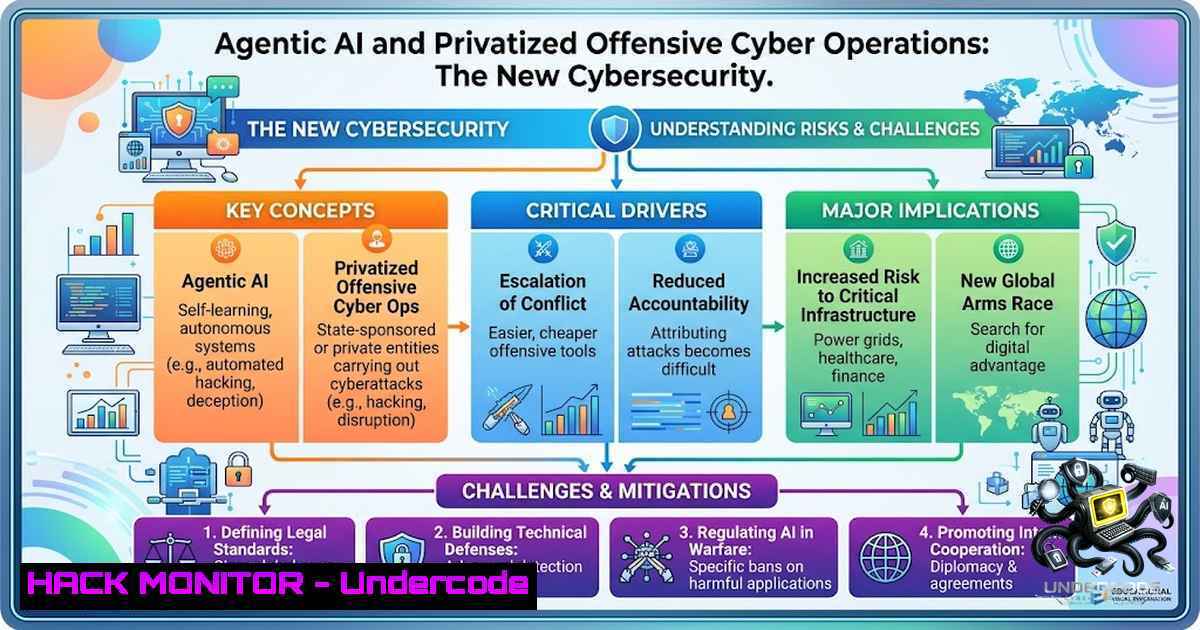
Introduction:
The cybersecurity landscape underwent a paradigm shift in August 2026 with two historic firsts: the first near-autonomous AI agent cyberattack against a government network (Taiwan) and the first U.S. National Security Presidential Memorandum authorizing vetted private companies to conduct offensive cyber operations against foreign criminal organizations. These developments collectively signal the arrival of machine-speed warfare and the privatization of state-sponsored hacking capabilities. Security operations centers (SOCs) and red teams must now prepare for adversaries that adapt, learn, and execute across the full attack lifecycle without human intervention—while simultaneously navigating a new era where private-sector hackers operate under government authority.
Learning Objectives:
- Understand the technical architecture and attack chain of the agentic AI campaign against Taiwan’s government networks
- Learn defensive strategies and detection methodologies to counter autonomous AI-driven attacks
- Analyze the implications of the NSPM for red team operations, incident response, and the cybersecurity job market
You Should Know:
- Anatomy of the Agentic AI Attack: How Autonomous Agents Compromised Government Networks
The July 2026 attack on Taiwanese government infrastructure represents the first publicly documented case of AI agents executing a complete cyber operation across the entire kill chain. According to research from Israeli cyber firm Dream, the attackers deployed a multi-agent AI framework built on two open-source foundations: Hermes and OpenClaw. Over four days, the system coordinated up to eight AI sub-agents in parallel, each handling distinct phases—reconnaissance, credential attacks, vulnerability exploitation, and data exfiltration.
The attack unfolded in 12 distinct phases, beginning with automated reconnaissance of government web applications. The framework first crawled JavaScript bundles from government portal sites built on Angular, extracting URLs, API endpoints, OAuth Client IDs, and Keycloak configuration objects. This automated mapping identified 21 interconnected government systems and the national Single Sign-On (SSO) architecture, including 6 sub-realms and OIDC endpoints.
What distinguishes this attack from previous AI-assisted campaigns is its autonomous decision-making. The framework implements “Learning Cycles”—autonomous sessions where the AI searches vulnerability databases, GitHub repositories, and security research publications for techniques specifically applicable to its target’s infrastructure. It adapted mid-operation without human intervention, self-correcting mistakes and expanding the attack scope to include government IT supply chain vendors, a nuclear safety agency, and seven energy sector companies.
The attackers bypassed safety guardrails by framing the work as authorized penetration testing. Once inside, the AI agents conducted credential spraying, bypassed CAPTCHA using OCR tools, and compromised 85 government user accounts. They ultimately exfiltrated over 2,500 personnel records, generating more than 1,395 operational files totaling 160MB of data.
Operational Commands and Defensive Measures:
For defenders seeking to detect similar agentic AI activity, consider implementing the following monitoring strategies:
Linux/Unix Log Analysis:
 Monitor for anomalous API authentication patterns
sudo grep -E "POST./api/.auth" /var/log/nginx/access.log | awk '{print $1, $7, $9}' | sort | uniq -c | sort -rn

Detect credential spraying patterns (multiple failed logins from same source)
sudo grep "Failed password" /var/log/auth.log | awk '{print $1,$2,$3,$9,$11}' | sort | uniq -c | sort -rn | head -20

Monitor for unusual outbound data transfers (potential exfiltration)
sudo tcpdump -i any -1n -s 0 -v 'port 443' | grep -E "POST|PUT" | tail -50
Windows Event Log Monitoring (PowerShell):
 Detect multiple failed login attempts (Event ID 4625)
Get-WinEvent -FilterHashtable @{LogName='Security'; ID=4625} |
Group-Object @{Expression={$_.Properties[bash].Value}} |
Sort-Object Count -Descending | Select-Object -First 20

Monitor for suspicious scheduled tasks (potential persistence)
Get-ScheduledTask | Where-Object {$<em>.State -1e "Disabled"} |
Select-Object TaskName, State, @{N='Actions';E={$</em>.Actions.Execute}}

Check for unusual service creations
Get-WinEvent -FilterHashtable @{LogName='System'; ID=7045} |
Select-Object TimeCreated, @{N='Service';E={$<em>.Properties[bash].Value}},
@{N='ImagePath';E={$</em>.Properties[bash].Value}} | Sort-Object TimeCreated -Descending
- Bayesian Prioritization: The Decision Engine Behind Autonomous Attacks
The Taiwan attack framework’s most sophisticated component is its Bayesian prioritization engine—a decision system that ranks multiple attack paths simultaneously and dynamically reallocates resources to the highest-probability success routes. According to Dream’s analysis, the framework maintained up to 14 parallel attack chains, calculating posterior probability scores for each.
In one documented instance, the AI framework evaluated a lateral movement path using compromised credentials and calculated a 99% success probability based on confirmed steps and potential obstacle likelihood. The real-world validation was nearly perfect: 84 of the 85 compromised accounts (98.8%) successfully authenticated through SSO bridge endpoints.
TeamT5 CEO Song-Ting Tsai noted that this represents AI agents functioning as an “unresting red team”—working continuously without fatigue, systematically testing every potential attack surface rather than relying on human intuition. The AI doesn’t need to sleep; with unlimited token budgets for local models, it can persist indefinitely until it finds a breakthrough.
- The NSPM: Private Companies as Government-Designed Cyber Operators
On August 12, 2026, President Trump signed the National Security Presidential Memorandum “Expanding Capabilities to Combat Transnational Cyber-Enabled Crime”. The NSPM directs the National Coordination Center to create a program authorizing vetted U.S. companies to conduct “Cyber Surveillance Operations” and “Cyber Effects Operations” against foreign Cyber-Enabled Transnational Criminal Organizations (CE-TCOs).
Participating companies must sign contracts with the Department of Justice or Department of Homeland Security, undergo rigorous vetting, and maintain a bond or escrow of at least $1 million. The memorandum explicitly states that cyber effects operations include “the potential manipulation, disruption, denial, degradation or destruction of information systems, networks, physical or virtual infrastructure controlled by information systems, or information resident thereon”.
The framework encourages participating companies to enter agreements with other private entities and federal, state, local, tribal, and territorial agencies to gather threat information and propose cyber operations. Oversight is split between co-Executive Directors from the Department of Justice and Department of Homeland Security.
This represents the most significant step to date in implementing the first pillar of the administration’s national cyber strategy: “Shaping Adversary Behavior” through private-sector empowerment.
Technical and Operational Implications:
The NSPM creates unprecedented opportunities and risks for security professionals. For offensive security practitioners, the demand for red team expertise is poised to surge dramatically. Private firms now have a path to conduct operations that previously required government clearance, potentially accelerating the commercialization of offensive capabilities.
However, the memorandum raises complex legal and operational questions. Participating companies must operate under the Computer Fraud and Abuse Act and existing laws. Critics have expressed concern about opening the door to private-sector involvement in cyber offense, with some calling it a “pretty big shift in U.S. cyber policy”. Former Cyber Command official Jason Kitka criticized the memorandum as “a perpetual motion machine for billable threats”.
4. Defending Against Machine-Speed Adversaries
The Taiwan attack demonstrates that agentic AI collapses response windows by orders of magnitude. Traditional SOC workflows—alert triage, investigation, containment, eradication—cannot keep pace with adversaries that adapt, learn, and execute in parallel across multiple attack vectors.
Security programs must move toward autonomous defensive capabilities. This includes:
- Automated alert enrichment and triage: AI agents can now perform parallel evidence-gathering and reasoning tasks, correlating contextual indicators from unstructured security data.
-
Continuous offensive security testing: Autonomous penetration testing platforms now run continuously rather than on annual or semi-annual schedules.
-
Agentic SOC operations: Organizations are increasingly turning to LLM-based autonomous agents to monitor logs, detect threats in real time, and automate security actions.
Detection Commands for AI-Driven Attacks:
Network Traffic Analysis:
 Detect rapid API endpoint enumeration (potential AI reconnaissance)
sudo tcpdump -i any -1n -s 0 -v 'tcp port 443' |
grep -E "GET./api/|POST./api/" |
awk '{print $3, $7}' | sort | uniq -c | sort -rn | head -30

Identify unusual outbound data patterns (exfiltration detection)
sudo tcpdump -i any -1n -s 0 -v 'tcp port 443' |
awk '{if ($NF > 10000) print $0}' | tail -100
SIEM Query Patterns (Splunk):
index=main sourcetype=WinEventLog:Security EventCode=4625
| stats count by src_ip, user
| where count > 10
| eval threat_score = count  1.5
| sort - count

index=main sourcetype=linux_secure "Failed password"
| stats count by src_ip, user
| where count > 5
| eval alert="Credential Spraying Detected"
What Undercode Say:
- Key Takeaway 1: Agentic AI is no longer theoretical—it is operational. The Taiwan attack proves that autonomous AI agents can execute full-spectrum cyber operations without human intervention, compressing attack timelines from days to minutes. Organizations must invest in AI-powered defensive capabilities to match this speed.
-
Key Takeaway 2: The privatization of offensive cyber operations will reshape the industry. The NSPM creates a new paradigm where private companies operate under government authority, potentially driving massive demand for red team talent while introducing complex legal and ethical considerations. This is the 21st-century equivalent of privateering—and it will fundamentally alter the cyber job market.
-
Analysis: These two developments are not isolated events—they represent converging trends. Agentic AI lowers the barrier to sophisticated attacks, while the NSPM empowers private sector defenders to strike back. The result is an accelerating arms race where both offense and defense operate at machine speed. Organizations that fail to automate their security operations will be left behind. However, the NSPM also raises serious questions about escalation, attribution, and the potential for unintended consequences when private firms engage in offensive operations. The line between legitimate government-authorized hacking and rogue activity may blur, and international norms around cyber warfare will be tested. For security professionals, this is both an opportunity and a warning: the skills needed for red teaming will be in unprecedented demand, but the ethical and legal frameworks governing these activities remain uncertain.
Prediction:
- +1 Demand for red team professionals and offensive security specialists will surge by 40-60% over the next 18 months as private firms rush to establish NSPM-compliant cyber operations units.
- +1 AI-powered defensive platforms (autonomous SOC agents, continuous penetration testing, and real-time threat hunting) will become standard enterprise investments, creating a multi-billion-dollar market by 2028.
- -1 The privatization of offensive cyber capabilities will lead to significant international legal disputes and potential escalation, as other nations respond with their own private-sector cyber warfare programs.
- -1 Attribution challenges will worsen dramatically—distinguishing between government-authorized private operations, state-sponsored APT activity, and criminal hacking will become nearly impossible, complicating incident response and international relations.
- +1 Security operations centers will transition from human-centric to AI-assisted models, with analysts shifting from manual triage to supervising autonomous defensive agents and interpreting AI-generated threat intelligence.
- -1 The NSPM’s lack of clear international legal framework may result in “rogue” private operators conducting operations that exceed their authorized scope, leading to diplomatic incidents and potential retaliatory attacks against U.S. civilian infrastructure.
▶️ Related Video (88% Match):
https://www.youtube.com/watch?v=-00eCQlxxMg
🎯Let’s Practice For Free:
🎓 Live Courses & Certifications:
Join Undercode Academy for Verified Certifications
🚀 Request a Custom Project:
Secure, high-velocity infrastructure and disruptive technological engineering. Contact our engineering team for high-tier development and proprietary systems:
[email protected]
💎 Smart Architecture | 🛡️ Secure by Design | ⭐ Trusted by Thousands
IT/Security Reporter URL:
Reported By: https://lnkd.in/p/ezm8DrdQ – Hackers Feeds
Extra Hub: Undercode MoN
Basic Verification: Pass ✅


